

Choose Amran or Sugiono? Here’s the Current Support Map in the Indonesian Parliament
-
News
-
1 minute ago
This article was translated by AI. Read the original article on Kompas.com. See Original
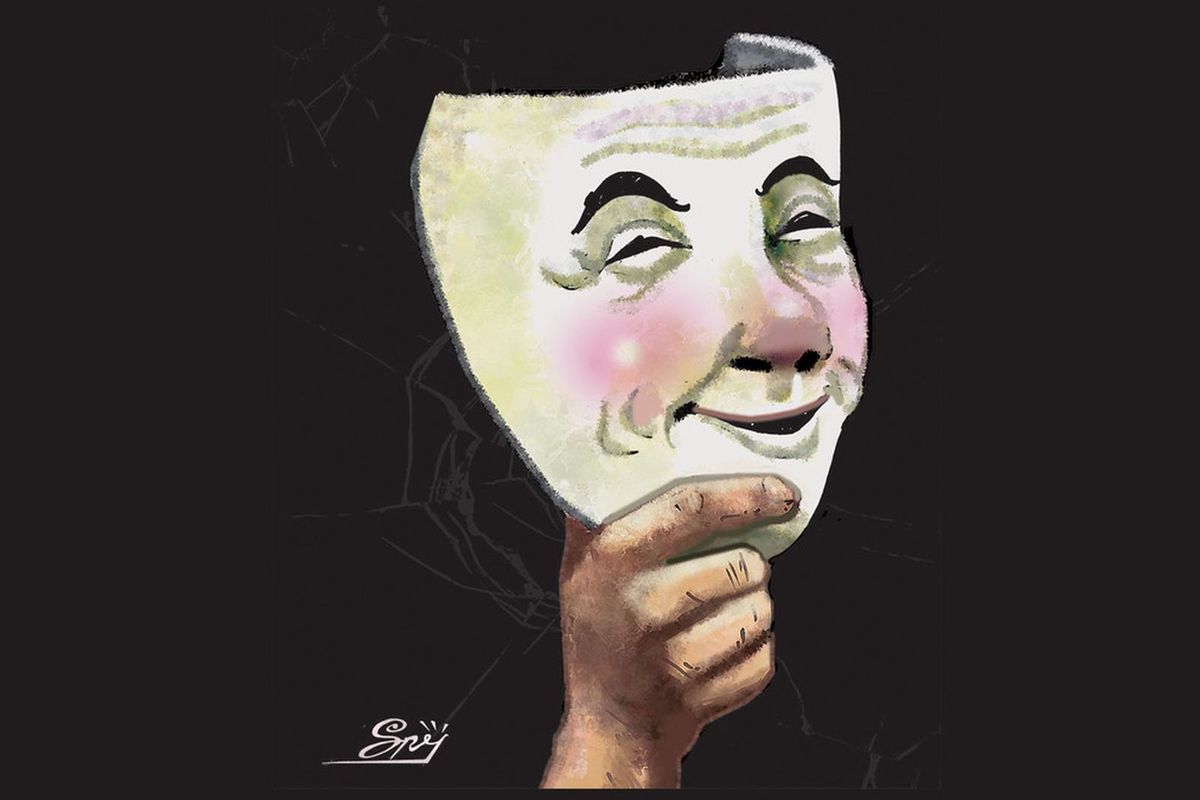
However, high expertise not supported by moral consistency will only yield a boomerang effect.
Legal rhetoric slips into a practice criticized by Aristotle since the Classical Greek era as sophism: intelligence in assembling arguments not to seek substantive truth, but as a rhetorical instrument to justify positions one wishes to validate.
The underlying question is: why would a well-known intellectual repeatedly sacrifice their doctrinal consistency?
The answer can be traced through three layers: sociological traces, philosophical perspectives on knowledge, and political survival calculations.
Sociologically, the career trajectories of such figures often mirror classic tales of wanderers who must penetrate the harsh power center of Jakarta without any heritage of economic capital or political aristocracy.
Within the framework of Pierre Bourdieu's habitus theory and capital conversion, actors who enter the political arena armed with academic intelligence often confront a bitter reality: ivory tower idealism is insufficient for survival.
To avoid being thrown back to the margins, legal expertise must be pragmatically converted into social and political capital. Compromise of principles becomes an adaptation mechanism to maintain a position within the elite circle.
This sociological adaptation aligns with a shifted perspective on legal science—from Kantian absolutism to legal pragmatism and utilitarianism.
While Kantian proponents view that anything constitutionally flawed remains wrong regardless of the consequences, utilitarians measure truth based on its practical usability for maintaining power stability.
This perspective becomes increasingly familiar among practitioners like advocates, who position law not as a singular rigid truth but as a compromise argumentative weapon to defend any of their clients.
This flexibility can also be seen as a strategy for political survival, as formulated by Bruce Bueno de Mesquita.
For someone without a strong political support base—for example, a political party with seats in parliament—the only way to remain within the core power coalition is to become an indispensable fixer.
This position as a legal ‘mechanic’ who can always find a constitutional way out for every regime, across governmental eras, becomes one form of survival mode.
At this point, it is already quite difficult to expect the steadfastness of a true intellectual who firmly adheres to their reasoning and scientific convictions.
On the contrary, as explained by Howard Giles' Communication Accommodation Theory, they must skillfully navigate through the foam, or as Giles describes it, converge upwards.
Upward convergence is a situation where someone with lower power consciously alters their language style, thought framework, and message substance to resemble those with greater power.
This convergence is carried out to gain social approval, build affiliations, and reduce psychological and political distance.
This explains why rapid attitude changes can occur: from speaking in the cold and rigid language of legal technocracy today to quickly adopting political-security language the next day.
The fact that such rapid shifts in attitude indicate a recurring pattern as an adaptive strategy shows this is not a reflexive or spontaneous action, but rather a well-prepared rhetorical skill.
They know when to diverge (to maintain distance from public opinion/criticism) and when to converge (to align with the center of power) for the continuity of their position.
It may sound utopian to expect an intellectual to steadfastly uphold their position when systemic pressures emerge.
In a cabinet or hierarchical government structure, control does not always take the form of direct orders.