
BI Reports Money Changer Transactions by Don Ritto Totaling Rp 220 Billion Since 2020
-
News
-
3 minutes ago
This article was translated by AI. Read the original article on Kompas.com. See Original
Deliberation is also closely related to the concept of deliberative democracy, developed, among others, by philosopher Jürgen Habermas.
In this approach, the legitimacy of political decisions is not only derived from the number of votes but also from the quality of dialogue and arguments preceding the decisions.
Long before deliberative democracy became a widely discussed discourse in contemporary political science, the founders of Indonesia established deliberation as one of the fundamental principles of national life.
However, as with international diplomacy, consensus has its limitations. Protracted deliberation can hinder decision-making.
Agreements reached through pressure or transactions among elites do not automatically reflect wisdom.
Thus, voting retains democratic legitimacy when differences cannot be bridged.
The quality of democracy is ultimately determined not only by the decision-making mechanism but also by the integrity of the process preceding it.
In relation to Pancasila democracy and international credibility, the selection of the vice president also has a broader dimension in international relations.
Amid global geopolitical uncertainty, the rivalry of major powers, and increasing economic fragmentation, domestic political stability is a crucial asset for a country in conducting its foreign policy.
A constitutional, transparent, and democratic leadership succession process can send a positive signal to the international community regarding the maturity of political institutions and the continuity of governance in Indonesia.
From the perspective of soft power, as developed by Joseph S. Nye, a country's attractiveness stems not only from its culture but also from its political values and the credibility of its foreign policies.
Pancasila democracy, if reflected in the practice of governance, has the potential to become one of Indonesia's attractions in the international community.
Indonesia's credibility in promoting dialogue, peaceful resolution, and consensus at the international forum is also connected to the consistency of applying those values domestically.
In this context, the implementation of Pancasila is not just a matter of national ideology but also has relevance for diplomacy and Indonesia's image on the international stage.
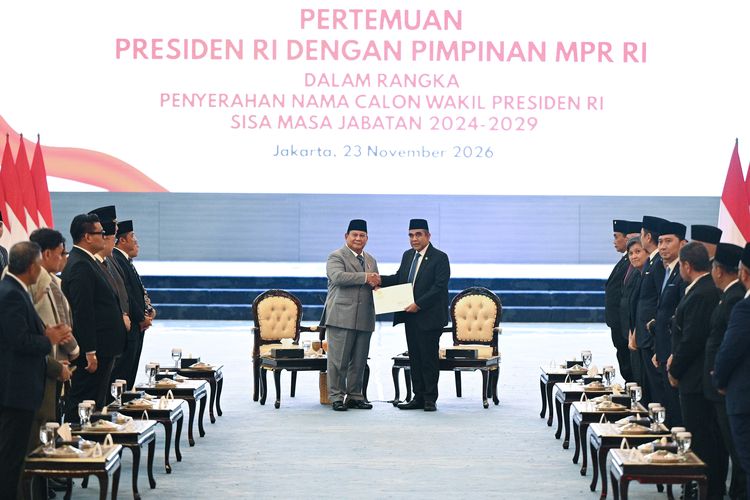
The selection of the vice president this time is a significant moment in Indonesia's constitutional history. The mechanism used will set a precedent for the future implementation of Article 8, Paragraph (2) of the 1945 Constitution.
Amid various programs for nurturing Pancasila ideology, constitutional practice is, in fact, one of the most tangible means of educating the public about Pancasila.
The nurturing of Pancasila ideology does not only occur in classrooms, seminars, training sessions, or through memorizing the five principles.
The nurturing of Pancasila ideology also takes place through the examples set by state officials in exercising power and making decisions.
The quality of deliberation in the MPR can serve as a public lesson on how differing interests are managed, arguments exchanged, and decisions accepted responsibly.
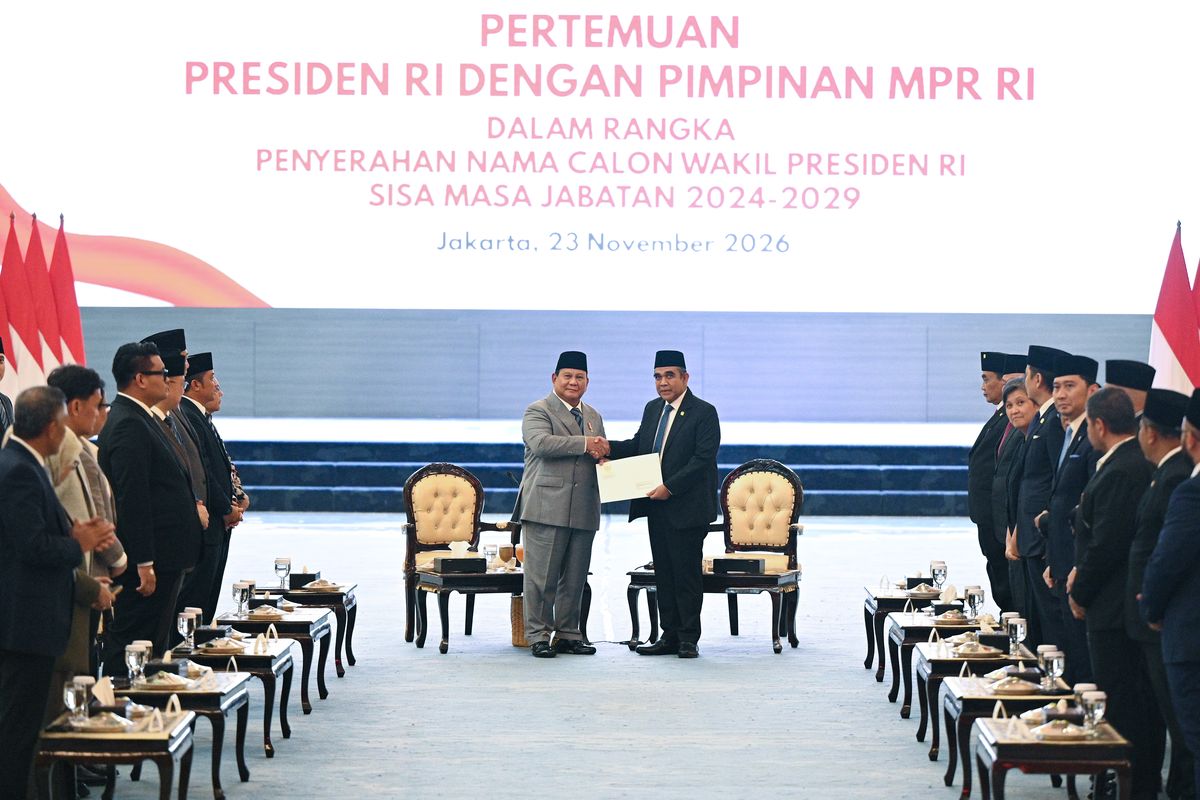
Ultimately, the public is not only waiting to see who between Andi Amran Sulaiman and Sugiono will become vice president.
The public is also waiting to see how Pancasila democracy finds its form in governance practice.
As in international diplomacy, the success of a decision-making process does not solely lie in reaching an agreement but also in the ability to maintain trust and good relations after a decision has been made.
Because Pancasila is not just an identity we present to the world, but a value that finds its credibility through the practice of nationhood and statehood.