
BI Reports Money Changer Transactions by Don Ritto Totaling Rp 220 Billion Since 2020
-
News
-
3 minutes ago
This article was translated by AI. Read the original article on Kompas.com. See Original
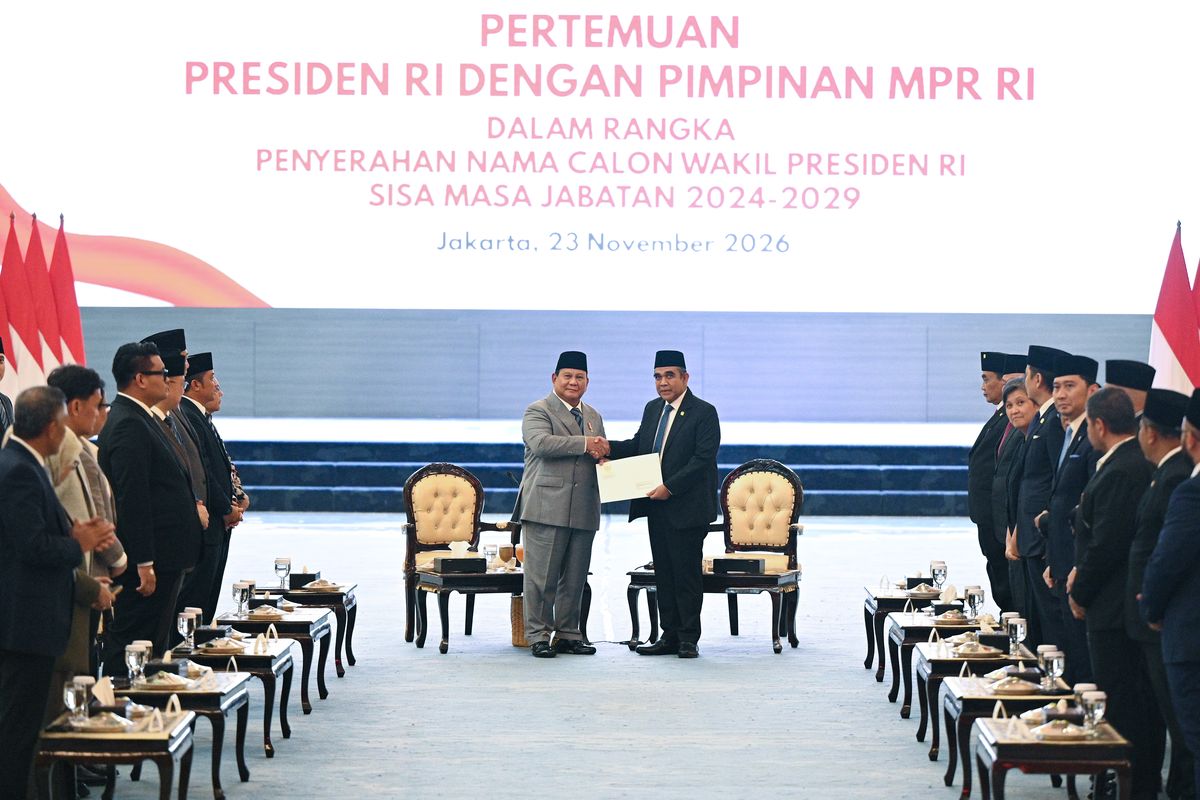
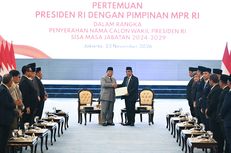
ON November 23, 2026, in accordance with the deadline set by the People’s Consultative Assembly (MPR), President Prabowo Subianto submitted two names for the vice-presidency to MPR Chairman Ahmad Muzani: Andi Amran Sulaiman and Sugiono, to fill the vacancy left by Gibran Rakabuming Raka's resignation on November 12, 2026.
The submission of these two names was in compliance with the mandate of Article 8, Paragraph (2) of the 1945 Constitution and Article 46 of Law No. 17 of 2014 on the MPR, DPR, DPD, and DPRD (MD3 Law).
The constitutional provision mandates that within a maximum of 60 days of the vice presidential vacancy, the MPR is to hold a session to elect a vice president from the two candidates proposed by the president.
With the submission of these names, public attention has now shifted to the MPR.
It is not only about who will be elected as vice president for the remaining term 2024–2029, but also how the selection mechanism will be carried out.
Will the MPR use a voting mechanism or consensus deliberation?
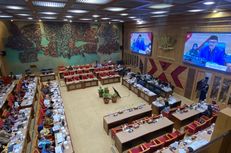
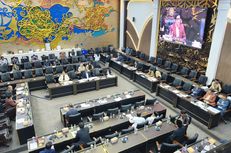
This question arose during a meeting of the Ad Hoc Committee (PAH) of the MPR in the parliamentary complex, Senayan, Jakarta, on Tuesday (November 24, 2026).
MPR PAH member Utut Adianto stated that voting is indeed quicker and easier to implement.
However, consensus deliberation is an opportunity to demonstrate that Pancasila is still alive in the governance practice of Indonesia, as well as to build mutual understanding.
Meanwhile, PAH MPR Executive Chairman Benny K Harman indicated that both mechanisms will be further analyzed to be brought to a joint meeting and decided in a plenary session of the MPR.
Utut Adianto's viewpoint is intriguing to examine, not only from the perspective of Pancasila’s application but also from the perspective of international relations.
There is a reflective question.
Given that Indonesia has prioritized dialogue, consultation, and consensus in resolving various international issues, how are those principles being applied in domestic political decision-making?
Constitutionally, voting is not contradictory to Pancasila. Article 2, Paragraph (3) of the 1945 Constitution states that all MPR decisions are made by a majority vote.
However, this provision needs to be read together with Article 64, Paragraphs (1) and (2) of the MD3 Law, which stipulates that decision-making in MPR sessions is first attempted through consensus deliberation.
If consensus is not reached, a decision is made through voting.
Thus, in the general framework of MPR decision-making, deliberation and voting are not two mechanisms that are entirely equal.
Deliberation is the primary effort, while voting becomes a solution when consensus is not achieved.
The issue is how far will deliberation be seriously attempted before a decision is made through voting.
In Indonesia's democratic practice, voting has become a commonly used mechanism, including in filling several public positions.
This can be seen, among others, in the selection of KPK leadership by Commission III of the DPR in November 2024.
There is certainly nothing wrong with voting as long as it is done democratically and in accordance with the legal regulations.
However, it is pertinent to question whether deliberation is still a substantive process for reaching a joint decision or merely a formal stage before voting takes place.
The fourth principle of Pancasila states, “The people are led by wisdom and deliberation in representation.”