
BI Reports Money Changer Transactions by Don Ritto Totaling Rp 220 Billion Since 2020
-
News
-
3 minutes ago
This article was translated by AI. Read the original article on Kompas.com. See Original
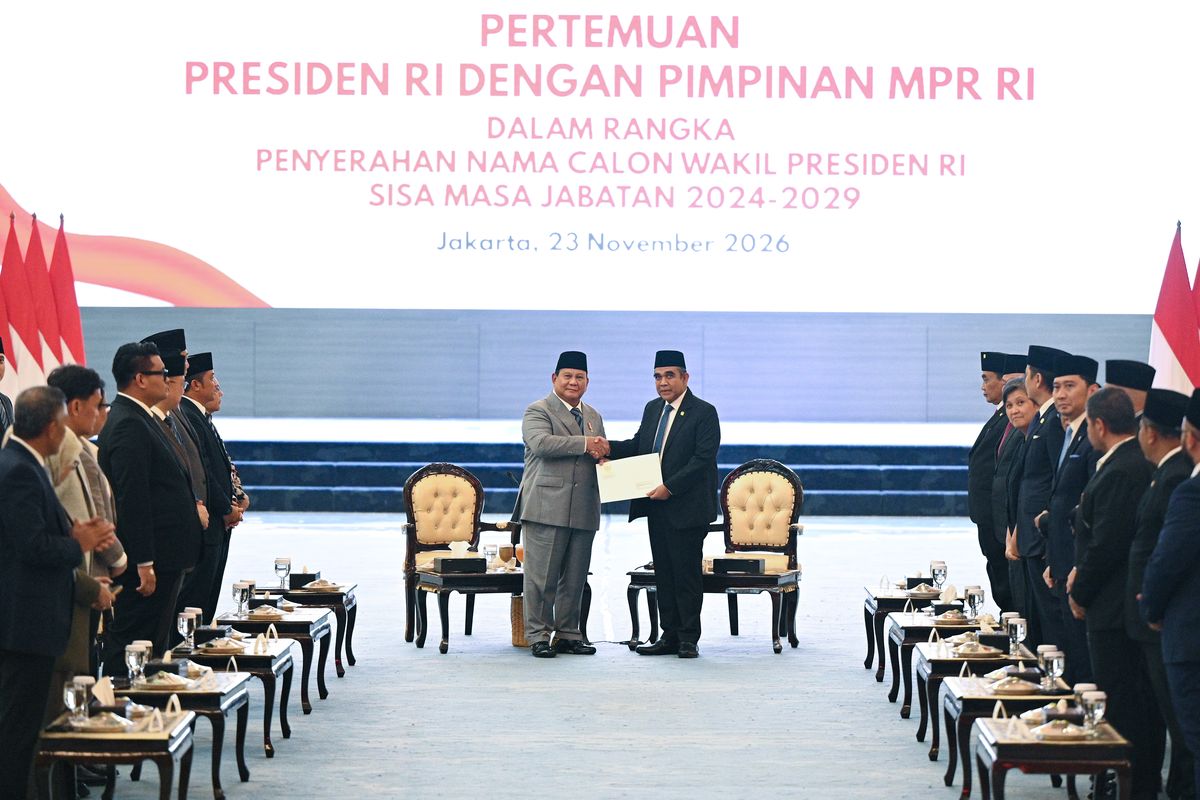
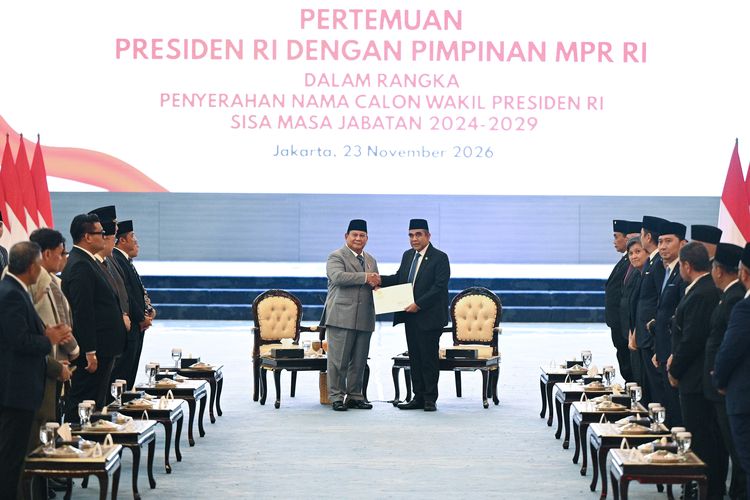
ON November 23, 2026, in accordance with the deadline set by the People’s Consultative Assembly (MPR), President Prabowo Subianto submitted two names for the vice-presidency to MPR Chairman Ahmad Muzani: Andi Amran Sulaiman and Sugiono, to fill the vacancy left by Gibran Rakabuming Raka's resignation on November 12, 2026.
The submission of these two names was in compliance with the mandate of Article 8, Paragraph (2) of the 1945 Constitution and Article 46 of Law No. 17 of 2014 on the MPR, DPR, DPD, and DPRD (MD3 Law).
The constitutional provision mandates that within a maximum of 60 days of the vice presidential vacancy, the MPR is to hold a session to elect a vice president from the two candidates proposed by the president.
With the submission of these names, public attention has now shifted to the MPR.
It is not only about who will be elected as vice president for the remaining term 2024–2029, but also how the selection mechanism will be carried out.
Will the MPR use a voting mechanism or consensus deliberation?
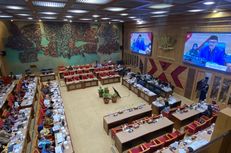
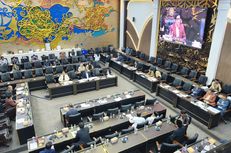
This question arose during a meeting of the Ad Hoc Committee (PAH) of the MPR in the parliamentary complex, Senayan, Jakarta, on Tuesday (November 24, 2026).
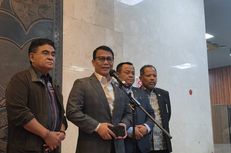
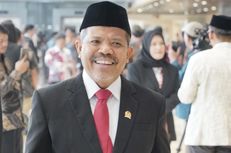
MPR PAH member Utut Adianto stated that voting is indeed quicker and easier to implement.
However, consensus deliberation is an opportunity to demonstrate that Pancasila is still alive in the governance practice of Indonesia, as well as to build mutual understanding.
Meanwhile, PAH MPR Executive Chairman Benny K Harman indicated that both mechanisms will be further analyzed to be brought to a joint meeting and decided in a plenary session of the MPR.
Utut Adianto's viewpoint is intriguing to examine, not only from the perspective of Pancasila’s application but also from the perspective of international relations.
There is a reflective question.
Given that Indonesia has prioritized dialogue, consultation, and consensus in resolving various international issues, how are those principles being applied in domestic political decision-making?
Constitutionally, voting is not contradictory to Pancasila. Article 2, Paragraph (3) of the 1945 Constitution states that all MPR decisions are made by a majority vote.
However, this provision needs to be read together with Article 64, Paragraphs (1) and (2) of the MD3 Law, which stipulates that decision-making in MPR sessions is first attempted through consensus deliberation.
If consensus is not reached, a decision is made through voting.
Thus, in the general framework of MPR decision-making, deliberation and voting are not two mechanisms that are entirely equal.
Deliberation is the primary effort, while voting becomes a solution when consensus is not achieved.
The issue is how far will deliberation be seriously attempted before a decision is made through voting.
In Indonesia's democratic practice, voting has become a commonly used mechanism, including in filling several public positions.
This can be seen, among others, in the selection of KPK leadership by Commission III of the DPR in November 2024.
There is certainly nothing wrong with voting as long as it is done democratically and in accordance with the legal regulations.
However, it is pertinent to question whether deliberation is still a substantive process for reaching a joint decision or merely a formal stage before voting takes place.
The fourth principle of Pancasila states, “The people are led by wisdom and deliberation in representation.”
The phrase wisdom reflects deep philosophical meaning. Wisdom encompasses qualities such as intelligence, clarity of understanding, and depth of moral consideration.
Meanwhile, deliberation reflects the ability to make decisions while considering the common interest, justice, and long-term impacts.
This means that Pancasila democracy is not only about the power of the majority vote but also about the quality of thought and moral responsibility underlying a decision.
In international relations, the principle of consensus deliberation is akin to the consultation and consensus mechanisms characteristic of ASEAN diplomacy.
This mechanism is part of what is known as the ASEAN Way—an approach to diplomacy that prioritizes consultation, dialogue, compromise, respect for sovereignty, and the search for a common agreement.
Article 20, Paragraph (1) of the ASEAN Charter explicitly places consultation and consensus as the foundation for ASEAN decision-making.
However, ASEAN also recognizes that consensus is not always achievable.
Article 20, Paragraph (2) grants the ASEAN Summit the authority to determine specific decision-making mechanisms if consensus cannot be reached.
As one of ASEAN's founding nations, Indonesia has a long-standing tradition of diplomacy emphasizing dialogue and searching for common ground amid the differing national interests of member states.
In diplomatic practice, reaching consensus often takes longer than voting.
Diplomats must consult, understand each party’s position, identify common interests, and formulate compromises that are acceptable.
Consensus does not always imply that every party obtains all of their wishes.
In fact, consensus often emerges from each party's willingness to accept some views of others for the sake of a greater interest.
Herein lies the intersection between international diplomacy and the philosophy of deliberation in Pancasila.
Both contain the values of willingness to listen, respect for differences, self-restraint, and ease in accepting joint decisions.
Nonetheless, the ASEAN consensus mechanism cannot be entirely equated with deliberation in the MPR.
ASEAN is an organization of sovereign states, whereas the MPR is a state institution operating under Indonesia's constitution.
The similarity lies in the philosophy of decision-making, not in the legal standing or the mechanisms involved.
In international relations theory and negotiations, the concepts of zero-sum game and positive-sum game are known.
In the zero-sum game approach, one party’s gain is viewed as another party’s loss.
Conversely, in the positive-sum game approach, parties seek to create mutual agreements that benefit everyone.
In the selection of the vice president, ultimately, only one candidate will be elected.
However, the selection process does not have to render the losing candidate as politically defeated in all respects.
Deliberation provides space to build a shared understanding of the nation's needs, governmental challenges, and the leadership quality required to navigate developments in the national and international strategic environment.
Deliberation is also closely related to the concept of deliberative democracy, developed, among others, by philosopher Jürgen Habermas.
In this approach, the legitimacy of political decisions is not only derived from the number of votes but also from the quality of dialogue and arguments preceding the decisions.
Long before deliberative democracy became a widely discussed discourse in contemporary political science, the founders of Indonesia established deliberation as one of the fundamental principles of national life.
However, as with international diplomacy, consensus has its limitations. Protracted deliberation can hinder decision-making.
Agreements reached through pressure or transactions among elites do not automatically reflect wisdom.
Thus, voting retains democratic legitimacy when differences cannot be bridged.
The quality of democracy is ultimately determined not only by the decision-making mechanism but also by the integrity of the process preceding it.
In relation to Pancasila democracy and international credibility, the selection of the vice president also has a broader dimension in international relations.
Amid global geopolitical uncertainty, the rivalry of major powers, and increasing economic fragmentation, domestic political stability is a crucial asset for a country in conducting its foreign policy.
A constitutional, transparent, and democratic leadership succession process can send a positive signal to the international community regarding the maturity of political institutions and the continuity of governance in Indonesia.
From the perspective of soft power, as developed by Joseph S. Nye, a country's attractiveness stems not only from its culture but also from its political values and the credibility of its foreign policies.
Pancasila democracy, if reflected in the practice of governance, has the potential to become one of Indonesia's attractions in the international community.
Indonesia's credibility in promoting dialogue, peaceful resolution, and consensus at the international forum is also connected to the consistency of applying those values domestically.
In this context, the implementation of Pancasila is not just a matter of national ideology but also has relevance for diplomacy and Indonesia's image on the international stage.
The selection of the vice president this time is a significant moment in Indonesia's constitutional history. The mechanism used will set a precedent for the future implementation of Article 8, Paragraph (2) of the 1945 Constitution.
Amid various programs for nurturing Pancasila ideology, constitutional practice is, in fact, one of the most tangible means of educating the public about Pancasila.
The nurturing of Pancasila ideology does not only occur in classrooms, seminars, training sessions, or through memorizing the five principles.
The nurturing of Pancasila ideology also takes place through the examples set by state officials in exercising power and making decisions.
The quality of deliberation in the MPR can serve as a public lesson on how differing interests are managed, arguments exchanged, and decisions accepted responsibly.
Ultimately, the public is not only waiting to see who between Andi Amran Sulaiman and Sugiono will become vice president.
The public is also waiting to see how Pancasila democracy finds its form in governance practice.
As in international diplomacy, the success of a decision-making process does not solely lie in reaching an agreement but also in the ability to maintain trust and good relations after a decision has been made.
Because Pancasila is not just an identity we present to the world, but a value that finds its credibility through the practice of nationhood and statehood.