DPD RI Leadership Seen as Alternative for Prabowo’s Vice Presidential Candidate, Here are the Considerations
-
News
-
Just now
This article was translated by AI. Read the original article on Kompas.com. See Original
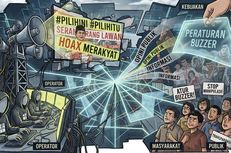
The existence of political buzzers also raises concerns about democratic quality, particularly when buzzer activities are used to influence public perceptions with misleading information.
Ari Junaedi stated that the influence of buzzers on democracy cannot be separated from their ability to craft an image for one candidate while undermining another.
He cited the phenomenon observed in the Philippine presidential elections which appears to have parallels with the political contests in Indonesia in 2024.
Through digital communication operations, voters' perceptions of a candidate can be directed by constructing a specific image or broadcasting detrimental narratives against opponents.
"The political perceptions of potential voters can be 'manipulated' through the use of buzzers as a contestant's team may degrade another contestant as an unworthy competitor by misconstruing facts and data," Ari explained.
He noted that the image-building process can even transform a candidate's weaknesses into perceived strengths through the narratives constructed on social media.
Ari believes such conditions can impact voter preferences as the public does not always acquire complete information about candidates based on their track records.
Besides influencing voter perception, buzzing activities can also intensify political polarization.
This happens when narratives disseminated primarily contain attacks on others without factual support.
The consequence is that political debates shift focus from ideas, programs, or track records to polarization between groups.
Similarly, Jamiluddin Ritonga asserts that buzzers in democratic nations can resemble a double-edged sword, possessing both positive and negative impacts.
On one hand, buzzers can expedite information dissemination, including amplifying government programs to a broader audience.
In the context of social campaigns or elections, buzzers can also boost participation and public awareness regarding political issues or policies that previously received inadequate attention.
Their presence can even introduce counter-narratives amidst the overwhelming flood of information, providing the public with alternatives to mainstream media portrayals.
However, Jamiluddin warns that employing buzzers can obscure the lines between facts, opinions, and false information to win particular narratives.
"Buzzer operations often blur the boundaries among facts, opinions, and hoaxes to gain favor for specific narrations, posing a risk of misleading the public," Jamiluddin noted.
Furthermore, the use of coordinated accounts to attack opposing sides can create noise in public spaces and foster hate speech.
This phenomenon can also bring about false opinions or astroturfing, a situation where a viewpoint appears to have widespread support from the community while such backing is artificially stimulated.
Jamiluddin added that mass attacks against government critics or specific groups, including through cyberbullying and doxing, can evoke a chilling effect.
As a result, the public may be inclined to remain silent due to fears of becoming targets when expressing differing critiques or opinions.