DPD RI Leadership Seen as Alternative for Prabowo’s Vice Presidential Candidate, Here are the Considerations
-
News
-
Just now
This article was translated by AI. Read the original article on Kompas.com. See Original
The changing role of buzzers is also evident in their operational patterns and the actors involved.
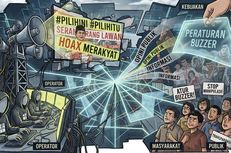
Digital communication expert Rulli Nasrulah explained that the current operational model of political buzzers tends to take the form of a networked ecosystem.
This means that buzzers’ activities are not just conducted by individuals commenting on social media.
A variety of stakeholders can be involved, including political sponsors or clients, communication consultants, digital agencies, network coordinators, influencers, and supporting accounts responsible for producing and disseminating messages.
Coordination typically includes narrative division, content material, timing of posts, and selection of distribution channels.
The messages are then spread across various platforms, such as TikTok, Instagram, X, Facebook, and WhatsApp.
"As a result, messages originally produced by one group can appear as though they are spontaneous conversations or support from a multitude of individuals," Rulli stated to Kompas.com on Friday.
This pattern blurs the lines between naturally occurring public discourse and organized discussions driven by coordinated efforts.
Rulli noted that public perception of buzzers in Indonesia tends to be negative because the term has increasingly become synonymous with political propaganda, defense of powerholders, attacks on critical groups, and organized opinion formation.
Buzzers are often viewed not as independent opinion bearers, but rather as agents acting on particular orders or interests.
Despite this, Rulli cautions that not all buzzing activities have negative objectives.
Some use social media to foster constructive discussions and exchanges of opinions.
According to him, political communication strategies leveraging buzzers can still be valuable as long as they are conducted transparently and without misinformation, false identities, or personal attacks.
The core issue lies in the low public trust regarding the authenticity of political conversations on social media.
Advancements in digital technology have also transformed how buzzers create and disseminate political messages.
Whereas previous narrative dissemination required manual production and distribution, the advent of artificial intelligence (AI) now allows for large-scale content creation in a shorter time frame.
Rulli noted that AI can be used to produce various forms of content, from text and images to videos, with differing political messages.
Meanwhile, social media platform's algorithms can optimize timing and reach for content distribution.
With this combination, a single narrative can be replicated in various formats and distributed across multiple accounts, creating the illusion of an organic conversation among diverse users.
Moreover, AI technology allows for the creation of deepfake content, where an individual's face, voice, and movements are manipulated to appear as though they are genuinely saying or doing something.
In the political context, such technology could be employed to enhance a political figure's image, undermine a rival’s reputation, or spread false statements purportedly from an individual.
"The issue is not solely misinformation but also a crisis of public trust as people find it increasingly difficult to discern between authentic content and AI manipulation," said this media and cultural studies Doctoral researcher from Gadjah Mada University (UGM) and senior researcher at Arus Survei Indonesia (ASI).
He assessed that with substantial financial backing, buzzer operations are likely to become more massive.
Thousands of content pieces can be produced rapidly, shared via accounts with varying communication styles, and subsequently reinforced in a coordinated manner.
The aim is not just to create viral content but to shape public perceptions and influence the direction of discourse on social media.
"The intention is not merely to make content viral but also to mold perceptions and manipulate discussions in such a way that opinions driven by specific groups come across as the dominant public voice," Rulli remarked.
This state of affairs, he argues, has the potential to turn the digital space into a battleground for influence among groups with available resources and communication networks.
Consequently, organically formed public voices may be drowned out by narratives that are produced and disseminated through organized efforts.