DPD RI Leadership Seen as Alternative for Prabowo’s Vice Presidential Candidate, Here are the Considerations
-
News
-
Just now
This article was translated by AI. Read the original article on Kompas.com. See Original
JAKARTA, KOMPAS.com - Social media has evolved into more than just a platform for public expression; it has become a battleground for influence within the political sphere.
In this competitive landscape, the role of buzzers—individuals who amplify messages on social media—has gained significance due to their ability to shape narratives, sway opinions, and undermine political opponents.
This phenomenon has gained renewed attention after the Chairperson of the Indonesian Democratic Party of Struggle (PDI-P), Megawati Soekarnoputri, urged the House of Representatives to draft regulations to manage political buzzers.
Megawati suggested that these buzzers often voice opinions online but shy away from confrontations with those they criticize.
However, the political buzzer phenomenon is not new to Indonesia's democratic landscape.
With technological advancements, the operation of buzzers has shifted from merely spreading messages to becoming part of a more organized network involving various actors and leveraging digital technology.
So, how has the political buzzer evolved in Indonesia, what is its impact on the quality of democracy, and will this phenomenon continue to persist in future political dynamics?
Political communication expert from Esa Unggul University, M Jamiluddin Ritonga, stated that discussions surrounding the existence of buzzers have been ongoing since their emergence around 2009.
"Buzzers emerged alongside the rise of social media use, particularly Twitter," Jamiluddin told Kompas.com on Friday (20/11/2026).
From the start, the messages conveyed by these buzzers have often been polarized.
There have been positive narratives crafted to enhance an individual or group's image, as well as negative narratives aimed at attacking individuals, groups, or specific institutions.
As time progressed, the role of buzzers has expanded beyond mere information dissemination or political image building.
Political communication expert and Director of Nusakom Pratama Political Studies Institute, Ari Junaedi, mentioned that buzzers are now an integral part of considered communication strategies in political contests.
According to Ari, the ability of buzzers to influence public opinion can contribute to the victory of a candidate while simultaneously tarnishing the image of competitors.
"Given the significant role of political buzzers, their influence cannot be overlooked. The success of buzzers in shaping public opinion contributes to a candidate's win while degrading others," said Ari to Kompas.com on Friday.
Thus, the activities of buzzers are not only related to message dissemination but also to shaping collective public perceptions of competing political actors.
Ari believes that these developments have granted buzzers a distinct position within political communication strategies.
This is especially pertinent as social media is increasingly utilized by the public to gain information and keep up with political developments.
The changing role of buzzers is also evident in their operational patterns and the actors involved.
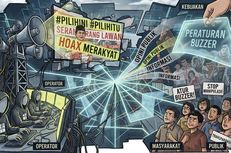
Digital communication expert Rulli Nasrulah explained that the current operational model of political buzzers tends to take the form of a networked ecosystem.
This means that buzzers’ activities are not just conducted by individuals commenting on social media.
A variety of stakeholders can be involved, including political sponsors or clients, communication consultants, digital agencies, network coordinators, influencers, and supporting accounts responsible for producing and disseminating messages.
Coordination typically includes narrative division, content material, timing of posts, and selection of distribution channels.
The messages are then spread across various platforms, such as TikTok, Instagram, X, Facebook, and WhatsApp.
"As a result, messages originally produced by one group can appear as though they are spontaneous conversations or support from a multitude of individuals," Rulli stated to Kompas.com on Friday.
This pattern blurs the lines between naturally occurring public discourse and organized discussions driven by coordinated efforts.
Rulli noted that public perception of buzzers in Indonesia tends to be negative because the term has increasingly become synonymous with political propaganda, defense of powerholders, attacks on critical groups, and organized opinion formation.
Buzzers are often viewed not as independent opinion bearers, but rather as agents acting on particular orders or interests.
Despite this, Rulli cautions that not all buzzing activities have negative objectives.
Some use social media to foster constructive discussions and exchanges of opinions.
According to him, political communication strategies leveraging buzzers can still be valuable as long as they are conducted transparently and without misinformation, false identities, or personal attacks.
The core issue lies in the low public trust regarding the authenticity of political conversations on social media.
Advancements in digital technology have also transformed how buzzers create and disseminate political messages.
Whereas previous narrative dissemination required manual production and distribution, the advent of artificial intelligence (AI) now allows for large-scale content creation in a shorter time frame.
Rulli noted that AI can be used to produce various forms of content, from text and images to videos, with differing political messages.
Meanwhile, social media platform's algorithms can optimize timing and reach for content distribution.
With this combination, a single narrative can be replicated in various formats and distributed across multiple accounts, creating the illusion of an organic conversation among diverse users.
Moreover, AI technology allows for the creation of deepfake content, where an individual's face, voice, and movements are manipulated to appear as though they are genuinely saying or doing something.
In the political context, such technology could be employed to enhance a political figure's image, undermine a rival’s reputation, or spread false statements purportedly from an individual.
"The issue is not solely misinformation but also a crisis of public trust as people find it increasingly difficult to discern between authentic content and AI manipulation," said this media and cultural studies Doctoral researcher from Gadjah Mada University (UGM) and senior researcher at Arus Survei Indonesia (ASI).
He assessed that with substantial financial backing, buzzer operations are likely to become more massive.
Thousands of content pieces can be produced rapidly, shared via accounts with varying communication styles, and subsequently reinforced in a coordinated manner.
The aim is not just to create viral content but to shape public perceptions and influence the direction of discourse on social media.
"The intention is not merely to make content viral but also to mold perceptions and manipulate discussions in such a way that opinions driven by specific groups come across as the dominant public voice," Rulli remarked.
This state of affairs, he argues, has the potential to turn the digital space into a battleground for influence among groups with available resources and communication networks.
Consequently, organically formed public voices may be drowned out by narratives that are produced and disseminated through organized efforts.
The existence of political buzzers also raises concerns about democratic quality, particularly when buzzer activities are used to influence public perceptions with misleading information.
Ari Junaedi stated that the influence of buzzers on democracy cannot be separated from their ability to craft an image for one candidate while undermining another.
He cited the phenomenon observed in the Philippine presidential elections which appears to have parallels with the political contests in Indonesia in 2024.
Through digital communication operations, voters' perceptions of a candidate can be directed by constructing a specific image or broadcasting detrimental narratives against opponents.
"The political perceptions of potential voters can be 'manipulated' through the use of buzzers as a contestant's team may degrade another contestant as an unworthy competitor by misconstruing facts and data," Ari explained.
He noted that the image-building process can even transform a candidate's weaknesses into perceived strengths through the narratives constructed on social media.
Ari believes such conditions can impact voter preferences as the public does not always acquire complete information about candidates based on their track records.
Besides influencing voter perception, buzzing activities can also intensify political polarization.
This happens when narratives disseminated primarily contain attacks on others without factual support.
The consequence is that political debates shift focus from ideas, programs, or track records to polarization between groups.
Similarly, Jamiluddin Ritonga asserts that buzzers in democratic nations can resemble a double-edged sword, possessing both positive and negative impacts.
On one hand, buzzers can expedite information dissemination, including amplifying government programs to a broader audience.
In the context of social campaigns or elections, buzzers can also boost participation and public awareness regarding political issues or policies that previously received inadequate attention.
Their presence can even introduce counter-narratives amidst the overwhelming flood of information, providing the public with alternatives to mainstream media portrayals.
However, Jamiluddin warns that employing buzzers can obscure the lines between facts, opinions, and false information to win particular narratives.
"Buzzer operations often blur the boundaries among facts, opinions, and hoaxes to gain favor for specific narrations, posing a risk of misleading the public," Jamiluddin noted.
Furthermore, the use of coordinated accounts to attack opposing sides can create noise in public spaces and foster hate speech.
This phenomenon can also bring about false opinions or astroturfing, a situation where a viewpoint appears to have widespread support from the community while such backing is artificially stimulated.
Jamiluddin added that mass attacks against government critics or specific groups, including through cyberbullying and doxing, can evoke a chilling effect.
As a result, the public may be inclined to remain silent due to fears of becoming targets when expressing differing critiques or opinions.
Despite facing numerous criticisms, the existence of political buzzers is expected to continue coloring Indonesia's political dynamics in the future.
Ari Junaedi believes that this phenomenon will remain as long as the democratic processes have not matured.
He notes that social media has become a primary arena for political communication, particularly for younger generations that are increasingly active on digital platforms.
This situation turns the political contest on social media into a battleground exploited by various interests.
"The political buzzer phenomenon will persist as long as the democratic process lacks maturity. The currently superficial democracy allows ample room for the existence of buzzers to favor candidates with substantial capital," Ari commented.
He further pointed out that the growing influence of social media among Generation Z leads users of buzzer services to view the political contest as a competitive space to be won.
Meanwhile, Rulli Nasrulah predicts that technological advancements will widen the capacities for narrative production and distribution.
If not matched with transparency and public awareness regarding information consumption, public discourse may become dominated increasingly by groups equipped with resources to mobilize communication networks.
In the long run, this could undermine public trust, deepen polarization, and disrupt the quality of democracy.
"Because the debates are controlled more by narrative production power than by healthy exchanges of ideas," Rulli concluded.