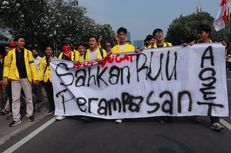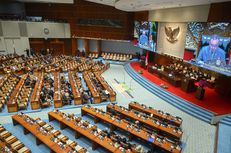
BREAKING NEWS! DPR Approves Asset Seizure Bill into Law
-
News
-
8 minutes ago
This article was translated by AI. Read the original article on Kompas.com. See Original

Next, regulations regarding equivalency in the RUU Sisdiknas must define simple procedures and provide certainty in timeframes.
"We must not complicate citizens who have genuinely completed education abroad with convoluted bureaucracy," he elaborated.
Moreover, he argued that the government needs to regulate fairness in equivalency. There should be no preferential treatment for certain parties, including children of officials and affluent individuals.
The same goes for children of migrant workers. Indra stated that everyone should meet the same requirements.
"Public services must not have different standards based on who makes the request," he stressed.
Furthermore, Indra urged the government to distinguish between academic qualification equivalency and professional competence recognition.
For example, in medicine, mere recognition of a diploma is insufficient, as there are competence requirements and licenses to be fulfilled.
He emphasized that the RUU Sisdiknas must be designed to address the long-term needs of national education.
On the other hand, he also reminded that recent diploma controversies should not prompt the DPR to hastily create new provisions without first evaluating the implementation of existing regulations.
"We must not focus on amending rules without questioning why the existing regulations are not being properly enforced," Indra emphasized.
According to Lalu Hadrian Irfani, Deputy Chairman of Commission X of the DPR, this regulation is necessary as the existing controversies have arisen due to the absence of a truly unified reference regulation.
He acknowledged that Indonesia lacks regulations regarding the equivalency of foreign diplomas recognized by the state.
According to him, equivalency of academic results obtained abroad must have its own mechanism. The existing regulations are merely internal regulations from the relevant ministries/institutions, while foreign academic results equivalency should have its own mechanism.
"This is a weakness for us as a large nation; upon reviewing regulations, I found that there are no specific provisions regarding how such equivalency is recognized by the state," he stated, referring to Ari.
Ari views the recent diploma controversies as an important evaluation material for Commission X of the DPR RI and all stakeholders.
Moreover, many Indonesian citizens are pursuing education abroad, thus requiring legal certainty in the recognition process of their education.
He hopes that the new regulations will be binding and eliminate any grounds for debates.
"Let us collaboratively create regulations that truly do not become barriers or sources of debate in the future, as various interpretations arise from our lack of binding regulations on this matter," Ari concluded.