
Get Ready for MPR to Choose Gibran's Replacement: 2 Teams Formed, Deadline Set
-
News
-
15 minutes ago
This article was translated by AI. Read the original article on Kompas.com. See Original
The extent of the Vice President's role in governance heavily depends on the division of tasks and the trust bestowed by the president. The Vice President does not have independent executive authority equivalent to that of the president.
This scenario becomes intriguing when connected to Prabowo's government trend of positioning the president as a dominant actor in determining policy direction.
A broad interpretation of executive authority as mentioned in Article 4, paragraph (1) of the 1945 Constitution serves as the basis for translating the president's political agenda into various national programs.
The Merah Putih Village/Neighborhood Cooperation (KDMP), for instance, is accelerated through Presidential Instruction Number 9 of 2025, targeting the establishment of 80,000 cooperatives.
Meanwhile, Free Nutritious Meals (MBG) is implemented through the National Nutrition Agency as established by Presidential Regulation Number 83 of 2024 and strengthened by Presidential Regulation Number 115 of 2025.
The issue is not just about the goals of these two programs but rather how presidential authority is translated into public policy without ignoring constitutional boundaries.
KDMP raises questions about economic democracy as stated in Article 33 of the 1945 Constitution, the independence of cooperative members, and village autonomy.
Cooperative formation should rely on the initiative, agreement, and interests of members, not merely on the central government's administrative targets.
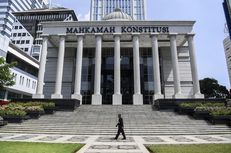
These questions are also part of constitutional scrutiny through Case Number 399/PUU-XXIV/2026 in the Constitutional Court.
Similarly, MBG incites debates on budget allocation for education as per Article 31, paragraph (4) of the 1945 Constitution.
Through Decision Number 40/PUU-XXIV/2026, the Constitutional Court mandated the separation of MBG funding, which is not a main educational component, from the education budget no later than in the 2028 State Budget.
This ruling indicates that presidential policies, despite having political legitimacy and social aims, must adhere to constitutional testing.
Executive authority cannot be interpreted without limits simply because a program is a priority for the government.
In this context, Prabowo has considerable political space to determine the direction for filling the Vice Presidential position, yet lacks constitutional authority to leave it vacant indefinitely.
The President has the authority to propose two candidate names to the MPR. If the nominated candidates are from his own party, specifically Gerindra, the question arises as to how independently the Vice President can perform their functions compared to the President.
As elite consolidation and coalition support for the government solidify, filling the position from within the same political circle may strengthen centralized control rather than create internal balance.
The Vice President is not designed to serve as an opposition to the President. However, their existence should not merely act as an extension of the President's political interests.
In a government increasingly reliant on discretion and executive interpretation, the functions of coordination, internal oversight, and policy continuity should gain clearer space.
Without substantial responsibility distribution, the Vice President's role risks becoming merely a formal complement in the power structure.