
Vice President and Constitutional Futility
-
News
-
Just now
This article was translated by AI. Read the original article on Kompas.com. See Original
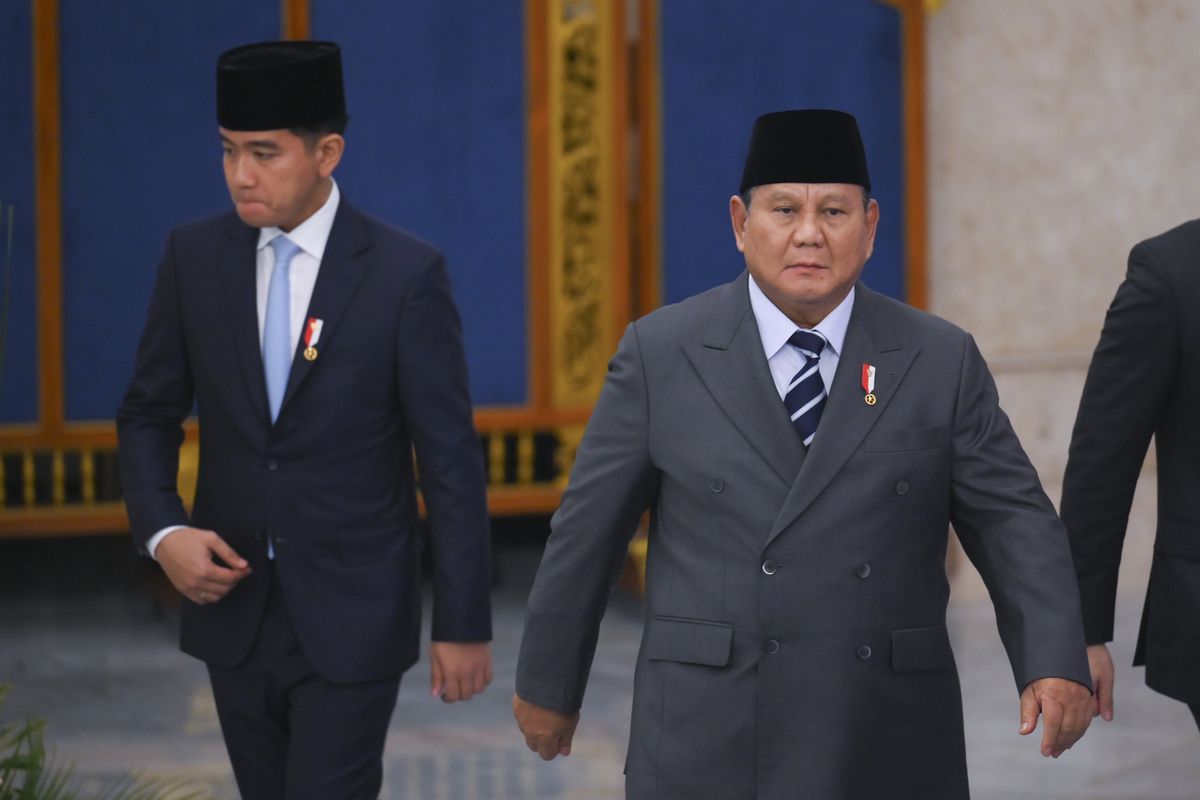
DECISION Gibran Rakabuming Raka's resignation from the position of Vice President reignites the debate over the role and significance of the Vice President within Indonesia's constitutional framework.
This question goes beyond who will replace Gibran; it addresses the importance of having a Vice President in the power configuration of the Prabowo Subianto administration, which has been in place for nearly two years.
Is filling this position a substantive need for governance, or merely a formality to meet constitutional requirements?
This incident recalls Indonesian political history when Mohammad Hatta resigned from the Vice Presidency on December 1, 1956.
However, the reasons behind their respective resignations are certainly different. Hatta made his decision after a fundamental disagreement over the direction of democracy, the governance system, and state management.
Hatta advocated for constitutional democracy with checks on power, while Sukarno increasingly pushed Indonesia towards Guided Democracy.
Hatta's resignation was not merely about leaving a position; it was a consequence of a principled disagreement over how the nation should be governed.
This decision marked the end of the synergetic unity of national leadership established during the struggle for independence.
After Hatta's departure, Sukarno governed without a Vice President until his rule ended in 1967.
This vacancy even continued into the early years of Suharto's administration until Sri Sultan Hamengkubuwono IX was elected Vice President in 1973.
This historical experience illustrates that governance can continue without a Vice President.
Similar practices can be found in several countries. Germany, France, and Italy, for example, do not have a Vice President. Instead, they have succession mechanisms through other state officials to ensure government continuity.
This means that a Vice President's existence is not the only institutional design that allows for governance to function.
However, Sukarno's experience cannot be directly interpreted as a legal precedent for Indonesia today. The amendments to the 1945 Constitution explicitly regulate the mechanism for filling a vacant Vice President position.
Article 8, paragraph (2) states that the MPR shall convene a session to elect a Vice President from two candidates proposed by the President within 60 days of the vacancy arising.
Thus, Gibran's resignation is not merely a political issue, but also a constitutional event that necessitates the process for filling the position.
The challenge lies in the constitutional obligation to fill the position, which does not automatically address the political and functional urgency of a Vice President.
In Indonesia's presidential system, the president and vice president are elected as a pair, but executive authority remains with the president.
Article 4, paragraph (2) of the 1945 Constitution states that the president, in carrying out their duties, is assisted by one Vice President.