

Prabowo to Travel Abroad While Vice Presidential Seat is Vacant, Yusril: No Problem
-
News
-
2 minutes ago
This article was translated by AI. Read the original article on Kompas.com. See Original
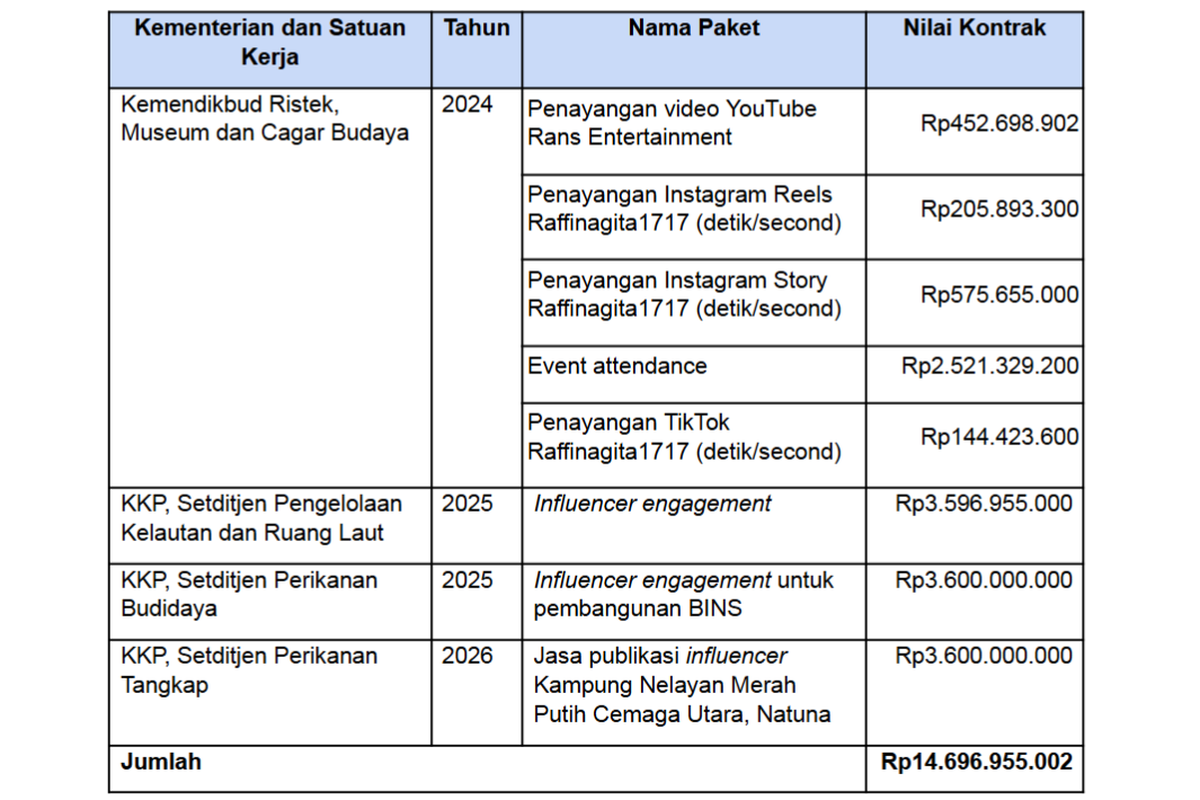
The substantial budget allocated by the government for influencer services ultimately needs to be assessed based on the impact produced.
Agustinus states that theoretically, the use of influencers in organizational communication has several objectives, including building a positive image, enhancing public trust, and making policies more understandable to the public.
However, the success of such activities is not solely measured by the quantity of content produced, the number of an influencer's followers, or the level of interaction on social media.
He insists that the success metric should be viewed from the community's perspective as the information recipients.
"If we want to assess the impact of branding from the citizens' side, it is whether the narratives, videos, or images in the content are trusted and followed by the community. If the answer is no, then the branding is merely for the ministry's interests," he explains.
In other words, the government needs to have clear indicators to measure whether the messages conveyed by influencers genuinely reach the communities targeted by the program.
Evaluations should also examine whether the public understands the information delivered, is aware of the program's benefits, and feels motivated to utilize government services being promoted.
Without such measurements, spending on influencer services risks becoming mere promotional activities whose results are difficult to substantiate.
Agustinus suggests that the government should also compare the effectiveness of using influencers with other dissemination methods, including through mass media and official ministry communication channels.
However, he cautions that effectiveness comparisons cannot solely rely on assumptions or subjective assessments.
"To answer such questions, serious research is necessary, not merely conjectures," he states.
He believes that if ministries feel their internal public relations functions have not optimally fulfilled their public communication tasks, budgets could instead be directed towards enhancing the competency of personnel.
Strengthening the human resources capacity within the ministries is part of leadership's responsibility to ensure the organization can carry out its duties.
"In my opinion, ministries need to revitalize their roles and organizational culture, rather than outsourcing or privatizing their functions to private parties," Agustinus adds.