

Prabowo to Travel Abroad While Vice Presidential Seat is Vacant, Yusril: No Problem
-
News
-
2 minutes ago
This article was translated by AI. Read the original article on Kompas.com. See Original
JAKARTA, KOMPAS.com - The use of influencers by ministries to promote government programs has come under scrutiny again.
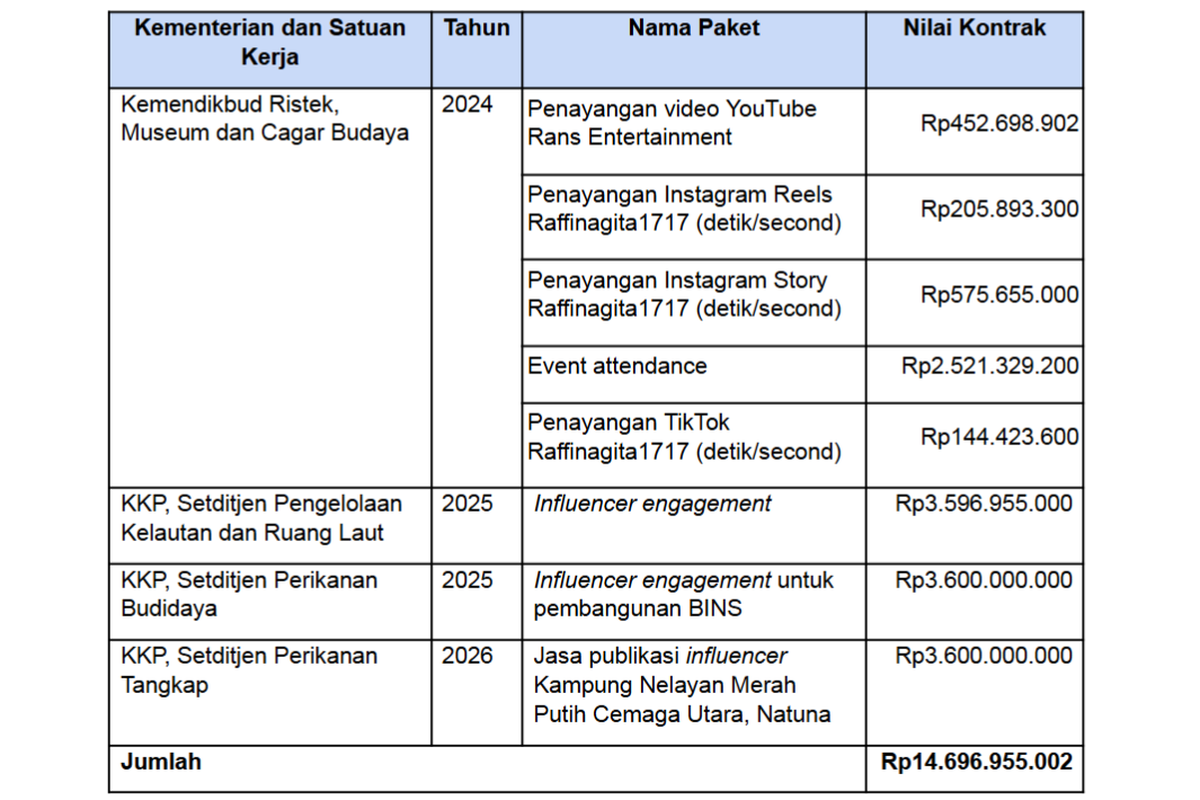
This comes after Indonesia Corruption Watch (ICW) highlighted a budget allocation of IDR 14.69 billion by two ministries to PT Rans Animasi Indonesia, a company allegedly owned by Raffi Ahmad, for influencer services from 2024 to 2026.
The two ministries in question are the Ministry of Education, Culture, Research, and Technology (Kemendikbud Ristek) and the Ministry of Marine Affairs and Fisheries (KKP).
Amid budget efficiency policies, spending tens of billions of rupiah to collaborate with a high-profile business has raised questions among the public.
Concerns range from the necessity of using influencers as a government communication channel to the effectiveness of the budget spent.
Public policy and political communication experts will discuss this as follows:
Political communication expert from Gadjah Mada University (UGM) and Executive Director of Indonesian Presidential Studies, Nyarwi Ahmad, views the government's use of influencers as a shortcut for communicating policies and programs to the public.
He states that this practice has been ongoing for more than a decade.
However, the selection of influencers is often not based on competence, reputation, or expertise relevant to the issues being addressed.
"For over the past 10 years, the government has preferred shortcuts by hiring influencers, and this has not been done selectively," Nyarwi told Kompas.com on Wednesday (11/11/2026).
He argues that the government tends to prioritize follower count and popularity when selecting public figures.
In reality, a large following on social media does not automatically indicate someone's ability to convey public information accurately.
Nyarwi reminds us that the influencers involved essentially function as public communicators.
Thus, they should possess the competence, understanding of the issues, and the ability to convey information responsibly.
He likens the selection of public communicators to the profession of doctors, which requires specialized skills.
"Public communicators should be trained with the necessary skills or have certification as public communicators. In simple terms, it's similar to being a doctor," he says.
According to Nyarwi, the government cannot arbitrarily appoint someone simply because they are famous or have many followers to present programs pertaining to public interest.
Moreover, information about government policies requires accurate messaging to avoid misunderstandings among the public.
He also highlights the risks of using influencers lacking credibility and adequate understanding of the issues disseminated.
"Often, instead of a communication process between the government and its citizens, we see the usage of influencers as a hegemonic instrument, dominating public discourse or mobilizing through their influence," Nyarwi explains.
He assesses that this situation indicates the government has not fully adapted to changes in the digital communication landscape.
Rather than strengthening public communication capacity within institutions, the government tends to take shortcuts by partnering with popular figures.
However, using influencers also carries risks if the chosen figures become embroiled in controversies or lose public trust.
"If the influencer's reputation falls, it affects the reputation of the hiring parties as well," he argues.
The government not only risks losing budget when the messages fail to reach the target audience but also faces issues of public trust.
In addition to competence issues, Nyarwi points out the potential for conflicts of interest when public figures who have businesses in the influencer space also hold positions in government.
According to him, the government should seriously consider the positions and business relationships of those involved in public communication activities.
There is a distinction between someone running a communication services business and someone in a public office.
"If they're purely business people or influencer consultants, it's obviously different if they're public officials. In my opinion, one choice cannot exist concurrently; if both roles are held, it means conflict of interest," he states.
In Prabowo's government, Raffi Ahmad has served as Special Presidential Envoy for Youth Development and Arts Workers since being appointed on October 22, 2024.
Nyarwi believes that this issue needs to be part of the government's evaluation when formulating influencer service procurement policies.
The selection of government communication partners should not only consider popularity but also integrity, track record, competence, and the potential for conflicts of interest.
Meanwhile, Agustinus Subarsono, a lecturer in the Department of Management and Public Policy at UGM, believes the use of influencers by ministries should be viewed from the perspective of good governance.
According to Agustinus, the ministries' dependency on external parties to promote government programs may indicate that their internal public relations functions have not been functioning optimally.
"The need for ministries to use influencers to disseminate government programs is empirical evidence that the public relations departments within those ministries lack competence and are powerless to disseminate the programs," Agustinus told Kompas.com on Thursday (12/11/2026).
He warns that if this practice continues, the government could face ballooning expenditures due to reliance on external service providers.
This situation is not in line with the budget efficiency spirit currently being pushed by the government.
In the long run, continuous spending on communication services delegated to private entities could burden the state budget (APBN), especially when the country's fiscal situation is under pressure.
Agustinus also raises the political aspects of the contract between the ministry and the company allegedly owned by Raffi Ahmad.
Since Raffi Ahmad is known to serve as a Special Presidential Envoy for Youth Development and Arts Workers, his proximity to the government's environment could provoke public perception of political networks in government contracts.
"The public cannot be blamed for interpreting that in contract matters, there may be policy biases that ultimately benefit specific company owners," he asserts.
He believes that this perception needs to be addressed by the government through transparent and accountable procurement governance.
Especially since there exists a paradox between President Prabowo Subianto's instruction on budget efficiency and large expenditures on influencer services by ministries.
"This case could increase political distrust in the government, and obviously, it needs to be prevented from recurring in the future," Agustinus warns.
The substantial budget allocated by the government for influencer services ultimately needs to be assessed based on the impact produced.
Agustinus states that theoretically, the use of influencers in organizational communication has several objectives, including building a positive image, enhancing public trust, and making policies more understandable to the public.
However, the success of such activities is not solely measured by the quantity of content produced, the number of an influencer's followers, or the level of interaction on social media.
He insists that the success metric should be viewed from the community's perspective as the information recipients.
"If we want to assess the impact of branding from the citizens' side, it is whether the narratives, videos, or images in the content are trusted and followed by the community. If the answer is no, then the branding is merely for the ministry's interests," he explains.
In other words, the government needs to have clear indicators to measure whether the messages conveyed by influencers genuinely reach the communities targeted by the program.
Evaluations should also examine whether the public understands the information delivered, is aware of the program's benefits, and feels motivated to utilize government services being promoted.
Without such measurements, spending on influencer services risks becoming mere promotional activities whose results are difficult to substantiate.
Agustinus suggests that the government should also compare the effectiveness of using influencers with other dissemination methods, including through mass media and official ministry communication channels.
However, he cautions that effectiveness comparisons cannot solely rely on assumptions or subjective assessments.
"To answer such questions, serious research is necessary, not merely conjectures," he states.
He believes that if ministries feel their internal public relations functions have not optimally fulfilled their public communication tasks, budgets could instead be directed towards enhancing the competency of personnel.
Strengthening the human resources capacity within the ministries is part of leadership's responsibility to ensure the organization can carry out its duties.
"In my opinion, ministries need to revitalize their roles and organizational culture, rather than outsourcing or privatizing their functions to private parties," Agustinus adds.
Beyond effectiveness issues, Agustinus argues that expenditures for influencers using the state budget must be accompanied by a transparent and accountable procurement mechanism.
He notes that openness should begin from the provider selection process, including providing opportunities for various companies to participate in the procurement.
He believes that using electronic auction mechanisms or e-procurement should be an essential aspect of procuring high-value services.
"E-auction or electronic tenders are certainly obligatory in the procurement of government goods and services, especially for large project values," Agustinus asserts.
In addition to the provider selection process, ministries must also disclose information regarding the evaluation criteria and basis for determining winning companies.
This way, the public can understand the reasons behind the government’s choice of one company over others.
Agustinus adds that bureaucratic accountability is insufficient if it only meets administrative and legal procurement requirements.
Officials making decisions must also be able to morally justify their policies to the public.
"Furthermore, bureaucrats need to be accountable in the sense of being able to justify their decisions legally, administratively, and morally," he concludes.