

Prabowo to Travel Abroad While Vice Presidential Seat is Vacant, Yusril: No Problem
-
News
-
2 minutes ago
This article was translated by AI. Read the original article on Kompas.com. See Original
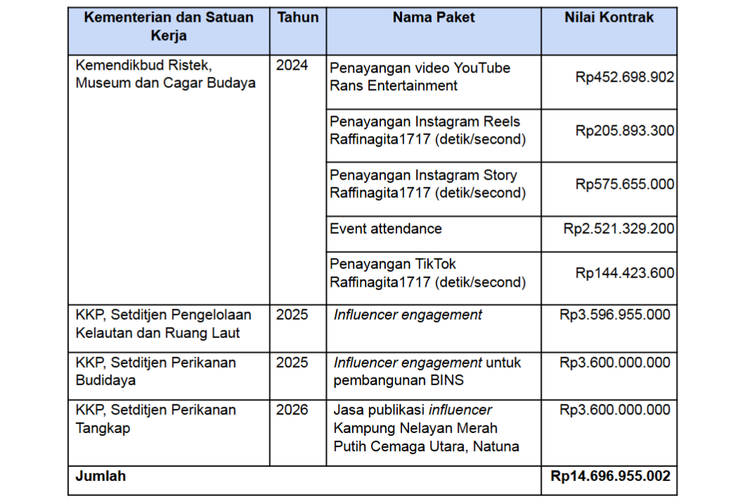
In addition to competence issues, Nyarwi points out the potential for conflicts of interest when public figures who have businesses in the influencer space also hold positions in government.
According to him, the government should seriously consider the positions and business relationships of those involved in public communication activities.
There is a distinction between someone running a communication services business and someone in a public office.
"If they're purely business people or influencer consultants, it's obviously different if they're public officials. In my opinion, one choice cannot exist concurrently; if both roles are held, it means conflict of interest," he states.
In Prabowo's government, Raffi Ahmad has served as Special Presidential Envoy for Youth Development and Arts Workers since being appointed on October 22, 2024.
Nyarwi believes that this issue needs to be part of the government's evaluation when formulating influencer service procurement policies.
The selection of government communication partners should not only consider popularity but also integrity, track record, competence, and the potential for conflicts of interest.
Meanwhile, Agustinus Subarsono, a lecturer in the Department of Management and Public Policy at UGM, believes the use of influencers by ministries should be viewed from the perspective of good governance.
According to Agustinus, the ministries' dependency on external parties to promote government programs may indicate that their internal public relations functions have not been functioning optimally.
"The need for ministries to use influencers to disseminate government programs is empirical evidence that the public relations departments within those ministries lack competence and are powerless to disseminate the programs," Agustinus told Kompas.com on Thursday (12/11/2026).
He warns that if this practice continues, the government could face ballooning expenditures due to reliance on external service providers.
This situation is not in line with the budget efficiency spirit currently being pushed by the government.
In the long run, continuous spending on communication services delegated to private entities could burden the state budget (APBN), especially when the country's fiscal situation is under pressure.
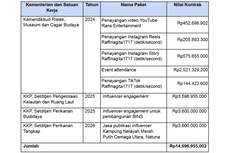
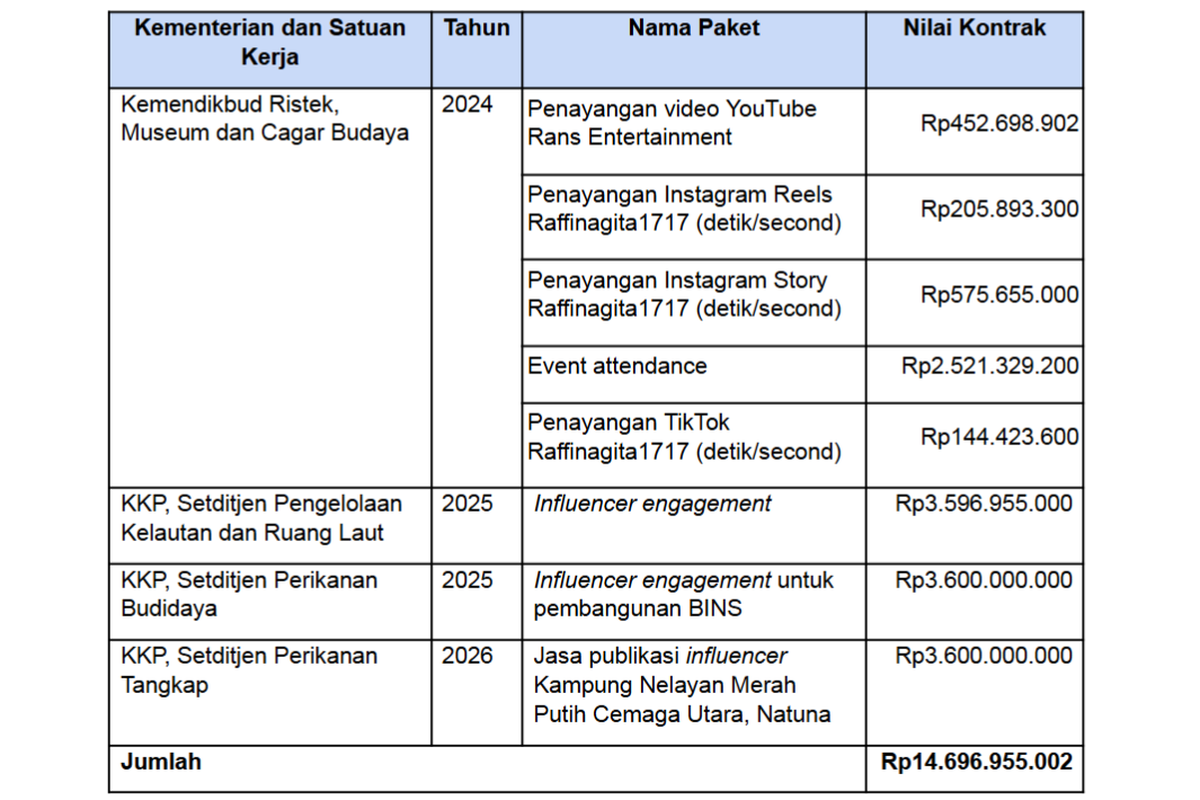
Agustinus also raises the political aspects of the contract between the ministry and the company allegedly owned by Raffi Ahmad.
Since Raffi Ahmad is known to serve as a Special Presidential Envoy for Youth Development and Arts Workers, his proximity to the government's environment could provoke public perception of political networks in government contracts.
"The public cannot be blamed for interpreting that in contract matters, there may be policy biases that ultimately benefit specific company owners," he asserts.
He believes that this perception needs to be addressed by the government through transparent and accountable procurement governance.
Especially since there exists a paradox between President Prabowo Subianto's instruction on budget efficiency and large expenditures on influencer services by ministries.
"This case could increase political distrust in the government, and obviously, it needs to be prevented from recurring in the future," Agustinus warns.