2 Climbers Missing on Semeru, BNPB: Do Not Recklessly Enter Disaster Areas and Mounts Under Alert Status
-
News
-
1 minute ago
This article was translated by AI. Read the original article on Kompas.com. See Original
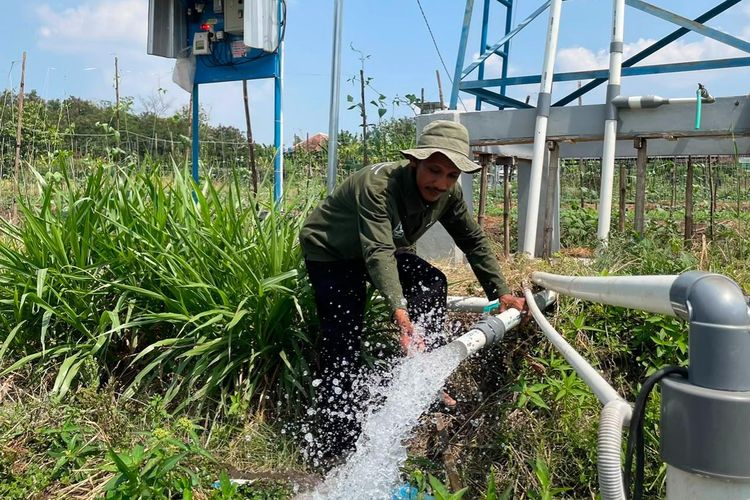 Farmers in Sobokerto Village, Boyolali, Central Java, transform barren land into productive fields using solar-powered pump technology through Pertamina's Independent Energy Village (DEB) program.
EVERY November 10, Indonesians commemorate Heroes Day as a moment to honor the sacrifices of those who fought for independence.
They fought on the battlefield, risking their lives for a noble ideal: an independent, sovereign Indonesia capable of determining its own future.
However, after more than eight decades of independence, the struggle of this nation is far from over.
While the battlegrounds have changed, the challenges facing the nation remain equally daunting.
Whereas heroes of the past fought to drive out colonizers, today, Indonesia must combat poverty, economic inequality, and food dependence, while ensuring the welfare of all its citizens.
In this context, we need to redefine heroism.
One group deserving of recognition as contemporary heroes is farmers, fishermen, livestock breeders, and all stakeholders in the food sector.
They may not bear weapons, sit atop historical stages, or always receive accolades from the state.
Yet, each day, they work to ensure that society can enjoy food on their tables.
They are the food heroes who sustain the nation’s very existence.
Ironically, those who support national food needs continue to face various welfare challenges.
We often refer to farmers as food heroes, but policies ensuring their welfare are still lacking.
Honoring farmers should not stop at slogans and ceremonies on Heroes Day.
Such recognition must be manifested through economic policies that guarantee income, access to land, financing, technology, enterprise protection, and a stronger bargaining position in the food supply chain.
Indonesia possesses vast agricultural resource potential. With rich natural resources, diverse agroecosystems, and a large population, the agricultural sector should form a cornerstone of national economic development.
Agriculture provides not only for the consumption needs of society but also serves as a livelihood for millions of households, a driver of rural economies, a supplier of raw materials for industry, and an essential instrument for maintaining social and economic stability.
However, this enormous potential has yet to translate into commensurate welfare for its stakeholders.
Structural issues in agriculture continue to overshadow farmers' lives, from land ownership limitations and uneven productivity to high production costs, restricted access to technology, and long distribution chains that result in value added mostly enjoyed by operators outside of the production level.
One fundamental issue is the relatively small and fragmented structure of agricultural land ownership.
Many farmers in Indonesia can still be classified as smallholders with very limited land.
This condition makes productivity increases not always correlate with actual income growth.
Farmers carry the burden of production risk and price volatility, while their capacity for business expansion remains extremely limited.
Another problem is the farmers' relatively weak bargaining position. During harvest periods, the prices of certain agricultural commodities can be pressurized due to increased supply alongside limited storage and processing facilities.
Conversely, when planting season arrives, farmers often face rising costs for production inputs.
This situation creates disparities in profit distribution along the food value chain.
Thus, the agricultural challenges in Indonesia extend beyond mere production increases.
The more fundamental challenge is how to ensure that increased production indeed leads to higher income and welfare for farmers.
This issue is reflected in the results of the 2023 Agricultural Census released by the Central Statistics Agency (BPS).
Of approximately 27.80 million agricultural users, 17.25 million are considered smallholders, cultivating less than 0.5 hectares.
This data reveals that approximately 62 percent of agricultural users fall within the smallholder category.
This figure underscores that land limitations persist as a serious challenge in agricultural development in Indonesia.
On the other hand, there are positive developments worthy of appreciation. The Farmers' Exchange Rate (NTP) in October 2026 reached 132.60, a 1.13 percent increase compared to September 2026.
This increase indicates that, on average, prices received by farmers are rising faster than their expenditures.
This is a positive signal for farmers' purchasing power.
However, the NTP must still be interpreted in a proportional way. An increase in this index does not automatically imply that all farmers are prosperous.
Differences in subsector, business scale, land ownership, and regions lead to varying economic conditions among farmers.
Therefore, the success of agricultural development should not merely be gauged by production increases or NTP figures.
A more substantive measure is whether farmers can enhance their real incomes, meet their family needs, educate their children, grow their businesses, and secure their agricultural activities for the future.
In recent years, food security has gained increased attention as an essential part of the national development agenda.
This focus is understandable since food is not just an economic commodity, but a basic necessity directly related to social stability, public health, and national sovereignty.
We should appreciate the increase in national food production.
BPS data indicates that Indonesia's rice production in 2025 reached 34.69 million tons, a 13.29 percent increase compared to 2024's 30.62 million tons.