

Former Customs Official Budiman Bayu Set to be Sentenced Next Week
-
News
-
1 minute ago
This article was translated by AI. Read the original article on Kompas.com. See Original
So, is it possible that all workers in Indonesia should become civil servants?
Must public service jobs be the only profession deemed to promise a secure future?
Certainly not. The government has a larger task ahead: to maintain a balance in the number of public servants, carry out measured efficiencies, and equally importantly, to revitalize the business and investment climate.
The state must not allow the public sector to become the sole place where people pin their hopes for economic certainty.
This issue also needs to be viewed through the lens of the disparities in minimum wages across different regions. In several provinces, the minimum wage still ranges from Rp 2 million to Rp 4 million.
This condition shows that the allure of becoming a civil servant cannot be separated from the low-income standards prevalent in certain job sectors.
When income in the private sector is not enough to provide adequate welfare, jobs as civil servants are bound to become more attractive.
On the other hand, policies for increasing the Provincial Minimum Wage (UMP) also need to be formulated with consideration for the capabilities of the business world.
Raising wages is indeed important for maintaining purchasing power and improving worker welfare.
However, such policies must be accompanied by careful calculations regarding productivity, industrial conditions, and the capacity of companies.
We must prevent policies aimed at enhancing welfare from inadvertently creating cost pressures that businesses cannot endure, leading to workforce reductions.
Thus, the uncertainty in the job market further strengthens the perception that becoming a civil servant is a safer choice.
I do not have a problem if someone chooses to become a civil servant to secure their financial condition.
That is a rational choice for individuals.
However, the question we need to reflect on is why this sense of security seems to be obtainable solely through jobs as civil servants?
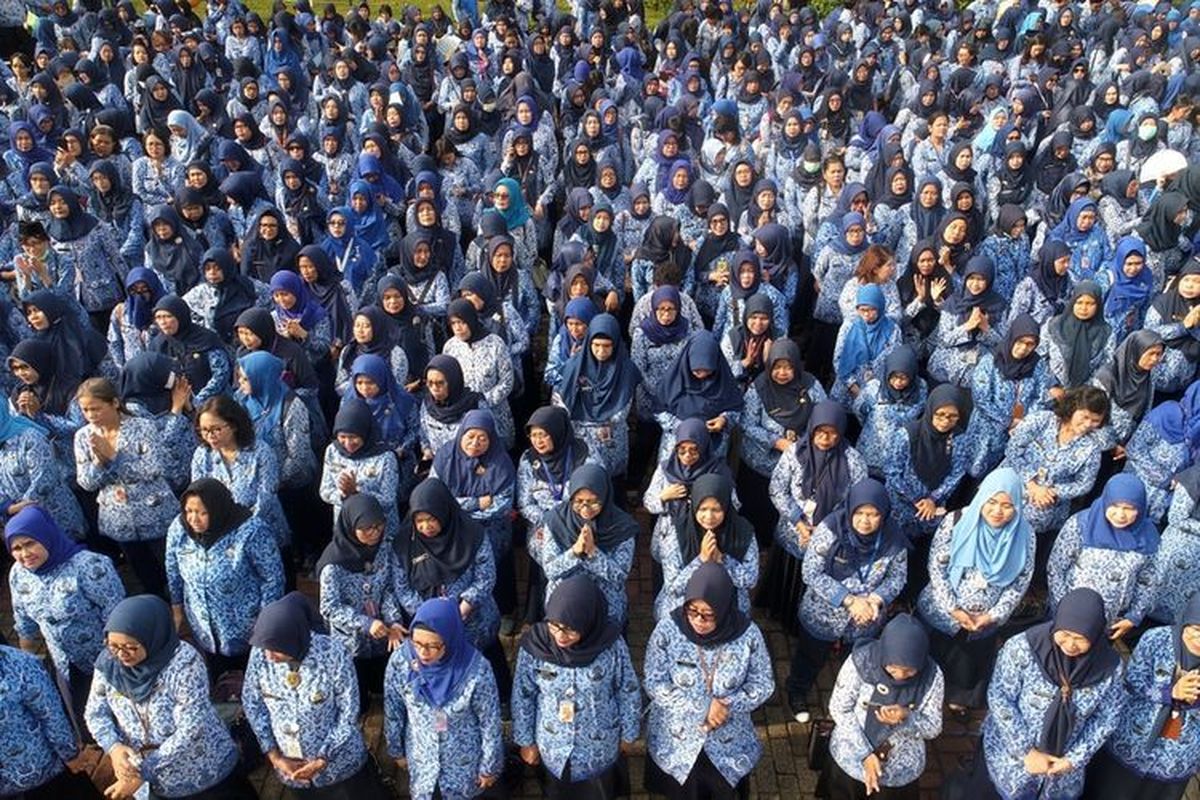
Today, that question of “when” is starting to be answered. The government has set the requirement for Civil Servant Candidates (CASN) for 2026–2027 at 167,113 positions.
Of this number, 154,052 positions are allocated for Civil Servant Candidates (CPNS) to support the implementation of national priority programs.
Out of the total CPNS positions, 118,208 are directed to support the Rapid Best Results Program and presidential priorities.
This allocation covers various fields, including forestry, higher education, healthcare, and education.
Meanwhile, 35,844 other positions are prepared to meet the needs of national priority sectors like law, statistics, food security, financial oversight, cybersecurity, and diplomacy.
Certainly, this policy should be welcomed as a fresh breeze to meet the needs of public servants, particularly in supporting the provision of public services and the implementation of government priority programs.
However, behind the large number of positions prepared, there is one fundamental question that needs to be answered: before recruiting hundreds of thousands of civil servants, has the government ensured that the Rapid Best Results Program and various presidential priorities have been thoroughly formulated, planned, and prepared?
We must not let the government recruit hundreds of thousands of civil servants while the programs they are set to implement lack mature and integrated planning.