

KPK Summons Wife of PPTR Director General Lampri as Witness in HGB Corruption Case
-
News
-
3 minutes ago
This article was translated by AI. Read the original article on Kompas.com. See Original
“When? When? When?”
PERHAPS that is the sentiment echoing in the minds of our society.
The word “when” has become a question directed at the government: when will the selection for Civil Servant Candidates (CASN) reopen?
In recent years, the surge in the number of applicants for civil service has indeed captured public attention.
Every time the government announces recruitment, millions of people from diverse educational backgrounds flock to compete for the available positions.
“In this economy” and “in this efficiency” are two phrases that have recently become common in conversations among young people.
Both seem to illustrate the heavy economic pressure currently faced by society.
From declining purchasing power, increasing layoffs, to various economic issues that ultimately affect household livelihoods.
In fact, on social media, it is not uncommon to see expressions like, “It feels like my economic pressure isn't as heavy as it was during the COVID-19 pandemic. Mercy!”
In this situation, the business world is facing significant pressures.
Economic uncertainty has forced some companies to implement efficiency measures, even making the difficult decision to reduce their workforce.
At the same time, an increasing number of young people are focusing their hopes on one goal: securing a position as a civil servant.
It’s not only recent graduates who are aiming for these roles but also those whose ages are nearing the maximum registration limits.
Why is this phenomenon occurring? We must acknowledge that becoming a civil servant is still viewed as a job option that offers financial security and certainty.
In the face of business uncertainties, the status of employment, relatively guaranteed income, and social protection become particularly attractive.
Moreover, amid the implementation of Presidential Instruction (Inpres) No. 1 of 2025 on Spending Efficiency in the Execution of the 2025 State Budget and Regional Budget, employee expenditure remains exempt from various efficiency policies.
This further illustrates that the income of state apparatus is relatively protected compared to workers in the business sector, who must confront dynamic risks.
This depiction is not merely an assumption. I recall a conversation with a colleague in a law firm who is facing economic pressures.
Previously, he had a relatively stable financial condition. However, changing business situations forced him to pivot and redefine his career choices.
He even remarked, “If I had known this, I should have just applied to become a civil servant earlier.”
From that simple experience, I began to realize that there is a greater issue than just the high enthusiasm for becoming a civil servant.
The current competition for civil servant positions does not solely stem from a desire to serve the country; rather, it is also an effort to secure an economic livelihood amid uncertainties.
Choosing to be a civil servant is increasingly seen as a solution when the private sector no longer offers the same security.
So, is it possible that all workers in Indonesia should become civil servants?
Must public service jobs be the only profession deemed to promise a secure future?
Certainly not. The government has a larger task ahead: to maintain a balance in the number of public servants, carry out measured efficiencies, and equally importantly, to revitalize the business and investment climate.
The state must not allow the public sector to become the sole place where people pin their hopes for economic certainty.
This issue also needs to be viewed through the lens of the disparities in minimum wages across different regions. In several provinces, the minimum wage still ranges from Rp 2 million to Rp 4 million.
This condition shows that the allure of becoming a civil servant cannot be separated from the low-income standards prevalent in certain job sectors.
When income in the private sector is not enough to provide adequate welfare, jobs as civil servants are bound to become more attractive.
On the other hand, policies for increasing the Provincial Minimum Wage (UMP) also need to be formulated with consideration for the capabilities of the business world.
Raising wages is indeed important for maintaining purchasing power and improving worker welfare.
However, such policies must be accompanied by careful calculations regarding productivity, industrial conditions, and the capacity of companies.
We must prevent policies aimed at enhancing welfare from inadvertently creating cost pressures that businesses cannot endure, leading to workforce reductions.
Thus, the uncertainty in the job market further strengthens the perception that becoming a civil servant is a safer choice.
I do not have a problem if someone chooses to become a civil servant to secure their financial condition.
That is a rational choice for individuals.
However, the question we need to reflect on is why this sense of security seems to be obtainable solely through jobs as civil servants?
Today, that question of “when” is starting to be answered. The government has set the requirement for Civil Servant Candidates (CASN) for 2026–2027 at 167,113 positions.
Of this number, 154,052 positions are allocated for Civil Servant Candidates (CPNS) to support the implementation of national priority programs.
Out of the total CPNS positions, 118,208 are directed to support the Rapid Best Results Program and presidential priorities.
This allocation covers various fields, including forestry, higher education, healthcare, and education.
Meanwhile, 35,844 other positions are prepared to meet the needs of national priority sectors like law, statistics, food security, financial oversight, cybersecurity, and diplomacy.
Certainly, this policy should be welcomed as a fresh breeze to meet the needs of public servants, particularly in supporting the provision of public services and the implementation of government priority programs.
However, behind the large number of positions prepared, there is one fundamental question that needs to be answered: before recruiting hundreds of thousands of civil servants, has the government ensured that the Rapid Best Results Program and various presidential priorities have been thoroughly formulated, planned, and prepared?
We must not let the government recruit hundreds of thousands of civil servants while the programs they are set to implement lack mature and integrated planning.
The recruitment of civil servants must go hand in hand with clear program designs, distribution of authority, competency needs, and budget readiness.
In this way, the number of recruited civil servants should genuinely reflect the organizational needs and real workload, not just an ambition to expand bureaucratic capacity.
Technically, the government also needs to ensure the suitability of job requirements and the competencies to be recruited.
We must prevent a buildup of employees in certain functional roles while other roles, which are in high demand, suffer from shortages.
On the other hand, we should not allow the government to open a large number of positions for roles with relatively limited actual demand.
Proper needs mapping should be meticulously formulated by the Ministry of Administrative and Bureaucratic Reform (PANRB), the National Civil Service Agency (BKN), along with other ministries, institutions, and local governments as proposing agencies.
Meanwhile, the high recruitment needs for civil servants should also consider the number of public servants currently employed by the state.
As of June 30, 2026, the total number of active civil servants in central and regional agencies reached 6,776,871 individuals.
This figure indicates that Indonesia actually already has a very large base of public servants.
Therefore, the challenge for the government is not merely to add to the number of employees but to ensure that every recruitment is truly based on organizational needs, strengthening institutional capacities, and results in improved public service quality.
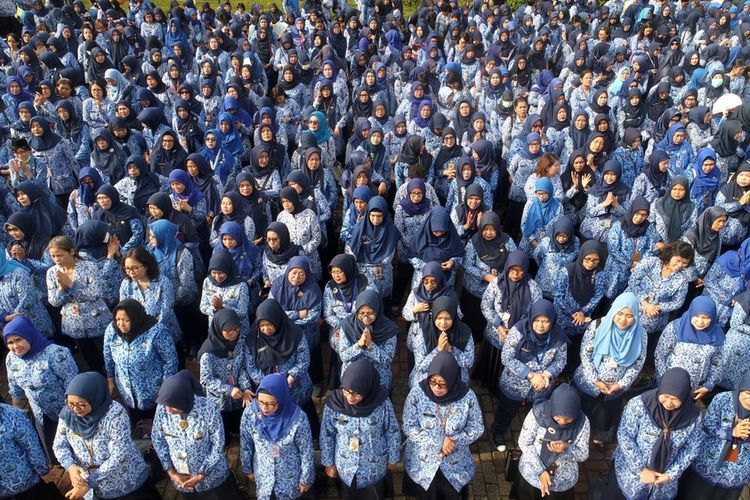
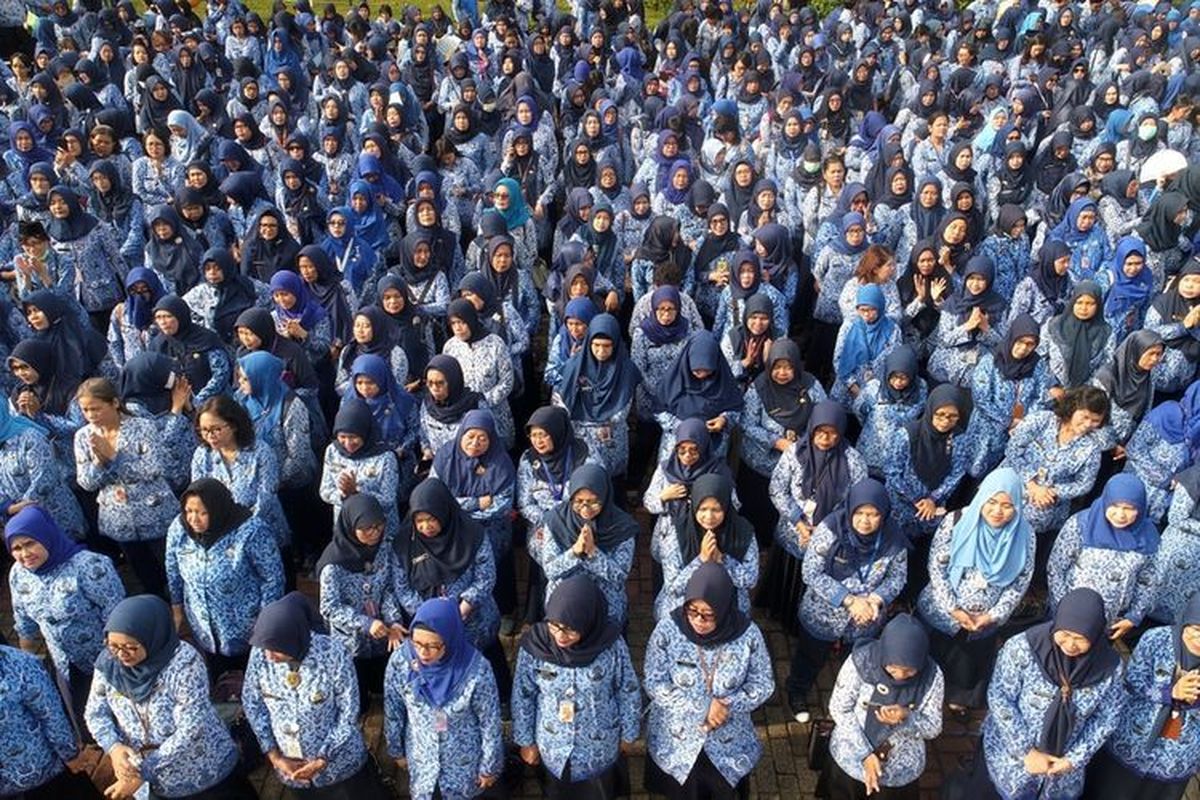
Ultimately, the position of civil servant will again become contested among millions.
As I mentioned earlier, the motivation for becoming a state apparatus today is not merely about the embellishment of service but is increasingly tied to the need for financial certainty.
This phenomenon should serve as a reflection point for the government to view the job market and the economic resilience of the community more comprehensively.
I wish to reiterate the core argument from my opinion piece published in Harian Kompas on March 12, 2025, titled: “The High Enthusiasm to Become a Civil Servant and the Heavy Burden of Bureaucracy”. A bloated bureaucracy can create unhealthy fiscal burdens, reduce the room for development spending, and slow down the achievement of government goals in providing public services.
The state certainly needs competent, professional, and integrity-driven public servants.
However, this need should not translate into an obligation to continually increase the number of employees.
Bureaucratic optimization should instead be carried out by balancing quantitative and qualitative aspects, strengthening the capacities of public servants, and ensuring that every employee expenditure generates real benefits for the community.
Moreover, the government must begin to restore public trust in the business sector.
Investment must be revived, productivity increased, and decent job opportunities expanded.
The success of development should not be measured by how many people succeed in becoming civil servants but by how wide the opportunities are for the community to secure decent employment and live prosperous lives.
We should not allow becoming a civil servant to be seen as the only path to securing a future.
A healthy state is one where not all citizens compete to enter the bureaucracy, but rather a state that can create an economic ecosystem in which society can thrive, whether as civil servants or as workers and entrepreneurs in the private sector.