
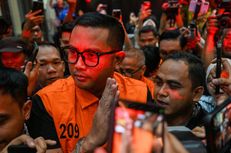
KPK Reveals Regent Hamenang Misused Authority for MURI World Record Chicken Soup
-
News
-
2 minutes ago
This article was translated by AI. Read the original article on Kompas.com. See Original
The government may change, officials can be criticized, and policies can be revoked or amended.
Meanwhile, the state remains anchored by the constitution and the sovereignty of the people.
This distinction is crucial. Criticism of officials should not be treated as an attack on the integrity of the state.
Public officials must be ready to account for their authority, as the power they wield originates from a mandate given by the people.
In academic life, the freedom to express opinions is also an essential part of intellectual responsibility.
Academics do not always have to justify government policies.
Indeed, the intellectual's duty includes the courage to scrutinize policies, highlight regulatory weaknesses, and offer alternatives based on scientific arguments.
If academic critiques are deemed threats, how can higher education fulfill its functions of education, research, and service to society independently?
The same applies to students and civil society. They are not enemies of the state.
They are citizens with rights and responsibilities to oversee governmental conduct.
Of course, freedom cannot be used to excuse violence, threats, or criminal acts.
The state must act against actions meeting the criteria of criminal offenses.
However, decisive actions must be distinguished from repressive measures. Firmness in the law must coexist with the protection of constitutional rights.
In my view, the use of the term treason must return to objective legal standards.
Let not this term become a political label to silence dissenting voices.
Nor should authorities lose their independence due to the pressure of power interests.
A strong state is not one that instills fear in its people to speak. A strong state is one that can accept criticism, rectify mistakes, and uphold the law fairly, including against those in power.
Treason is a criminal act that must be proven through legal processes.
Criticism is a constitutional right that must be protected. Mixing the two is a mistake that can undermine democracy.
We must not live in a state where people are more afraid to express opinions than to engage in abuses of power.
When criticism begins to be regarded as treason, what should be questioned is not only the freedom of society, but also the maturity of our democracy and the integrity of our rule of law.
In a democracy, criticizing the government is not treason.
Indeed, when power is no longer willing to be criticized, that is when democracy is truly in danger.