
General Listyo Sigit Refuses to Attend Ethics Hearing Despite Being Detained, What Are the Consequences?
-
News
-
9 minutes ago
This article was translated by AI. Read the original article on Kompas.com. See Original
Its financing scheme is also not solely through the state budget; it includes cooperation between the government and business entities as well as private investments.
With such a structure, changes in priorities within an annual planning document do not automatically cancel work contracts, published DIPA, or ongoing development activities.
If the government indeed intends to stop or cancel development, it would need clear administrative decisions and actions, including resolving contractual consequences, assets, and state financial obligations.
To date, I have not found any official government decision stating the total cessation of physical work on IKN.
What needs criticism is how the government ensures that the continuity of development remains measurable, efficient, and accountable.
The first article uses the cancellation of the plan to build the LPS office in IKN as a signal of the government's weakening commitment.
In my view, that decision merits consideration, but it is insufficient evidence to conclude that the IKN development has been halted.
The Chairman of the LPS Board of Commissioners, Anggito Abimanyu, explained that his agency has shifted its plan for the office from IKN to Jakarta to align with RKP direction and government priorities.
Previously, the LPS allocated approximately IDR 421 billion for setting up the office in IKN. Now, it proposes around IDR 1.46 trillion for office procurement in Jakarta.
There are two important points to note.
First, the LPS decision is an institutional one regarding its headquarters' location and needs.
Anggito's statement regarding adjustments to the RKP cannot be immediately interpreted as a governmental decision to halt IKN development.
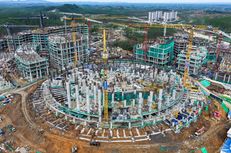
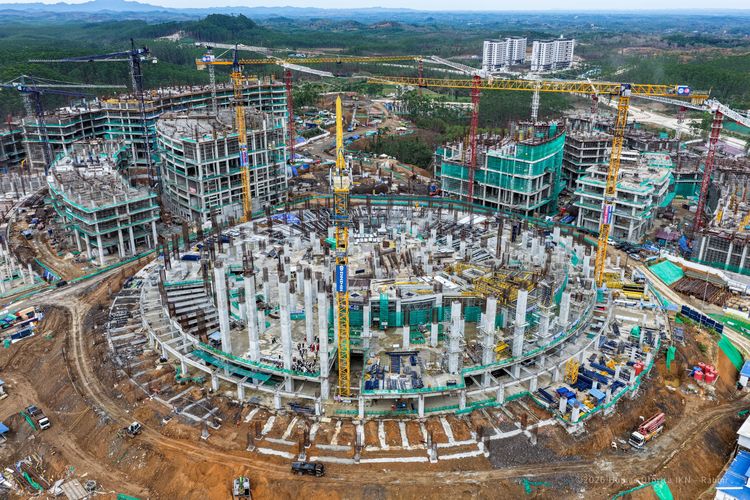
Moreover, at the same time, OIKN continues to carry out physical work with government budget support.
Second, the amount of IDR 421 billion should not be directly treated as state losses or unutilized asset value.
It is essential to know how much has been realized, the status of the land and its construction, and whether expenditures have led to physical asset creation. Allocated budgets are not synonymous with spent money.
If there are works or assets that have been built, the government must ensure their utilization.
However, this is an investment and asset management issue, not evidence that the entire IKN development has lost direction.
Another matter that needs clarification is the relationship between physical development and the status relocation of the national capital.
The Constitutional Court's Decision Number 71/PUU-XXIV/2026 dated May 12, 2026, emphasizes this point.
In its considerations, the Court indicated that the relocation of the national capital to IKN depends on the issuance of a Presidential Decision regarding the transfer of the capital from Jakarta to Nusantara.
In other words, physical development of IKN can continue without waiting for the presidential decree for capital relocation.
Conversely, the completion of various buildings and infrastructures does not automatically designate IKN as the national capital legally.
This construction aligns with Article 39 paragraph (1) of Law Number 3 of 2022 on the National Capital, as amended by Law Number 21 of 2023.
This provision affirms that the status, function, and role of the national capital remain in Jakarta until the Presidential Decision on the transfer to IKN is established.
Therefore, the absence of a presidential decree for capital relocation cannot be used as a basis to claim that IKN development has been halted.
Such a decree is related to the enforcement of the capital status relocation, and is not a prerequisite for carrying out any construction work.
The government has the space to continue development while preparing for a gradual relocation decision.
In fact, this approach allows the government to ensure the readiness of infrastructure, institutions, and public services before officially determining the relocation.
Presidential Regulation Number 79 of 2025 still directs IKN's development as the Political Capital by 2028.
This target certainly needs to be translated into practical stages and readiness.
However, as long as there is no decision altering or revoking that policy direction, it is not correct to consider it abandoned merely due to changes in political emphasis.
I also disagree with linking the future of IKN too closely to the figures of a particular president or vice president.