
General Listyo Sigit Refuses to Attend Ethics Hearing Despite Being Detained, What Are the Consequences?
-
News
-
9 minutes ago
This article was translated by AI. Read the original article on Kompas.com. See Original
TWO consecutive days, Kompas.com published two opinion articles questioning the future of the Nusantara Capital City (IKN) development.
The first article, The Fate of IKN After Its Exclusion from the Government Work Plan (25/11/2026), highlighted the changing priorities of Prabowo Subianto's administration, planning uncertainties, and the cancellation of plans to build the Deposit Insurance Corporation (LPS) office in IKN.
The next article, IKN: A Palace Left Before Occupancy (26/11/2026), linked the future of IKN to Gibran Rakabuming Raka's resignation as vice president and the loss of a political figure considered a main supporter of the capital city relocation.
Both pieces provide interesting insights into the political dynamics and development policies.
However, there are several conclusions that I believe need clarification.
A shift in government development priorities does not automatically indicate the cessation of IKN development.
Similarly, the absence of specific mention of IKN in the budget speech or its omission as a separate priority program in the Government Work Plan (RKP) does not necessarily mean that the government has abandoned the project.
We need to differentiate between a change in priority emphasis, adjustments in budget allocations, halting physical construction, and the legal decision to relocate the capital.
These four issues are distinct and should not be conflated.
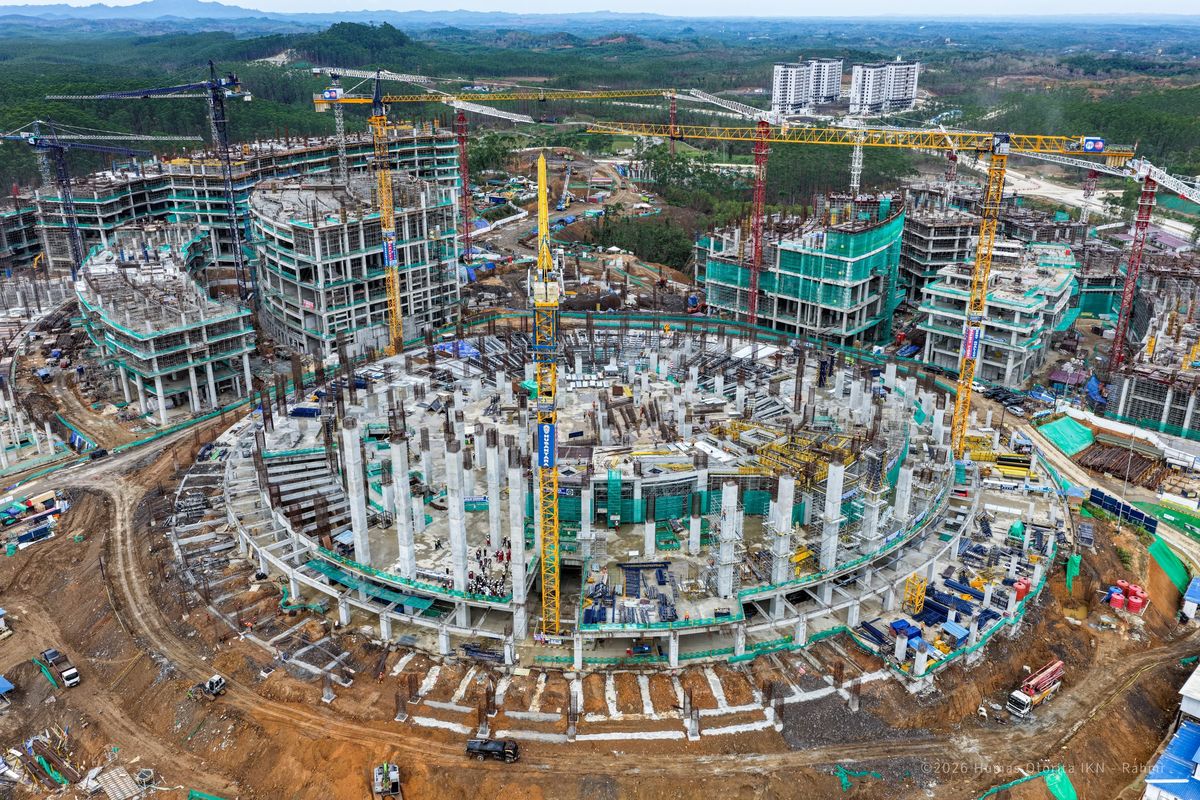
Looking at the budget documents and on-site developments, there is no basis to conclude that the government has halted physical work on IKN.
On January 2, 2026, the Nusantara Capital Authority (OIKN) officially announced that the Budget Implementation List (DIPA) for the 2026 Fiscal Year was issued with an amount of approximately IDR 6 trillion.
The issuance of the DIPA was accompanied by the appointment of treasury officials, including budget users and commitment makers.
This means the OIKN's activities are funded by an officially established fiscal management framework.
In the government's budget, the definitive ceiling for OIKN in 2026 is recorded at IDR 6.262 trillion.
Of this amount, approximately IDR 5.618 trillion is allocated for Strategic Area Development Programs and IDR 644 billion for Management Support Programs.
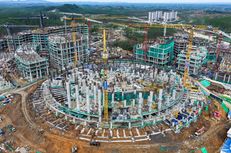
Indeed, the progress of physical projects can be concretely observed.
As of November 15, 2026, OIKN reported that the construction of legislative building and infrastructure has reached an average physical progress of 25.40 percent.
Meanwhile, the judicial area has reached 32.83 percent progress. Construction of retention ponds, road networks, and other supporting infrastructures is also ongoing.
OIKN's July 2026 report even noted that there were 40 physical work packages managed by OIKN, with 15 packages under construction and 16 packages in the bidding preparation stage.
The Ministry of Public Works is also handling 90 physical work packages, with 12 packages still under construction.
This data indicates that IKN development has not stalled.
Physical work continues through the OIKN budget as well as through ministries/agencies according to their mandates and authorities.
For the 2027 fiscal year, the House of Representatives' Commission II on September 16, 2026, approved the definitive ceiling for OIKN at IDR 6.72 trillion.
Additionally, there is a proposal for an additional IDR 15.80 trillion budget which will be discussed further.
This decision also demonstrates that OIKN financing continues to have a place in the national budgeting process.
Therefore, concluding that IKN is being abandoned based only on the absence of specific mention in the presidential address or changes in RKP priorities is a misreading.
I understand that changes in government priorities are a natural part of development administration.
President Prabowo has a different agenda from the previous administration.
The Free Nutritious Meals program, Red and White Village Cooperatives, housing development, and various social service programs require substantial fiscal support.
However, development priorities should not be perceived as mutually exclusive choices.
The government can place greater emphasis on social infrastructure development without having to stop physical infrastructure projects already underway.
Moreover, IKN development is not conducted through a single institution.
OIKN coordinates development, while ministries/agencies implement work according to their functions and responsibilities.
Its financing scheme is also not solely through the state budget; it includes cooperation between the government and business entities as well as private investments.
With such a structure, changes in priorities within an annual planning document do not automatically cancel work contracts, published DIPA, or ongoing development activities.
If the government indeed intends to stop or cancel development, it would need clear administrative decisions and actions, including resolving contractual consequences, assets, and state financial obligations.
To date, I have not found any official government decision stating the total cessation of physical work on IKN.
What needs criticism is how the government ensures that the continuity of development remains measurable, efficient, and accountable.
The first article uses the cancellation of the plan to build the LPS office in IKN as a signal of the government's weakening commitment.
In my view, that decision merits consideration, but it is insufficient evidence to conclude that the IKN development has been halted.
The Chairman of the LPS Board of Commissioners, Anggito Abimanyu, explained that his agency has shifted its plan for the office from IKN to Jakarta to align with RKP direction and government priorities.
Previously, the LPS allocated approximately IDR 421 billion for setting up the office in IKN. Now, it proposes around IDR 1.46 trillion for office procurement in Jakarta.
There are two important points to note.
First, the LPS decision is an institutional one regarding its headquarters' location and needs.
Anggito's statement regarding adjustments to the RKP cannot be immediately interpreted as a governmental decision to halt IKN development.
Moreover, at the same time, OIKN continues to carry out physical work with government budget support.
Second, the amount of IDR 421 billion should not be directly treated as state losses or unutilized asset value.
It is essential to know how much has been realized, the status of the land and its construction, and whether expenditures have led to physical asset creation. Allocated budgets are not synonymous with spent money.
If there are works or assets that have been built, the government must ensure their utilization.
However, this is an investment and asset management issue, not evidence that the entire IKN development has lost direction.
Another matter that needs clarification is the relationship between physical development and the status relocation of the national capital.
The Constitutional Court's Decision Number 71/PUU-XXIV/2026 dated May 12, 2026, emphasizes this point.
In its considerations, the Court indicated that the relocation of the national capital to IKN depends on the issuance of a Presidential Decision regarding the transfer of the capital from Jakarta to Nusantara.
In other words, physical development of IKN can continue without waiting for the presidential decree for capital relocation.
Conversely, the completion of various buildings and infrastructures does not automatically designate IKN as the national capital legally.
This construction aligns with Article 39 paragraph (1) of Law Number 3 of 2022 on the National Capital, as amended by Law Number 21 of 2023.
This provision affirms that the status, function, and role of the national capital remain in Jakarta until the Presidential Decision on the transfer to IKN is established.
Therefore, the absence of a presidential decree for capital relocation cannot be used as a basis to claim that IKN development has been halted.
Such a decree is related to the enforcement of the capital status relocation, and is not a prerequisite for carrying out any construction work.
The government has the space to continue development while preparing for a gradual relocation decision.
In fact, this approach allows the government to ensure the readiness of infrastructure, institutions, and public services before officially determining the relocation.
Presidential Regulation Number 79 of 2025 still directs IKN's development as the Political Capital by 2028.
This target certainly needs to be translated into practical stages and readiness.
However, as long as there is no decision altering or revoking that policy direction, it is not correct to consider it abandoned merely due to changes in political emphasis.
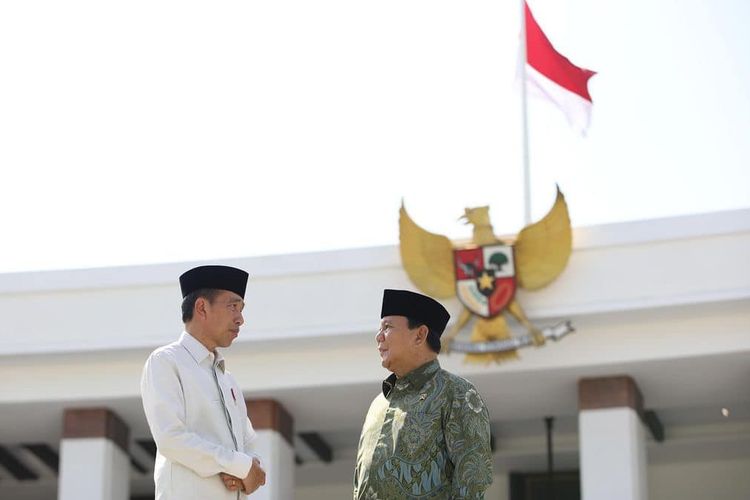 Joko Widodo and Prabowo Subianto
I also disagree with linking the future of IKN too closely to the figures of a particular president or vice president.
It is undeniable that the development of IKN gained significant political acceleration during Joko Widodo's administration.
Similarly, Gibran has, during his vice presidency, expressed his support for the continuation of IKN development.
However, the construction of the national capital has a legal foundation, presidential regulations, master plans, budgeting documents, and government activities involving multiple ministries and agencies.
The status of this project does not solely depend on the will or political interest of a single individual.
Linking the future of IKN to whether the successor vice president is willing to occupy the Vice Presidential Palace oversimplifies the issue.
Office arrangement is part of governmental organization, while sustained development is a broader state responsibility.
The vice president is not the sole determinant of the success of the capital relocation.
There is also the president, ministries/agencies, OIKN, DPR, civil service apparatus, local governments, and the public, all of which play their respective roles.
IKN should not be positioned as a personal legacy of Jokowi that must be accepted or rejected by Prabowo.
Government transitions can indeed lead to policy corrections but should not cause strategic state development to be constantly tossed about by the political preferences of its leaders.
While I do not agree with the conclusion that IKN has been abandoned, that does not mean the development should be accepted without scrutiny.
On the contrary, while physical work is still ongoing and national budgets are still allocated, oversight of development effectiveness must be intensified.
The more important question is not merely whether IKN is still being built, but whether every rupiah spent yields corresponding benefits.
The government needs to explain the priorities of completing projects, the preparedness of public service facilities, operational requirements of the region, and the stages of relocating ministries/agencies and civil servants.
Likewise, private investments should be measured by the realized developments and economic activities that are truly operational, not just the value of commitments or cooperation agreements.
City development is not complete when the government buildings are erected.
A capital city needs residents, economic activities, healthcare, education, transportation, and a social ecosystem that enables it to function sustainably.
The government must be more transparent. How much funding is needed to complete the next development phase? What infrastructure is most urgent?
What are the operational and maintenance costs? How much private investment capacity supports regional economic activity? And when can the relocation of ministries/agencies actually take place?
These questions are far more productive than merely speculating if Prabowo still has political commitment to Jokowi's project.
We do not want IKN development to proceed recklessly, just as we do not want strategic state projects halted solely due to a change in government. Development continuity must go hand in hand with evaluation, efficiency, and accountability.
In my view, the issue surrounding IKN today is not about who will inherit or abandon the project.
The question is how the state ensures that the development already set in motion can be completed with better planning, measurable financing, and accountable benefits.
Official data shows that OIKN still possesses DIPA, development budgets remain available, and physical work is ongoing.
Meanwhile, the legal transfer of the capital is still awaiting the Presidential Decision as emphasized in the Court's ruling.
Therefore, the public needs a complete picture. We must avoid perceiving changes in government priority emphasis as halting development while physical work is still ongoing.
Conversely, the presence of budgets and construction activities should not be an excuse to suppress criticism of effective public funds utilization.
The government needs to maintain policy consistency while being brave enough to correct planning that is no longer relevant.
IKN is not the exclusive property of a single president, nor is it a monument for one family or political group.
IKN is a state project whose funding repercussions will be borne by the public.
Building a new capital is not just a bold initiative; its success is measured by the government's ability to complete the development, orderly transfer governmental functions, and make the city functional for the public interest.
Do not misinterpret changes in priorities as halting development. However, do not assume that the sustainability of development guarantees success.