

More Loved After Becoming a Former Leader
-
News
-
35 minutes ago
This article was translated by AI. Read the original article on Kompas.com. See Original

Thus, if he wishes to follow Carter's path, Gibran needs to consider restoring trust by shedding electoral ambitions for a sufficient period.
Negotiating this will indeed require an art of its own.
Secondly, William Benoit's Image Restoration Theory provides that corrective action is the most dignified way out of a reputation crisis.
Carter did not spend the rest of his life giving speeches defending his past policies.
He took concrete corrective actions by eradicating tropical diseases in Africa and building decent housing for vulnerable groups.
In Gibran's case, his decision to resign ahead of impeachment was just the beginning to subdue the crisis.
For his image to recover fully, he would need long-term corrective actions that certainly operate outside government structures.
He needs to implement corrective measures that directly address the root causes of his downfall.
Such corrective actions should not come from verbal clarifications, but from demonstrable work capacity.
Thirdly, Symbolic Non-Verbal Communication. This perspective, rooted in Blumer’s symbolic interactionism and Mehrabian's body language, explains why physical presence and gestures often speak much louder than defense speeches.
Carter sent messages of humility through everyday symbols that contrasted with the opulence of the White House.
He lived in a simple house in Plains. He hammered wood himself in poverty housing projects.
At this point, Gibran stands to have a comparative advantage that Carter lacked when he began his post-presidency chapter at nearly 60 years old. Gibran is still only 39.
Gibran possesses physical flexibility and high mobility that allow him to directly engage with communities without the barriers of protocol.
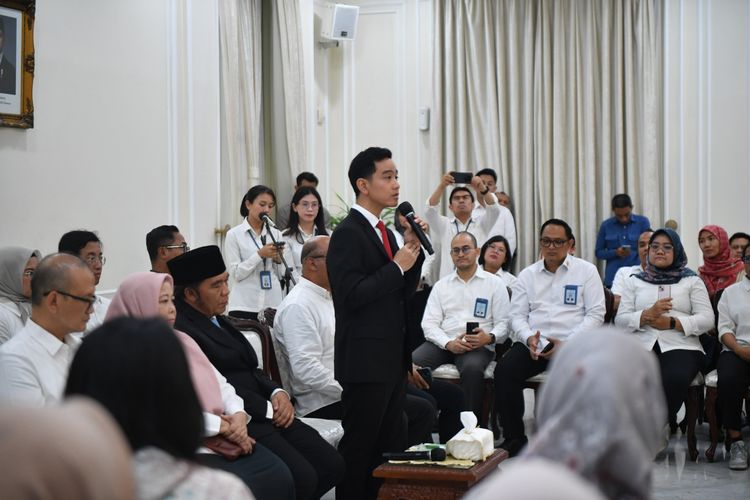
His ability to visit citizens—such as reaching out to victims of the Free Nutritious Meal (MBG) program with calm empathy without saying much or bravely riding a motorcycle through the rain to hard-to-reach areas—represents a powerful symbolic language.
Such grounded gestures effectively break down the psychological distance between elites and the populace.
However, for the symbolism to resonate like Carter’s hammer, there is one essential requirement: it must occur in silence. The choreography of cameras and social media content production teams, which often incite public cynicism, must be kept at bay.
Suggesting Gibran emulate Jimmy Carter's route is sure to upset many. At least three fundamental criticisms might arise.
First, from his supporters, the view may emerge that Gibran is not at fault and merely fell victim to political pressures using legal instruments.
Engaging in image restoration connoting 'atonement' would emphasize Gibran's admission of guilt.
In response, in political communication, the debate surrounding legal truth does not always align with public perception reality.
Pursuing Carter’s path is not entirely an admission of guilt but rather a corrective action strategy to shift his position as a communication subject: from merely a 'victim of circumstance' to a 'statesman sovereign over his own steps.'
Carter also often felt like a victim of the political situations of his time, yet he chose not to waste energy seeking scapegoats.
Here, maintaining calm outside of power proves to be the most rational legitimacy investment for Gibran.
The second criticism concerns differing calibers. Gibran, who has only served two years as vice president, is certainly not in the same league as a U.S. president.
Comparing Gibran with Jimmy Carter is akin to comparing two boxers from different weight classes in the same ring.