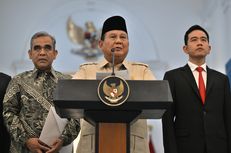


After the Philippines, Prabowo Arrives in China for the APEC Summit
-
News
-
5 minutes ago
This article was translated by AI. Read the original article on Kompas.com. See Original

"Ultimately, the most rational justification for granting wiretapping authority should only be within the scope of law enforcement. We shouldn't take this lightly because wiretapping constitutes a human rights violation," Fickar emphasized.
Aside from determining which institutions have authority, oversight becomes an important issue that must be regulated in the RUU on Wiretapping.
Researcher from Indonesia Corruption Watch (ICW), Seira Tamara, pointed out that the need for a specific wiretapping law has actually been affirmed by the Constitutional Court since 2010.
This refers to Constitutional Court Decision No. 5/PUU-VIII/2010, which asserts that wiretapping procedures should be governed by law.
However, to date, the specific law has yet to be established.
Meanwhile, Article 136, paragraph 2 of the Criminal Procedure Code has now returned to delegate wiretapping regulations to a separate law.
As a result, since January 2026, the Criminal Procedure Code refers to wiretapping regulations that are not yet available.
Seira explained that for nearly 16 years, agencies with wiretapping authority have operated based on their own regulations.
"For nearly 16 years, agencies with wiretapping authority have operated based on their own rules. The standards, duration, and extension mechanisms also vary," Seira stated in her remarks to Kompas.com on Tuesday.
She cited the wiretapping regulations in the police environment, which are governed by the Regulation of the Chief of the Indonesian National Police (Perkap) No. 5 of 2010 concerning Wiretapping Procedures at the Indonesian National Police Monitoring Center.
According to that regulation, the Head of the Criminal Investigation Agency has the authority to request approval for wiretapping operations, while the Monitoring Center is accountable to the Head of Criminal Investigation Agency.
Specifically, Perkap No. 5 of 2010 requires court approval before wiretapping is executed.
Article 6, paragraph 1 stipulates that the Head of Criminal Investigation Agency must submit a request for wiretapping permission to the Chairperson of the District Court after deeming the wiretapping plausible.
Subsequently, Article 6, paragraph 2 affirms that wiretapping operations can only proceed after obtaining that permission.
However, according to Seira, the presence of internal rules alone is insufficient to guarantee that there won't be misuse of authority.
She also highlighted the absence of independent oversight outside of the internal command chain to ensure that every number wiretapped has a legal basis.
According to Seira, this issue is critical since oversight confined within institutions may not be adequate to detect deviations early on.
Therefore, Seira asserts that wiretapping without authorization should be treated as unlawful action and abuse of authority.
She emphasized that issues of illegal wiretapping are not solely related to who is targeted for interception but also concern the protection of constitutional rights for all citizens.
"The issue is not just because the target of it is the Head of State, but because illegal wiretapping represents an assault on democracy, press freedom, and the privacy rights of every citizen guaranteed by Article 28G of the 1945 Constitution," Seira concluded.