

Prabowo Instructs Renovation of All Community Health Centers and Every District to Have a Good Hospital
-
News
-
16 minutes ago
This article was translated by AI. Read the original article on Kompas.com. See Original
The constitution intentionally makes the path difficult. The opinion of the House of Representatives must first gain support from at least two-thirds of the members present in a plenary session attended by no less than two-thirds of the total number of House members.
After that, the House of Representatives must request the Court to examine, adjudicate, and decide on that opinion.
If the Court agrees, the House still has to hold a plenary session to forward the dismissal proposal to the People’s Consultative Assembly, which can then exercise its authority per the requirements outlined in Article 7B. There are no shortcuts.
Impeachment is not a vote of no confidence. In a presidential system, the President and Vice President cannot be removed solely because they lose the majority support of parliament. That is why the 1945 Constitution limits the reasons for dismissal and creates layered procedures.
Politics can open doors. The constitution determines how far it may go.
There is an intriguing paradox. If this issue should someday genuinely enter the mechanism of Article 7B, it will return to the same building: the Constitutional Court, but not the same case.
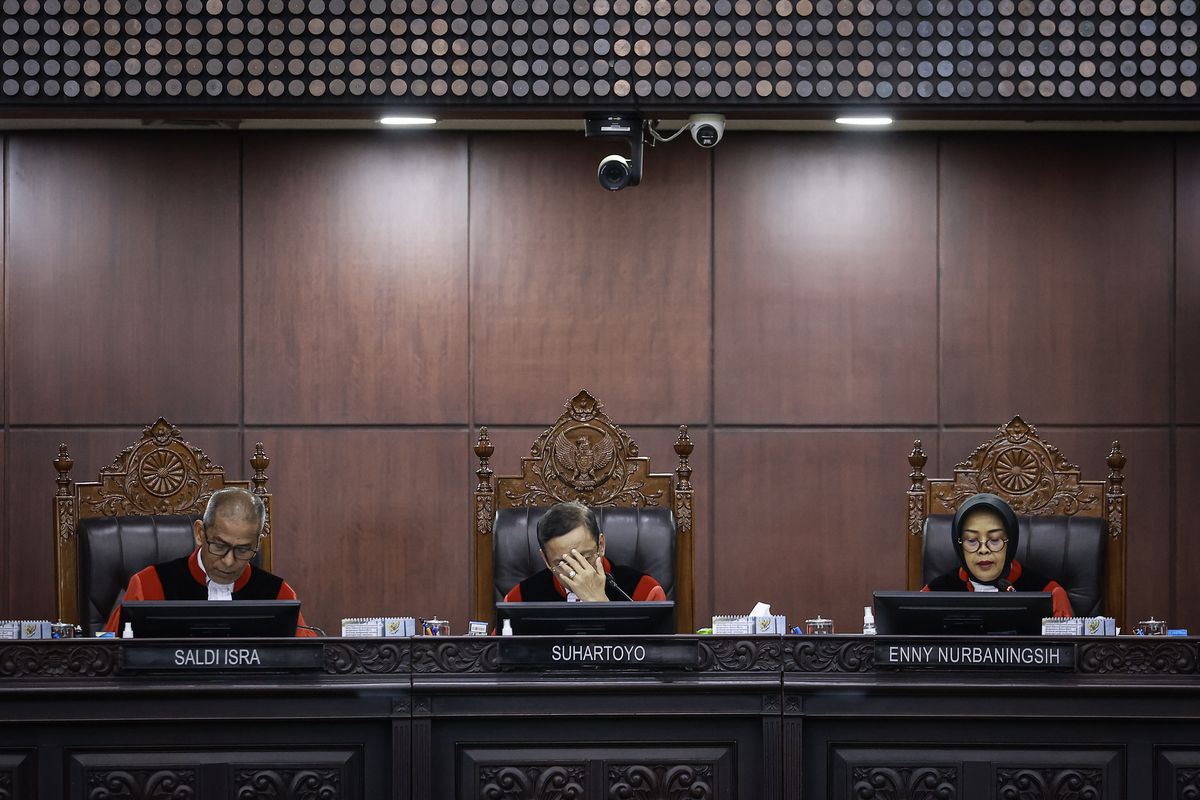
In Decision No. 01/PHPU.PRES-XXIV/2026, the Court faced a case presented through the presidential and vice-presidential PHPU regime.
In Article 7B, the Court performs its constitutional duty to examine the House of Representatives’ opinion regarding allegations of whether grounds for dismissal of the President or Vice President exist.
The individual may be the same. Some facts might overlap. The adjudication is the same. However, the subject, jurisdiction portal, procedures, and constitutional consequences are different.
Thus, the considerations in the current ruling cannot be treated as a dismissal verdict ready for execution.
If the House chooses to use its constitutional authority, it must build its opinion.
If that opinion reaches the Court, then the Court must examine it based on Article 7B, not merely confirm what was previously written in the PHPU case.
The House also needs to answer two fundamental questions: can the issue regarding candidate requirements translate to the issue of requirements as Vice President; and can “no longer meet the requirements” encompass circumstances that were questioned since the candidacy stage?
The answer cannot be obtained merely by counting the number of seats.
The ruling concerning Gibran ultimately reveals one complex issue within our state architecture.
The law clearly outlines the requirements for someone to enter the contest. The constitution also provides mechanisms for dismissing the President or Vice President during their term.
What remains less clear is the bridge between the two.
What happens if issues regarding the fulfillment of requirements at the candidacy stage only gain relevance when the candidate has become an officeholder?
The Court has stated the existence of facts found during the trial. The Court also determined the limits of PHPU: Gibran is no longer a candidate, so the Court cannot disqualify him as Vice President through this case.
At the same time, the Court stated that follow-up on the facts it discovered lies within the realm of the institution empowered by the 1945 Constitution.
Who that institution is remains unspecified. The constitutional consequences of this are also not delineated in the ruling.
Thus, this decision does not provide a basis to assert that Gibran must be dismissed automatically. It is equally incorrect to say the Court has instructed the House of Representatives to initiate impeachment proceedings.
The outcome of this ruling cannot be determined with the metaphor of a “hot potato,” but by answering one constitutional question: can the issue regarding the fulfillment of candidacy requirements, after inauguration, be assessed as an issue of “no longer meeting the requirements” as Vice President according to Article 7A of the 1945 Constitution?
In a rule of law, finding facts, having the authority to evaluate them, and having the authority to render legal consequences are three things that do not always lie within the same institution's jurisdiction.
The ruling is complete. Its constitutional puzzle remains unsolved.

























