

Prabowo Instructs Renovation of All Community Health Centers and Every District to Have a Good Hospital
-
News
-
16 minutes ago
This article was translated by AI. Read the original article on Kompas.com. See Original
This means that “special situation” is not merely a decorative phrase in the consideration. It plays a role in the Court's legal reasoning.
However, it should not be read too broadly. A special circumstance does not automatically create new authority for the Court. The Court continues to operate within the authority granted by the 1945 Constitution and procedural law.
Herein lies the uniqueness of this case. The Court opened review space even though the deadline had passed, evaluated the questioned documents, noted the facts obtained, yet did not carry that assessment to disqualification because the individual in question has changed status from being a candidate to the officeholder.
So, what happens to those facts? The answer lies in the conclusion part of the considerations.
The Court stated that the facts it obtained substantively fall within the realm of “the institution empowered to assess the validity and fulfillment of the requirements for presidential and vice-presidential candidates as stipulated in the 1945 Constitution.”
This consideration employs even more appealing language: “follow-up on the facts discovered by the Court” became the authority of the institutions as defined in the 1945 Constitution. It is here where the decision leaves a mystery.
There are facts that have been discovered. There is follow-up that is mentioned. There is an institution that has authority. However, the name of that institution is not mentioned.
There are no sentences instructing the House of Representatives to take action. There are no directives to the People’s Consultative Assembly. The ruling does not state that the case be forwarded to either of them.
The expression that the Court has “passed the hot potato to the House of Representatives” might be an interesting political metaphor. As a legal description, it is too far reaching.
The Applicants indeed sought more. They requested, among other things, the disqualification, annulment of decisions related to Gibran's candidacy, annulment of his inauguration as Vice President, and an order for the People’s Consultative Assembly to elect a Vice President from the two candidates proposed by the President.
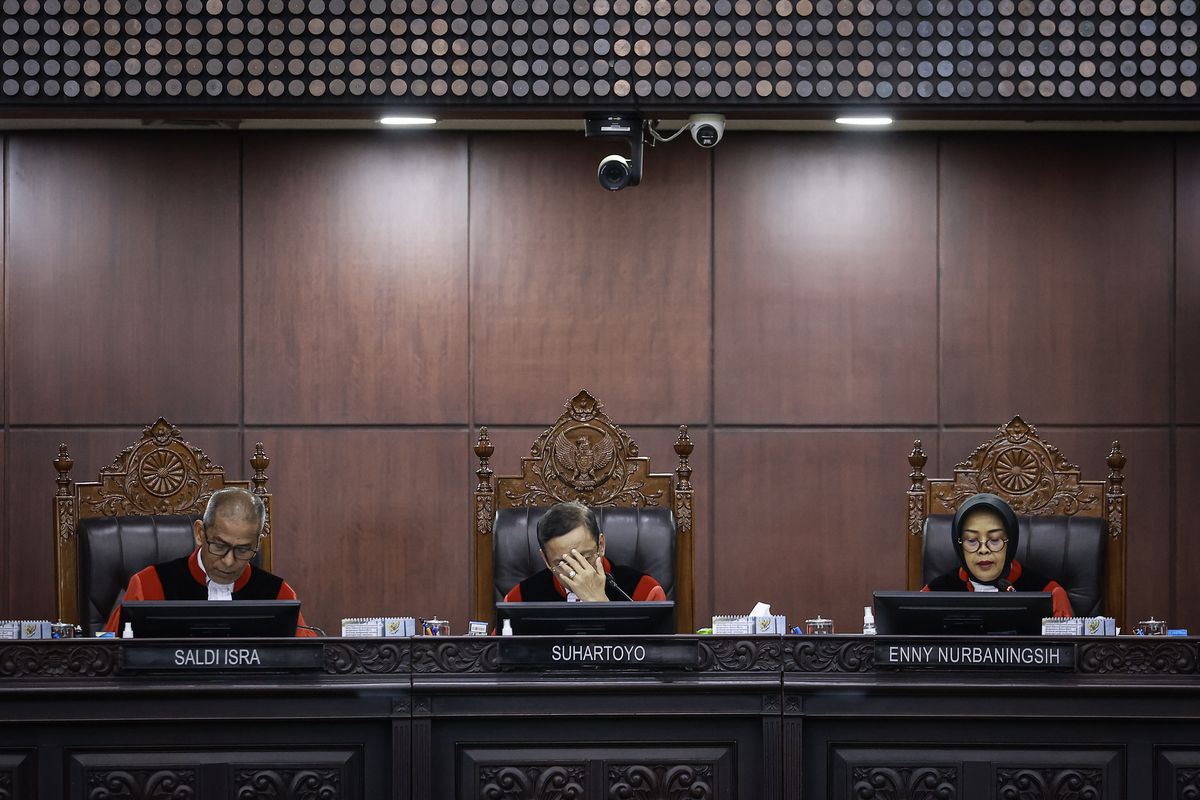
Those requests did not become part of the ruling. The Court only granted the Respondent's exception concerning legal standing, rejected the Respondent's and Related Party's exceptions aside from that, and then declared the Applicants' request inadmissible. This is the ruling of the Court.
Therefore, the question is not whether the Court has ordered the House of Representatives. The answer is clear: no.
The more challenging question is who can constitutionally provide a legal interpretation regarding the facts recorded by the Court after the status of the candidate changed to that of an officeholder.
Here, the issue becomes even more complicated. The Court’s ruling speaks about “the legality and fulfillment of the requirements for presidential and vice-presidential candidates.”
Article 7A of the 1945 Constitution uses a different construction. The President and/or Vice President may be dismissed if they meet the category of reasons defined by the constitution, including if it is proven that they “no longer meet the requirements as President and/or Vice President.”
One addresses candidate requirements. The other addresses the criteria for an officeholder. The two cannot simply be equated.
The constitutional question lies precisely in four words: “no longer meet the requirements.” What does “no longer” mean?
Grammatically, the phrase can be read simply: someone initially meets the requirements, then due to a circumstance does not meet them anymore.
However, what if the issue is different? What if after someone is in office, questions arise regarding the requirements that should have been fulfilled when they were still a candidate? Can Article 7A cover this?
Decision No. 01/PHPU.PRES-XXIV/2026 does not answer that question. The 1945 Constitution also does not explicitly regulate it.
Interpretation that only considers changing circumstances post-inauguration leaves questions regarding how the constitution deals with issues of requirements that are only uncovered once someone has assumed office.
Conversely, broadening Article 7A so that any past candidacy dispute can be resurrected as a reason for dismissal also poses serious issues.
Elections require finality. Constitutional positions need certainty. However, the requirements to hold an office are not meant to lose their significance the moment the oath is taken.
Finding a balance among the three is the task of constitutional interpretation.
If the phrase “the institution empowered” is read systematically alongside the 1945 Constitution, Articles 7A and 7B become hard to evade references.
However, that is an interpretation of the ruling, not a statement from the Court that the House of Representatives is obliged to utilize those two articles.
Article 7B places the assessment concerning alleged non-fulfillment of presidential or vice-presidential requirements within the supervisory function of the House of Representatives. The House of Representatives cannot directly bring a Vice President to the People’s Consultative Assembly.

























