

Prabowo Instructs Renovation of All Community Health Centers and Every District to Have a Good Hospital
-
News
-
16 minutes ago
This article was translated by AI. Read the original article on Kompas.com. See Original
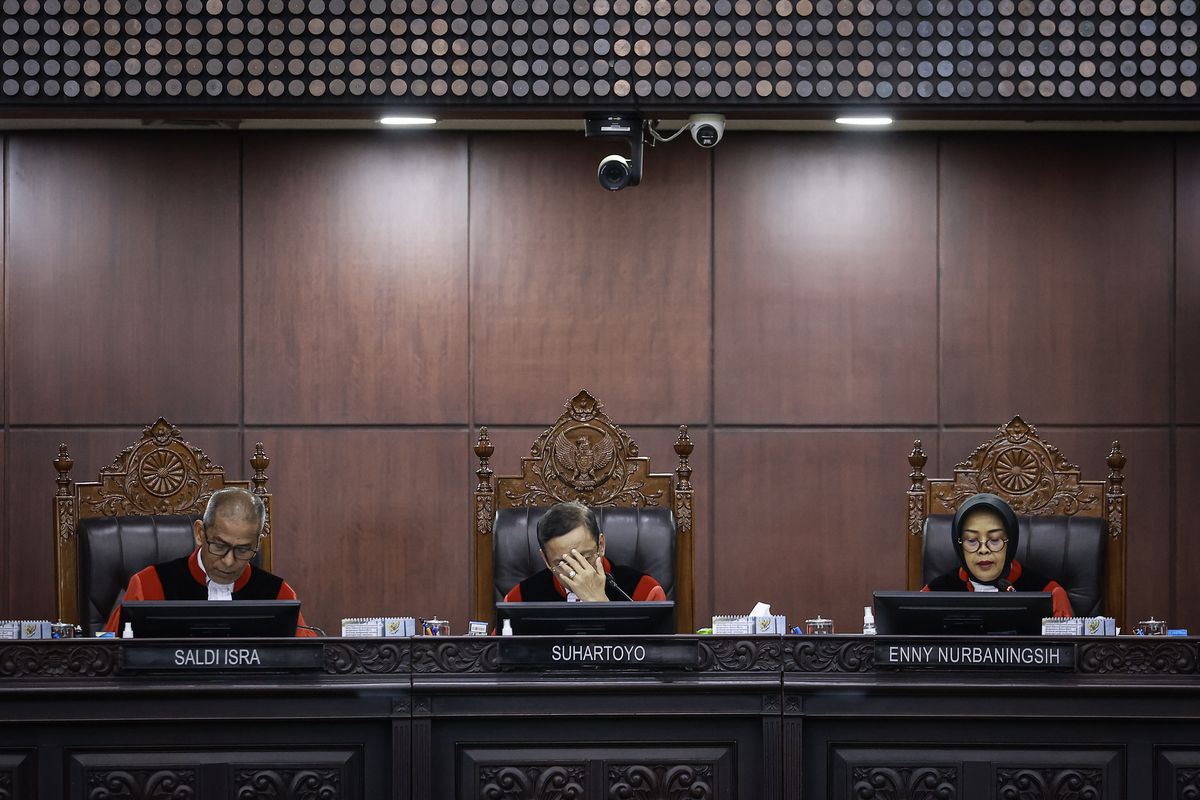
DECISION of the court typically culminates in a verdict. Disputes are decided, parties leave the courtroom, and the law provides certainty regarding the consequences that must be fulfilled.
The Constitutional Court's Decision Number 01/PHPU.PRES-XXIV/2026 regarding the educational qualifications of Gibran Rakabuming Raka is not so straightforward.
The case is indeed concluded. The request was declared inadmissible because the Applicants did not have legal standing.
However, before reaching this conclusion, the Court conducted a substantive assessment of the questioned facts and documents.
In its consideration, the Constitutional Court expressed confidence regarding the existence of a “special situation.”
During the hearings, the Court did not find or obtain convincing evidence indicating that Gibran possessed a diploma, certificate, or foreign degree that could be equated with the lowest education level as mentioned in Article 169 letter r and Article 227 letter l of the Election Law.
Nevertheless, the Court did not take that assessment to the point of disqualification. There was a change in status that was decisive: Gibran was no longer a presidential candidate. Since October 20, 2024, he has been inaugurated and sworn in as Vice President.
The case is closed. The constitutional issue remains uncertain.
A presidential candidate and the Vice President can be the same individual, but they are in different legal standings. The former is on the path to power, while the latter has already attained it.
This distinction determines the legal regime in play. While someone is still a candidate, the validity of their candidacy is within the framework of electoral law.
After inauguration, they hold a constitutional position whose removal process is governed by the 1945 Constitution. This is the line drawn by the Court.
The Constitutional Court stated that the issues raised by the Applicants are substantively no longer appropriate to be included within the regime of presidential and vice-presidential election result disputes.
Gibran’s status as a candidate ended when he was inaugurated and sworn in as Vice President on October 20, 2024. That inauguration also marked the conclusion of the 2024 presidential election stages.
Thus, even though the hearings did not find or obtain convincing evidence about foreign education documents as mentioned by the Court, it ruled that it could not annul or disqualify Gibran in his position as Vice President.
Here, it is important to distinguish between identifying legal issues and having the authority to render legal consequences regarding those issues. The court works with both.
Before reaching that boundary, the Court provided an important assessment of the documents used in the candidacy.
The Court assessed Letter Number 9149/D.D1/KS/2019 has procedurally met the requirements of the Education and Culture Ministerial Regulation. However, the Court did not stop at its procedural validity.
According to the Court, the letter represents equivalence in knowledge equivalent to completing vocational school, not equivalence to high school diplomas or their foreign equivalents, which were not factually found in the trial examination. This distinction is crucial.
The Court stated that the phrase “assessed to have equivalent knowledge” is not the same as “having at least completed high school” as stipulated in Article 169 letter r of the Election Law.
The latter should be proven by possession of a diploma, certificate, or degree, not merely an assessment of knowledge equivalence.
This ruling does not imply that Gibran forged his diploma, nor does it state he never attended the education he claims.
The Court's conclusion is much more specific: no convincing evidence was found or obtained regarding degrees, certificates, or foreign diplomas that could serve as a basis for equivalence as referred to in the Election Law.
The accuracy in interpreting statements like this is of utmost importance. In a court ruling, one extra word can lead to an entirely different legal conclusion.
Another intriguing aspect of this ruling is the issue of the timeframe. The request was submitted on September 10, 2026.
Meanwhile, the deadline for submitting PHPU for the 2024 presidential election, according to the provisions referenced by the Court, had already passed on March 23, 2024, at midnight. The difference is more than two years.
However, the Court did not accept the exception regarding the timeframe. In its consideration, the Court stated that even though the request was submitted past the established deadline, this situation could be justified due to a special circumstance/event and the principle of ius curia novit.
Therefore, the exception regarding the timeframe was declared legally unfounded.
This means that “special situation” is not merely a decorative phrase in the consideration. It plays a role in the Court's legal reasoning.
However, it should not be read too broadly. A special circumstance does not automatically create new authority for the Court. The Court continues to operate within the authority granted by the 1945 Constitution and procedural law.
Herein lies the uniqueness of this case. The Court opened review space even though the deadline had passed, evaluated the questioned documents, noted the facts obtained, yet did not carry that assessment to disqualification because the individual in question has changed status from being a candidate to the officeholder.
So, what happens to those facts? The answer lies in the conclusion part of the considerations.
The Court stated that the facts it obtained substantively fall within the realm of “the institution empowered to assess the validity and fulfillment of the requirements for presidential and vice-presidential candidates as stipulated in the 1945 Constitution.”
This consideration employs even more appealing language: “follow-up on the facts discovered by the Court” became the authority of the institutions as defined in the 1945 Constitution. It is here where the decision leaves a mystery.
There are facts that have been discovered. There is follow-up that is mentioned. There is an institution that has authority. However, the name of that institution is not mentioned.
There are no sentences instructing the House of Representatives to take action. There are no directives to the People’s Consultative Assembly. The ruling does not state that the case be forwarded to either of them.
The expression that the Court has “passed the hot potato to the House of Representatives” might be an interesting political metaphor. As a legal description, it is too far reaching.
The Applicants indeed sought more. They requested, among other things, the disqualification, annulment of decisions related to Gibran's candidacy, annulment of his inauguration as Vice President, and an order for the People’s Consultative Assembly to elect a Vice President from the two candidates proposed by the President.
Those requests did not become part of the ruling. The Court only granted the Respondent's exception concerning legal standing, rejected the Respondent's and Related Party's exceptions aside from that, and then declared the Applicants' request inadmissible. This is the ruling of the Court.
Therefore, the question is not whether the Court has ordered the House of Representatives. The answer is clear: no.
The more challenging question is who can constitutionally provide a legal interpretation regarding the facts recorded by the Court after the status of the candidate changed to that of an officeholder.
Here, the issue becomes even more complicated. The Court’s ruling speaks about “the legality and fulfillment of the requirements for presidential and vice-presidential candidates.”
Article 7A of the 1945 Constitution uses a different construction. The President and/or Vice President may be dismissed if they meet the category of reasons defined by the constitution, including if it is proven that they “no longer meet the requirements as President and/or Vice President.”
One addresses candidate requirements. The other addresses the criteria for an officeholder. The two cannot simply be equated.
The constitutional question lies precisely in four words: “no longer meet the requirements.” What does “no longer” mean?
Grammatically, the phrase can be read simply: someone initially meets the requirements, then due to a circumstance does not meet them anymore.
However, what if the issue is different? What if after someone is in office, questions arise regarding the requirements that should have been fulfilled when they were still a candidate? Can Article 7A cover this?
Decision No. 01/PHPU.PRES-XXIV/2026 does not answer that question. The 1945 Constitution also does not explicitly regulate it.
Interpretation that only considers changing circumstances post-inauguration leaves questions regarding how the constitution deals with issues of requirements that are only uncovered once someone has assumed office.
Conversely, broadening Article 7A so that any past candidacy dispute can be resurrected as a reason for dismissal also poses serious issues.
Elections require finality. Constitutional positions need certainty. However, the requirements to hold an office are not meant to lose their significance the moment the oath is taken.
Finding a balance among the three is the task of constitutional interpretation.
If the phrase “the institution empowered” is read systematically alongside the 1945 Constitution, Articles 7A and 7B become hard to evade references.
However, that is an interpretation of the ruling, not a statement from the Court that the House of Representatives is obliged to utilize those two articles.
Article 7B places the assessment concerning alleged non-fulfillment of presidential or vice-presidential requirements within the supervisory function of the House of Representatives. The House of Representatives cannot directly bring a Vice President to the People’s Consultative Assembly.
The constitution intentionally makes the path difficult. The opinion of the House of Representatives must first gain support from at least two-thirds of the members present in a plenary session attended by no less than two-thirds of the total number of House members.
After that, the House of Representatives must request the Court to examine, adjudicate, and decide on that opinion.
If the Court agrees, the House still has to hold a plenary session to forward the dismissal proposal to the People’s Consultative Assembly, which can then exercise its authority per the requirements outlined in Article 7B. There are no shortcuts.
Impeachment is not a vote of no confidence. In a presidential system, the President and Vice President cannot be removed solely because they lose the majority support of parliament. That is why the 1945 Constitution limits the reasons for dismissal and creates layered procedures.
Politics can open doors. The constitution determines how far it may go.
There is an intriguing paradox. If this issue should someday genuinely enter the mechanism of Article 7B, it will return to the same building: the Constitutional Court, but not the same case.
In Decision No. 01/PHPU.PRES-XXIV/2026, the Court faced a case presented through the presidential and vice-presidential PHPU regime.
In Article 7B, the Court performs its constitutional duty to examine the House of Representatives’ opinion regarding allegations of whether grounds for dismissal of the President or Vice President exist.
The individual may be the same. Some facts might overlap. The adjudication is the same. However, the subject, jurisdiction portal, procedures, and constitutional consequences are different.
Thus, the considerations in the current ruling cannot be treated as a dismissal verdict ready for execution.
If the House chooses to use its constitutional authority, it must build its opinion.
If that opinion reaches the Court, then the Court must examine it based on Article 7B, not merely confirm what was previously written in the PHPU case.
The House also needs to answer two fundamental questions: can the issue regarding candidate requirements translate to the issue of requirements as Vice President; and can “no longer meet the requirements” encompass circumstances that were questioned since the candidacy stage?
The answer cannot be obtained merely by counting the number of seats.
The ruling concerning Gibran ultimately reveals one complex issue within our state architecture.
The law clearly outlines the requirements for someone to enter the contest. The constitution also provides mechanisms for dismissing the President or Vice President during their term.
What remains less clear is the bridge between the two.
What happens if issues regarding the fulfillment of requirements at the candidacy stage only gain relevance when the candidate has become an officeholder?
The Court has stated the existence of facts found during the trial. The Court also determined the limits of PHPU: Gibran is no longer a candidate, so the Court cannot disqualify him as Vice President through this case.
At the same time, the Court stated that follow-up on the facts it discovered lies within the realm of the institution empowered by the 1945 Constitution.
Who that institution is remains unspecified. The constitutional consequences of this are also not delineated in the ruling.
Thus, this decision does not provide a basis to assert that Gibran must be dismissed automatically. It is equally incorrect to say the Court has instructed the House of Representatives to initiate impeachment proceedings.
The outcome of this ruling cannot be determined with the metaphor of a “hot potato,” but by answering one constitutional question: can the issue regarding the fulfillment of candidacy requirements, after inauguration, be assessed as an issue of “no longer meeting the requirements” as Vice President according to Article 7A of the 1945 Constitution?
In a rule of law, finding facts, having the authority to evaluate them, and having the authority to render legal consequences are three things that do not always lie within the same institution's jurisdiction.
The ruling is complete. Its constitutional puzzle remains unsolved.

























