

Prabowo Gathers Gerindra Cadres in Hambalang, Dasco and KDM Attend
-
News
-
1 hour ago
This article was translated by AI. Read the original article on Kompas.com. See Original
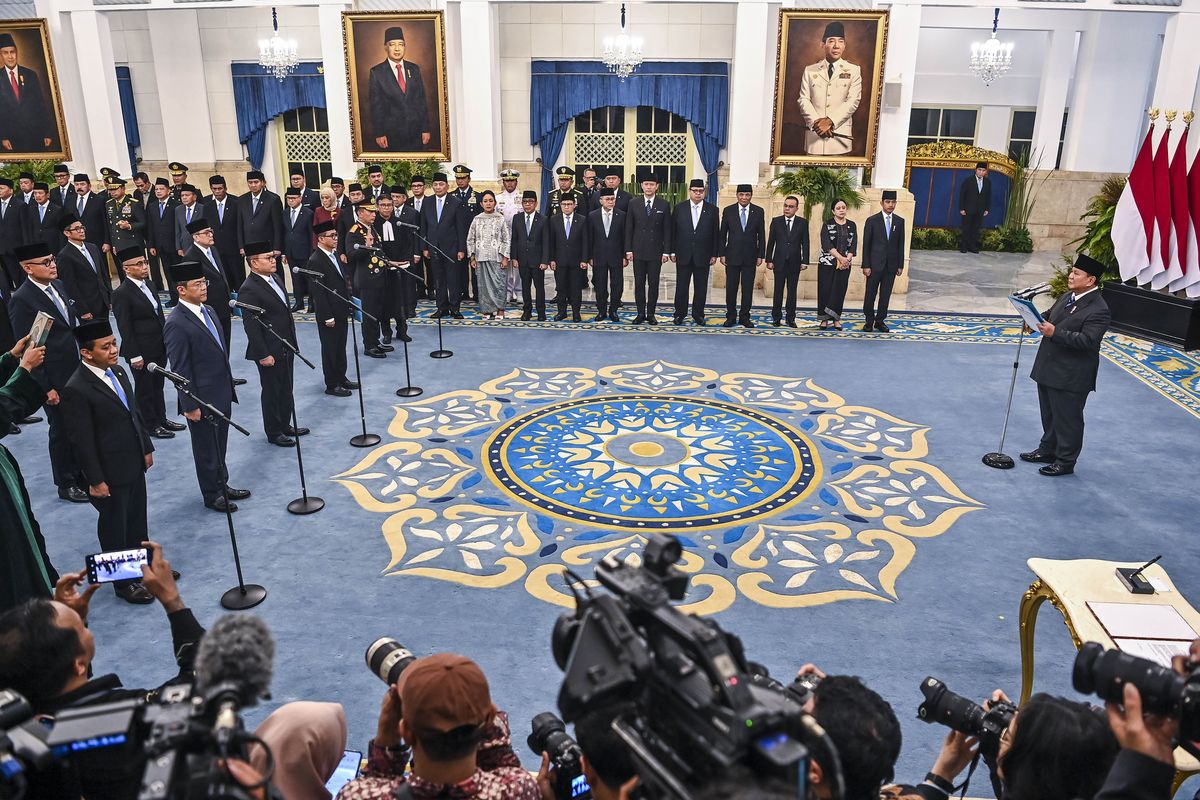
Within the big tent he has erected, Prabowo positions himself as the "living ideology" of his administration.
No longer do factions operate on the basis of their respective party manifestos; all elements must align their narratives to a single primary command from the President.
Interestingly, in Prabowo's politics of magnanimity, there is no guarantee that friendly camaraderie will last.
Looking at precedents over the past two years of his leadership, Prabowo has not hesitated to act as a "ruthless king."
The phenomenon of sudden dismissals of close associates and political allies, even allowing trusted figures to be caught up in legal issues (KPK/Prosecutor's Office), evidences the supremacy of 'abundance mentality' from another angle.
Prabowo seems to feel blessed with electoral mandates and full public trust.
He appears never to feel a shortage of replacement figures for those he dismisses.
His generosity in distributing positions is balanced with firmness in punishing those who fail in executing missions or tarnishing the moral legitimacy of the regime.
Once again, this is done because the queue of replacement figures under his big tent is still perceived as very abundant.
Although it provides political stability, at least in the short term, the politics of magnanimity has its weaknesses.
Excessive politics of magnanimity can trigger serious systemic challenges.
First, the logical consequence of embracing all factions is the bloating of the cabinet.
The creation of new ministries and agencies for political accommodation can significantly drain fiscal space.
Ultimately, this triggers inefficiencies and budget deficits amid calls for financing national mega-project programs.
Second, an overly bloated and heterogeneous cabinet prolongs bureaucratic chains which can trigger overlapping authorities. This risks slowing down tactical decision-making.
Third, erosion of meritocracy and credibility can become a threat.
When public offices are distributed as compensation to quell public criticism, the quality of governance risks declining due to the placement of figures that do not match their competencies (mismatch).
Fourth, gathering figures across ideologies with a history of past conflicts under one roof potentially shifts confrontations from the public sphere to the internal cabinet environment.
In a worst-case scenario, this could lead to various excesses, such as policy sabotage or leakage of information.
To prevent Prabowo's politics of magnanimity from resulting in chronic government dysfunction, he needs to enforce objective and transparent performance metrics for every new ministry/agency resulting from accommodation.
Rigid performance contracts need to be implemented. In the future, opportunities for cabinet reshuffles based on performance—not for political accommodation—should be wide open.
Under the abundance of political magnanimity, internal budget efficiency becomes far more crucial.
The President needs to ensure that the operational costs of a bloated cabinet do not sacrifice public spending budget positions.
Herein lies the President's ability to balance the greatness of spirit of a patron with the decisiveness of a commander in maintaining the rhythm of the state bureaucracy is being tested.