

Prabowo Gathers Gerindra Cadres in Hambalang, Dasco and KDM Attend
-
News
-
1 hour ago
This article was translated by AI. Read the original article on Kompas.com. See Original
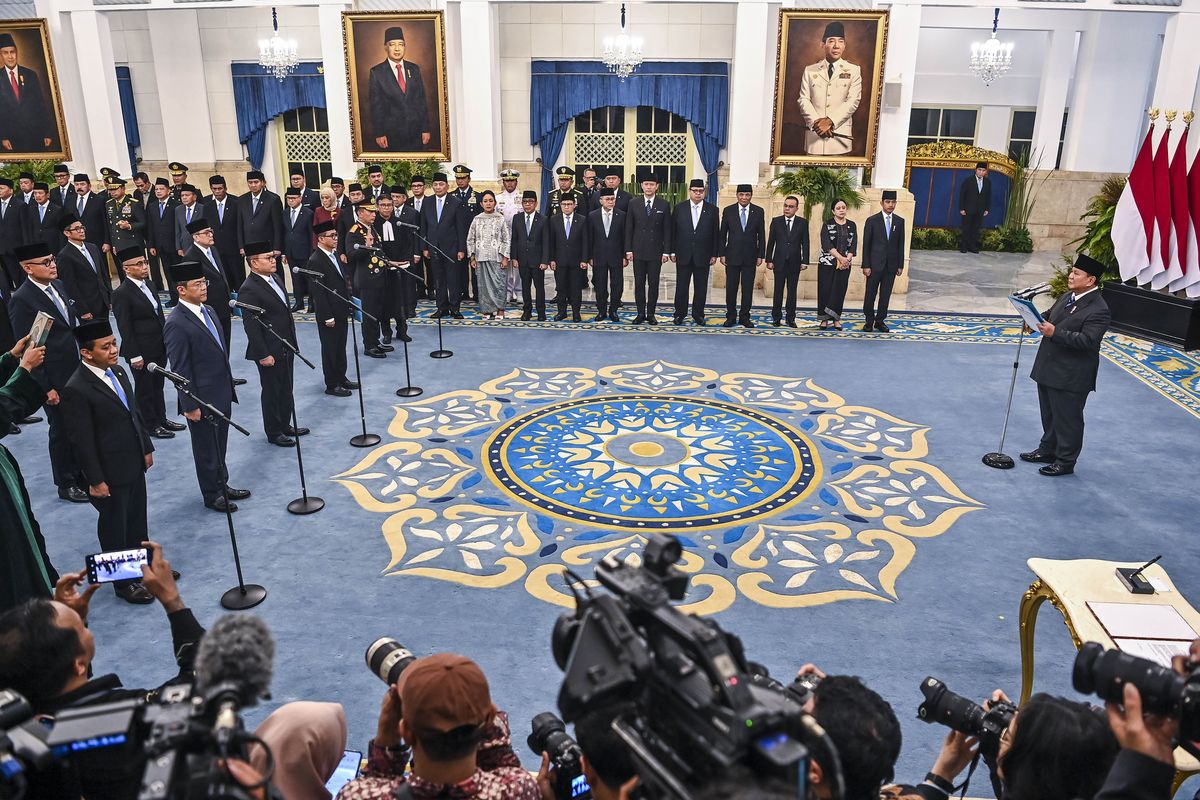
RESHUFFLE of the cabinet multiple times in the two years of President Prabowo Subianto's administration has drawn the attention of political observers.
Many aspects invite interpretation. On one hand, this constant reshuffling displays an aggressive consolidation of power.
On the other hand, the high frequency of filling positions cannot be separated from a political accommodation mode or large-scale "power-sharing."
This essay aims to elaborate on this latter aspect as a practice of political magnanimity.
Etimologically, 'magnanimity' derives from the Latin words 'magnus' (great) and 'animus' (spirit), which literally means greatness of spirit.
In actions and policies, it manifests as generosity, willingness, and pleasure in giving, including extending forgiveness.
In the political realm, 'political magnanimity' is implemented in the form of embracing, accommodating, and even offering political protection to opposing elements.
Instead of carrying out purges or political revenge against opponents, 'political magnanimity' fosters great tolerance and provides honorable places for adversaries or critics.
This essay departs from the premise that Prabowo's politics of magnanimity, as reflected in the cabinet reshuffle—especially bringing radical critics into the palace circle—is rooted in an abundance mentality he inherited from his family and showcased since his youth.
However, at the same time, political magnanimity is also a necessity in the face of political challenges in the era of disruption.
To briefly explain this, the essay employs a Psychohistorical approach from the realm of Political Science and Attribution Theory from the field of Communication Studies.
Psychohistory connects public policies, leadership styles, and the actions of a figure with his personal background, such as parental upbringing, family values, and the social environment in which he grew up.
Similar to Psychohistory, Attribution Theory in communication shows how humans explain someone's actions and behaviors by attributing them to one of two attributions: internal attribution and external attribution.
Internal attribution is a way of thinking that concludes a person's behavior is caused by factors within themselves, such as personality, character, talent, beliefs, motivation, or their past.
External/situational attribution, conversely, views someone's behavior as a result of their surrounding situations, environment, social pressures, or chance events.
Using the Psychohistorical and Attribution Theory approaches, the cabinet reshuffle and the distribution of power seats carried out by Prabowo can be seen as a politics of magnanimity with an abundance mentality as its root.
The abundance mentality is a term coined by Stephen Covey, meaning a mindset or paradigm where one believes that everything in the world—such as resources, opportunities, success, attention, and happiness—is abundantly available and more than enough for everyone.
This mindset causes one to focus on opportunities, believing that others' success does not diminish their own, enjoying sharing, and being oriented towards win-win solutions in social and political interactions.
A political leader with this mentality sees power, influence, and resources not as a limited 'cake' that will run out when shared (‘scarcity mentality’), but as something that is always enough for everyone.
Based on Prabowo's political views, his childhood history, family background, and testimonies from his friends, he tends to adopt an abundance mentality.
People who know him, such as Irfan Wahid (Ipang Wahid) in an interview, have expressed this aspect of his abundance mentality.
Ipang Wahid testified that Prabowo is a leader who is very easily moved, emotionally touched, enjoys feeding ants, and is generous.
This personal character of generosity has been publicly revealed on several occasions.
For example, the Indonesian public was captivated by Prabowo's spontaneous act of gifting a luxury Rolex watch to all players and coaching staff of the Indonesia National Football Team after a crucial victory in World Cup qualifiers.
The palace confirmed that the fantastic gift came purely from Prabowo's personal funds, not using state budget.
Long before becoming president, while still active in the military, this trait of abundance was also manifested in his concern for human resources.
Prabowo was known to often finance and bring potential TNI cadres from remote areas to continue their higher education in Jakarta, even sending the best cadets abroad to improve their qualifications.
As the son of the economic sage, Prof. Sumitro Djojohadikusumo, Prabowo was raised in an upper-class environment, both economically and intellectually.
Prabowo has repeatedly emphasized the importance of family upbringing in an individual's personality growth.
In a speech, he stated that higher education does not guarantee the quality of a person's success (citing ESDM Minister Bahlil Lahaladia, who is not a graduate of prestigious universities but has succeeded), rather it is the education and values instilled by parents that determine one’s core nature.
The traces of Prabowo's abundance mentality can be traced back to the same mentality that characterizes the Djojohadikusumo family.
The Djojohadikusumo family has a long history of viewing privilege, networks, and capital not as something to hoard for personal comfort, but as instruments for struggle.
Prof. Sumitro Djojohadikusumo's role as a 'maecenas' (large benefactor and facilitator) for various political movements, even opening paths and relations with the Ford Foundation to send young Indonesian economists abroad, is a prime example of pure abundance mentality.
This family environment, which consistently thinks on a macro scale and prioritizes public interests, has shaped Prabowo's thinking horizons since childhood, as testified by peers.
This is recorded in Catatan Seorang Demonstran by Soe Hok Gie.
Gie, a very critical activist, noted how Prabowo, at a young age, met him with a head full of big ideas for community development through a concept of students going into villages.
Prabowo initiated a movement involving students to descend into villages to assist farmers and the poor.
Gie saw 'Bowo' as a young man whose life horizon was filled with social vision rather than the typical selfish pleasures of his teenage peers.
Although Gie assessed Prabowo as naive and deemed his project poorly planned, his testimony validates the trait of Prabowo's abundance mentality.
Over time, this abundance mentality transformed into more personal actions during Prabowo's education at the Military Academy (Akmil) in Magelang in the early 1970s.
His cadet friends at Akmil often recall how Prabowo loved to host and treat his friends selflessly.
When money for pocket expenses came from his parents, the first thing he did was ensure his fellow comrades—especially those living modestly—would share in the fullness and experience sufficiency.
This abundance mentality can also be detected in the ideological synthesis he poured into his book Paradoks Indonesia.
In that book, Prabowo asserts that Indonesia is a country rich in natural resources.
Macroscopically, he views Indonesia as a vessel of abundance.
Now, as President, he applies the same mindset in political management: attracting all talents under a big tent because he believes the space for political accommodation can always be expanded.
At this point, we can see that the politics of magnanimity is no longer just an internal attribution, but also blends with political needs, or external attribution.
The implementation of politics of magnanimity based on an abundance mentality is no longer a pure act of embodying personal values, but a political strategy to generate tactical gains for the stability of his administration.
Politics of magnanimity is employed to forge absolute loyalty from his team members.
By embracing and providing political protection to opposing elements, Prabowo creates a psychological effect of indebtedness (reciprocity) that locks the loyalty of these elites into the system.
In doing so, he accelerates the consolidation of power. The parliamentary space and streets become relatively calm as the main axes of criticism transform into parts of the government bureaucracy.
At the same time, Prabowo becomes the center of his power. He is building a Prabowo-centric regime.
Within the big tent he has erected, Prabowo positions himself as the "living ideology" of his administration.
No longer do factions operate on the basis of their respective party manifestos; all elements must align their narratives to a single primary command from the President.
Interestingly, in Prabowo's politics of magnanimity, there is no guarantee that friendly camaraderie will last.
Looking at precedents over the past two years of his leadership, Prabowo has not hesitated to act as a "ruthless king."
The phenomenon of sudden dismissals of close associates and political allies, even allowing trusted figures to be caught up in legal issues (KPK/Prosecutor's Office), evidences the supremacy of 'abundance mentality' from another angle.
Prabowo seems to feel blessed with electoral mandates and full public trust.
He appears never to feel a shortage of replacement figures for those he dismisses.
His generosity in distributing positions is balanced with firmness in punishing those who fail in executing missions or tarnishing the moral legitimacy of the regime.
Once again, this is done because the queue of replacement figures under his big tent is still perceived as very abundant.
Although it provides political stability, at least in the short term, the politics of magnanimity has its weaknesses.
Excessive politics of magnanimity can trigger serious systemic challenges.
First, the logical consequence of embracing all factions is the bloating of the cabinet.
The creation of new ministries and agencies for political accommodation can significantly drain fiscal space.
Ultimately, this triggers inefficiencies and budget deficits amid calls for financing national mega-project programs.
Second, an overly bloated and heterogeneous cabinet prolongs bureaucratic chains which can trigger overlapping authorities. This risks slowing down tactical decision-making.
Third, erosion of meritocracy and credibility can become a threat.
When public offices are distributed as compensation to quell public criticism, the quality of governance risks declining due to the placement of figures that do not match their competencies (mismatch).
Fourth, gathering figures across ideologies with a history of past conflicts under one roof potentially shifts confrontations from the public sphere to the internal cabinet environment.
In a worst-case scenario, this could lead to various excesses, such as policy sabotage or leakage of information.
To prevent Prabowo's politics of magnanimity from resulting in chronic government dysfunction, he needs to enforce objective and transparent performance metrics for every new ministry/agency resulting from accommodation.
Rigid performance contracts need to be implemented. In the future, opportunities for cabinet reshuffles based on performance—not for political accommodation—should be wide open.
Under the abundance of political magnanimity, internal budget efficiency becomes far more crucial.
The President needs to ensure that the operational costs of a bloated cabinet do not sacrifice public spending budget positions.
Herein lies the President's ability to balance the greatness of spirit of a patron with the decisiveness of a commander in maintaining the rhythm of the state bureaucracy is being tested.