
Witness Admits to Withdrawing IDR 13 Billion Cash After Office Raided in Febrie's Money Laundering Case
-
News
-
7 minutes ago
This article was translated by AI. Read the original article on Kompas.com. See Original
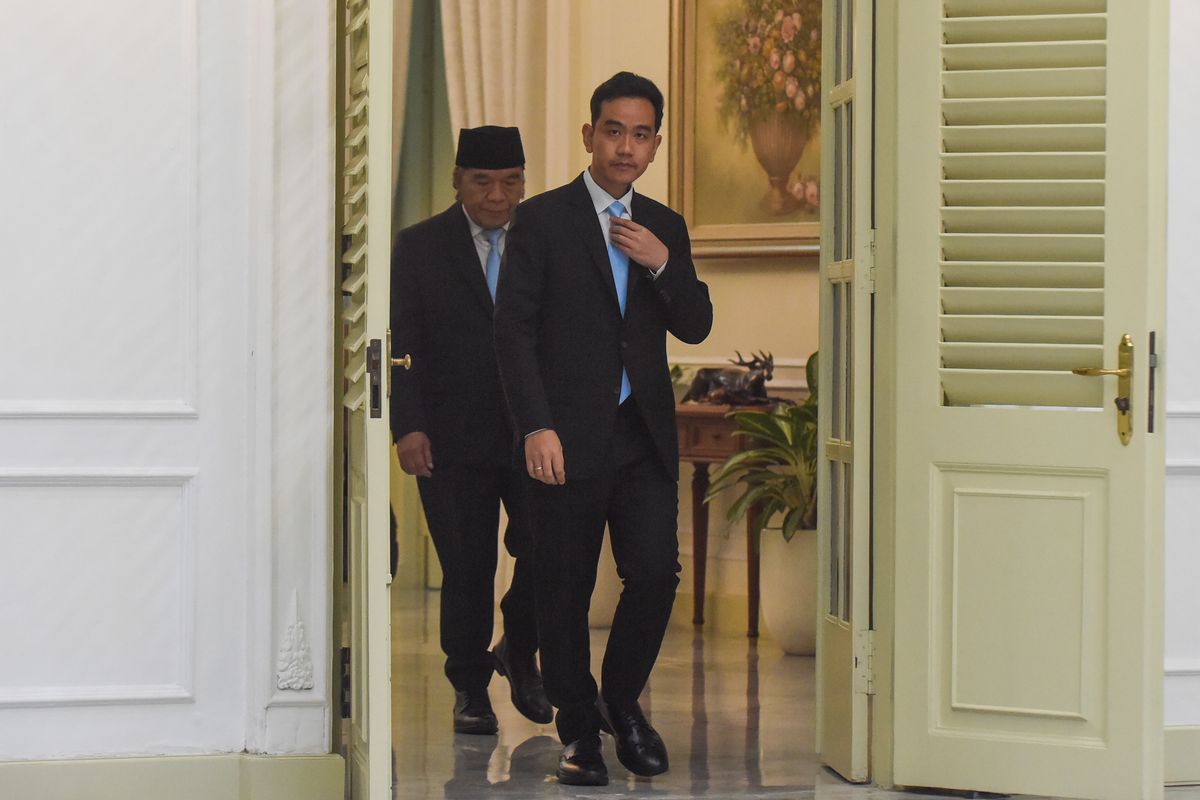
ERRORS in nomination may be discovered after inauguration. However, is that discovery sufficient to terminate a constitutional office?
Two court rulings regarding Gibran Rakabuming Raka's educational documents illustrate the complexity of distinguishing administrative corrections from the termination of authority.
The Constitutional Court ruling No. 01/PHPU.PRES-XXIV/2026 and the Supreme Court ruling No. 742 K/TUN/2026 place this issue within two different legal domains.
The Constitutional Court (MK) examines objections to nomination requirements, while the Supreme Court (MA) tests the validity of the equivalency certificate issued by the government.
Both found issues regarding the evidentiary basis of educational administration. However, neither ruling removed Gibran from his position as vice president.
Herein lies the legal tension. Administrative errors must not be overlooked just because the official has been inaugurated.
Conversely, a constitutional office cannot be terminated through the extended legal consequences of a ruling that addresses a different object.
A rule of law must be bold enough to correct mistakes without losing discipline regarding the limits of authority.
In ruling No. 01/PHPU.PRES-XXIV/2026, the MK examined a petition questioning Gibran's fulfillment of educational requirements when he was a candidate for vice president in the 2024 election.
The examination included statements from electoral organizers, educational authorities, experts, witnesses, and supporting documents.
On pages 372–375, the MK stated that it found no convincing evidence in the form of diplomas, certificates, or foreign educational degrees that could serve as a basis for equivalency with upper secondary education or its equivalent.
The Court distinguished between a certificate of attendance, which indicates presence in educational processes, and documents that prove graduation.
The MK also emphasized that the assessment of equivalent knowledge is not identical to evidence of completion of educational levels.
This distinction is crucial, as Article 169 letter r of the Election Law mandates that presidential and vice-presidential candidates must have at least completed upper secondary education or its equivalent.
However, findings in the considerations did not lead to disqualification.
The MK stated that the status of the vice-presidential candidate ended after the inauguration on October 20, 2024.
The dispute regarding candidacy was no longer appropriately resolved through the election result dispute mechanism. The Court also stated that the petitioners do not have legal standing.
The ruling declared the petition unacceptable.
The distinction between considerations and rulings becomes very important. The MK did not definitively rule that Gibran lacked all required educational qualifications.
The Court stated it did not find convincing evidence in the examination of the case.
That finding has legal significance but should not be extended to a ruling of dismissal that was never issued.
The matter continued through the MA ruling No. 742 K/TUN/2026, decided on October 30, 2026.
The MA annulled the Certificate from the Director General of Primary and Secondary Education No. 9149/D.D1/KS/2019 dated August 6, 2019, and ordered the issuing official to revoke it.
The Court deemed the issuance of the equivalency certificate unsupported by adequate graduation evidence.
This situation was seen as contrary to the principle of diligence in government administration.
This ruling has clear administrative consequences. The certificate, which was the subject of the dispute, loses its validity based on the court's ruling.
However, the equivalency certificate is not a diploma.
A diploma proves the completion of education. An equivalency certificate is an administrative product that explains the equivalence of educational qualifications based on applicable provisions.
Therefore, the cancellation of the equivalency certificate does not equate to the cancellation of a diploma.
The MA also did not annul the KPU's decision regarding the determination of the candidates, the election results, or the inauguration of the vice president.
However, the annulment of the certificate should not be seen as a trivial matter. The insufficiency of graduation evidence that served as its basis touches on substantive issues.
The legal question then shifts: does the defect in the administrative decision simultaneously prove that the educational requirements were not fulfilled at the time of candidacy?
The answer requires separate examination.