

The Fate of IKN After Being Excluded from the Government Work Plan
-
News
-
28 minutes ago
This article was translated by AI. Read the original article on Kompas.com. See Original
PROVERB 'more rafters than posts' seems relevant when assessing the current governance direction.
On one hand, the government calls for budget efficiency; on the other hand, the executive power structure continues to grow through the addition and restructuring of positions.
In fact, a large government does not necessarily equate to an effective government, just as a bloated cabinet does not automatically make the state more agile.
This means we must be wary of expending political energy more on expanding power structures than on strengthening bureaucratic capacity and ensuring that policies serve the public.
In Indonesian politics, the distribution of positions often becomes part of the art of maintaining coalitions. However, as political consolidation becomes more dominant, the boundary between the needs of government organization and political accommodation becomes crucial to question.
Every public position should arise from functional needs, not merely from compromise requirements.
The state is not lacking in seats to fill, but it needs officials capable of making technocratic decisions, solving problems, and being accountable for their performance.
The dynamics of politics in Indonesia seem never-ending. Today's politics is no longer solely an elite or adult consumption matter but has become a part of the public conversation, including school-age children who are exposed to political issues through social media.
The torrent of information makes political decisions and maneuvers increasingly accessible to the public.
On October 20, 2026, the government of President Prabowo Subianto and Vice President Gibran Rakabuming Raka will complete two years since their inauguration on October 20, 2024.
At the start of his administration, Prabowo announced the Red and White Cabinet for the 2024–2029 period, featuring an initial lineup of 7 Coordinating Ministers, 41 ministers, 55 deputy ministers, and five officials at the ministerial level.
As the administration progressed, the structure of executive power continued to develop. Amid calls for budget efficiency, the addition and restructuring of positions occurred through the formation of coordinating ministries, the appointment of special presidential advisors, presidential special staff, and various other supporting positions.
Repeated cabinet reshuffles have altered the composition of officials without necessarily addressing questions regarding the effectiveness of governmental organization.
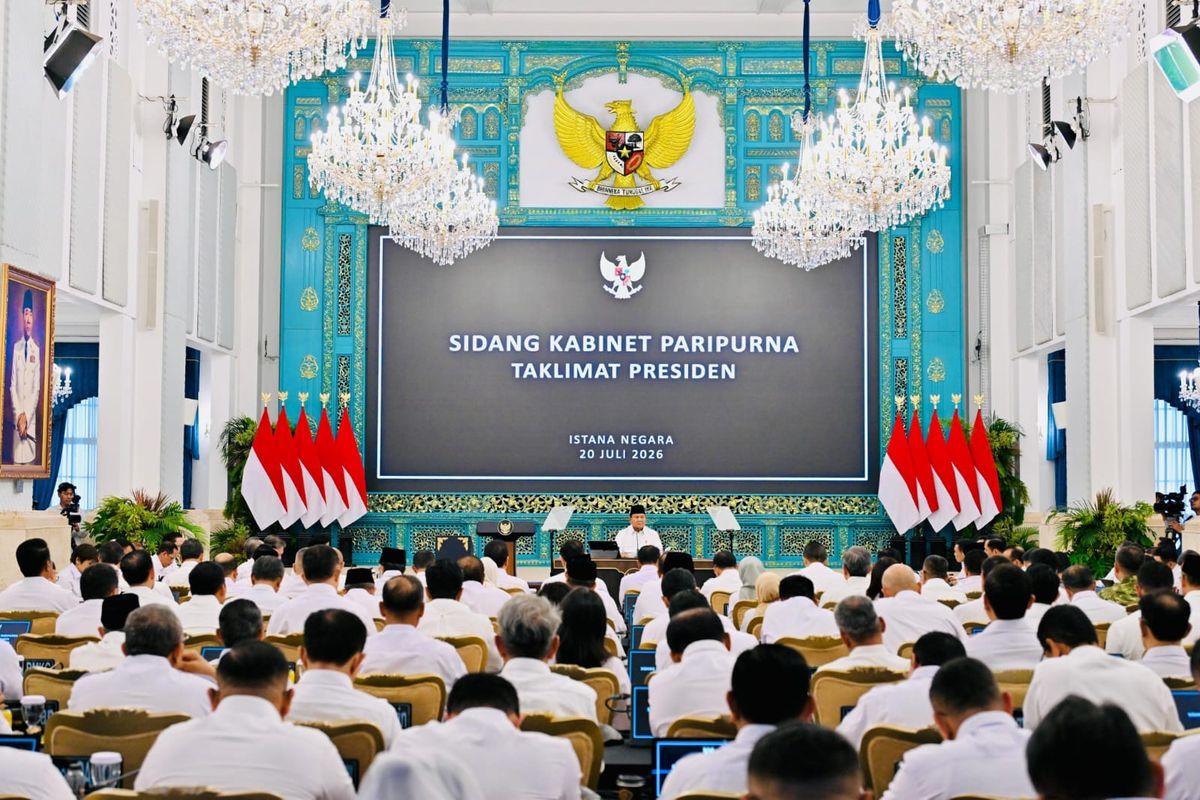
The seventh reshuffle of President Prabowo's cabinet on October 1, 2026, marked the latest face of the administration.
The day after, the President also appointed 26 members of the Presidential Advisory Council (Wantimpres). This series of changes demonstrates that political consolidation and the structuring of government are still vital aspects of Prabowo's leadership direction.
The question is whether the expansion of this structure is in line with the enhancement of government capacity and the quality of public services.
Based on my mapping, following the cabinet reshuffle on October 1, 2026, there are 131 positions within the structure, comprising 8 Coordinating Ministers, 4 Deputy Coordinating Ministers, 42 ministers, 51 Deputy Ministers, and 26 officials at the ministerial level and heads of agencies.
This figure does not yet include the 26 members of Wantimpres or various other presidential special position holders.
The vastness of this government structure raises fundamental questions about the design of the cabinet institutions.
A multitude of positions does not automatically indicate strong state capacity. A large structure may increase coordination layers, prolong decision-making chains, and heighten operational spending needs if authority division, functions, and performance indicators are not designed proportionally.
Compared to the Indonesia Maju Cabinet during Joko Widodo's second term, President Prabowo Subianto's government structure appears significantly larger, especially when accounting for deputy ministers, officials at the ministerial level, and heads of agencies.
This situation presents a paradox in governance. Amid budget efficiency policies dictated by Presidential Instruction (Inpres) No. 1 of 2025, the cabinet structure continues to grow.
The government must not merely demand budget savings from ministries and agencies but also evaluate whether the large structure of executive power aligns with the needs and fiscal capabilities of the state.
Efficient budgeting should not solely target expenditures but also address the rationality of the structure that generates those expenditures.
Efficiency policies risk losing their substance if the government cuts spending on one side while simultaneously expanding the bureaucratic structure on the other.
The larger the cabinet structure, the greater the potential operational spending needs that must be accounted for.
The burden includes salaries and allowances for officials, Ministerial Operational Funds (DOM), official facilities, and various other supporting needs for positions.
Thus, every position added should be based on organizational need analysis, fiscal consequence evaluations, and measurable performance targets.