

Health Minister Prays for President Prabowo to Live to 100 Years
-
News
-
8 minutes ago
This article was translated by AI. Read the original article on Kompas.com. See Original
PROVERB 'more rafters than posts' seems relevant when assessing the current governance direction.
On one hand, the government calls for budget efficiency; on the other hand, the executive power structure continues to grow through the addition and restructuring of positions.
In fact, a large government does not necessarily equate to an effective government, just as a bloated cabinet does not automatically make the state more agile.
This means we must be wary of expending political energy more on expanding power structures than on strengthening bureaucratic capacity and ensuring that policies serve the public.
In Indonesian politics, the distribution of positions often becomes part of the art of maintaining coalitions. However, as political consolidation becomes more dominant, the boundary between the needs of government organization and political accommodation becomes crucial to question.
Every public position should arise from functional needs, not merely from compromise requirements.
The state is not lacking in seats to fill, but it needs officials capable of making technocratic decisions, solving problems, and being accountable for their performance.
The dynamics of politics in Indonesia seem never-ending. Today's politics is no longer solely an elite or adult consumption matter but has become a part of the public conversation, including school-age children who are exposed to political issues through social media.
The torrent of information makes political decisions and maneuvers increasingly accessible to the public.
On October 20, 2026, the government of President Prabowo Subianto and Vice President Gibran Rakabuming Raka will complete two years since their inauguration on October 20, 2024.
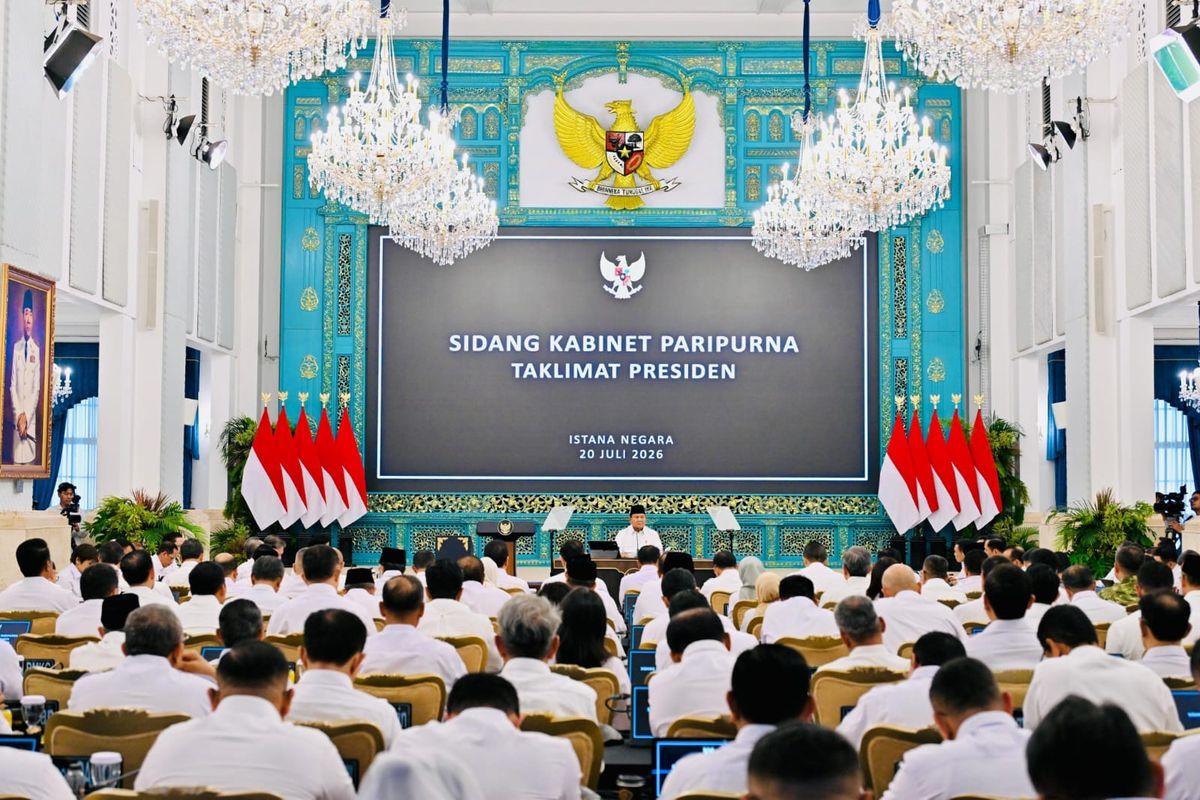
At the start of his administration, Prabowo announced the Red and White Cabinet for the 2024–2029 period, featuring an initial lineup of 7 Coordinating Ministers, 41 ministers, 55 deputy ministers, and five officials at the ministerial level.
As the administration progressed, the structure of executive power continued to develop. Amid calls for budget efficiency, the addition and restructuring of positions occurred through the formation of coordinating ministries, the appointment of special presidential advisors, presidential special staff, and various other supporting positions.
Repeated cabinet reshuffles have altered the composition of officials without necessarily addressing questions regarding the effectiveness of governmental organization.
The seventh reshuffle of President Prabowo's cabinet on October 1, 2026, marked the latest face of the administration.
The day after, the President also appointed 26 members of the Presidential Advisory Council (Wantimpres). This series of changes demonstrates that political consolidation and the structuring of government are still vital aspects of Prabowo's leadership direction.
The question is whether the expansion of this structure is in line with the enhancement of government capacity and the quality of public services.
Based on my mapping, following the cabinet reshuffle on October 1, 2026, there are 131 positions within the structure, comprising 8 Coordinating Ministers, 4 Deputy Coordinating Ministers, 42 ministers, 51 Deputy Ministers, and 26 officials at the ministerial level and heads of agencies.
This figure does not yet include the 26 members of Wantimpres or various other presidential special position holders.
The vastness of this government structure raises fundamental questions about the design of the cabinet institutions.
A multitude of positions does not automatically indicate strong state capacity. A large structure may increase coordination layers, prolong decision-making chains, and heighten operational spending needs if authority division, functions, and performance indicators are not designed proportionally.
Compared to the Indonesia Maju Cabinet during Joko Widodo's second term, President Prabowo Subianto's government structure appears significantly larger, especially when accounting for deputy ministers, officials at the ministerial level, and heads of agencies.
This situation presents a paradox in governance. Amid budget efficiency policies dictated by Presidential Instruction (Inpres) No. 1 of 2025, the cabinet structure continues to grow.
The government must not merely demand budget savings from ministries and agencies but also evaluate whether the large structure of executive power aligns with the needs and fiscal capabilities of the state.
Efficient budgeting should not solely target expenditures but also address the rationality of the structure that generates those expenditures.
Efficiency policies risk losing their substance if the government cuts spending on one side while simultaneously expanding the bureaucratic structure on the other.
The larger the cabinet structure, the greater the potential operational spending needs that must be accounted for.
The burden includes salaries and allowances for officials, Ministerial Operational Funds (DOM), official facilities, and various other supporting needs for positions.
Thus, every position added should be based on organizational need analysis, fiscal consequence evaluations, and measurable performance targets.
Without these three elements, cabinet expansion risks increasing budget burdens without providing commensurate value to public services.
Indeed, the formation and organization of the cabinet fall under the constitutional authority of the President as the head of government, as outlined in the 1945 Constitution of the Republic of Indonesia.
However, this authority does not imply that the cabinet's design is exempt from public scrutiny. Every exercise of executive authority must be accountable based on state operational needs, institutional effectiveness, and fiscal accountability principles.
In this context, Francis Fukuyama's thoughts in his book, "State-Building: Governance and World Order in the 21st Century," are once again relevant for understanding this issue.
Fukuyama emphasizes the importance of state capacity in performing governance functions effectively. The significance of the state does not automatically indicate robust capacity.
Expansion of structure and authority, without adequate institutional capability, may complicate coordination, weaken policy implementation effectiveness, and increase the space for inefficiency and weak accountability.
This means that state capacity building cannot merely be accomplished by adding institutions or positions; it must be accompanied by strengthening organizational capabilities to produce effective policies and public services.
If this framework of thought is applied to assess the current state of governance, several fundamental questions must be posed.
Does the current cabinet structure genuinely reflect the technocratic needs of the state or predominantly accommodate the interests of political consolidation?
Moreover, have the distributions of tasks among ministries, agencies, and government bodies been designed based on clear function differentiation?
Or are there still overlaps of authority, program duplications, and multiple agencies addressing similar fields without clear responsibility delineation?
As the second year of President Prabowo Subianto's administration approaches, a systematic institutional evaluation must be conducted.
This evaluation should include the suitability of mandates, workloads, position needs, coordination effectiveness, and operational costs of each institution.
The government also needs to measure the relationship between expenditures and outcomes achieved.
Thus, the addition of positions or the formation of new agencies should not solely be based on political considerations, but must have foundations in technocratic needs, organizational rationality, and measurable benefits.
Amid the debate about the vastness of the cabinet structure, we must also look at a more fundamental technical issue: how does the government ensure that its bureaucratic capacity matches the complexity of challenges faced by the state?
Latest data from Statistics Indonesia (BPS) shows that Indonesia's economy grew 5.29 percent year-on-year in the second quarter of 2026.
During the same period, the Gross Domestic Product (GDP) at current prices reached IDR 6,552.1 trillion, while the GDP at constant 2010 prices reached IDR 3,576.2 trillion (BPS, 2026).
This figure indicates that the national economy remains relatively strong.
However, these aggregate achievements do not automatically depict equitable prosperity or the capability of all social layers to cope with economic pressures.
Economic growth in the second quarter of 2026 also slowed compared to the first quarter of 2026, which grew 5.61 percent year-on-year.
The decline of 0.32 percentage points does not inherently indicate weakness in all economic sectors, but serves as a reminder that growth achievements must be interpreted alongside other indicators, such as job creation, public purchasing power, industrial performance, and the distribution of development benefits.
Good economic growth on paper is insufficient if it has not been fully translated into job security, income increases, and welfare felt by the public.
The issues awaiting government resolution are instead becoming longer, as if the state’s homework list never truly ends.
The rupiah continues to face pressure, job opportunities are not promising enough, industries are plagued by issues and layoffs, the middle class is increasingly squeezed, poverty remains a major challenge, and law enforcement continues to need reform.
Before one issue is resolved, another arrives: forest and land fires, bureaucratic reforms needing proof, debates on the military's expanding role in civil matters, governance of the Free Nutritious Meals (MBG) program needing continuous improvement, and natural disasters repeatedly testing the state's preparedness.
The problem is that while the list of government positions continues to grow, the list of public issues shows no signs of decrease.
In such a situation, the public surely does not need merely the addition of officials or optimistic statements that sound reassuring on podiums.
What is needed are policies that work, coordination that does not merely toss responsibility back and forth, and a bureaucracy capable of moving faster than the problems that need to be addressed.
We must not allow the government to be so quick in managing the consolidation of power while being slow to confront the consolidation of solutions.
The public cannot pay for their livelihoods with a bloated cabinet, cannot secure jobs with an abundance of officials, and cannot feel safe simply because the state has a larger government structure.
Ultimately, what society evaluates is not how many people sit in the circle of power, but how many problems have genuinely been resolved.
In fact, many in the public still question the progress of the IKN development initiated by Jokowi: "How far along is it and how will the capital relocation be executed?"
This question shows that the public seeks clarity in direction, targets, schedules, and development outcomes.
The government cannot simply respond through political communication or optimistic narratives. The public needs measurable information about program progress, budget utilization, implementation challenges, and anticipated benefits for national interests.
Therefore, today's government challenges cannot be addressed solely through political consolidation and accommodating positions.
Consolidation may maintain governmental stability, but stability is merely a prerequisite, not an end goal.
The government must still prove that this stability can produce targeted policies, effective bureaucracies, and solutions that can be felt by the community.
The essential question is no longer how broad the political support has been gathered, but how ready the government is to translate that support into the capacity to solve public issues.
This is not to exaggerate the problems, but the reality indicates that the government's agenda remains vast.
As we approach the second anniversary of Prabowo's leadership, the government should no longer merely be focused on structuring, organizational adjustments, or internal consolidation.
This phase should become a momentum to expedite policy execution, clarify development priorities, and resolve issues based on measurable targets and performance indicators.
The government's time continues to pass, while public issues cannot wait for the entire political and bureaucratic process to find its ideal form.
I recall Tere Liye's opinion in the Kompas Daily (7/8/2026), which raised concerns about the possibility that society is experiencing collective psychological pressure.
This reflection is relevant for understanding the relationship between political dynamics and everyday life in society.
Politics is not merely an elite contest or a debate in the halls of power. Government decisions regarding the economy, employment, education, social assistance, law enforcement, and public services also determine the sense of safety and certainty in people's lives.
When fundamental issues remain unresolved, while the public space is filled with political noise, social fatigue can increasingly be felt.
I am not being pessimistic about the government but want to emphasize the importance of technocratic planning capable of systematically addressing issues.
The government needs to set priorities based on urgency, strengthen inter-agency coordination, allocate budgets according to needs, and measure success based on tangible outcomes.
Reducing public restlessness must begin with a government that operates optimally, provides certainty, and produces impacts that can be felt in daily lives.
Ultimately, as we approach the two-year mark of President Prabowo's administration, national issues are not just about how many officials sit in the cabinet, but how effectively they execute their mandates.
A strong government is not measured by the size of its organizational structure or the breadth of its political accommodations, but by its ability to make sound decisions, consistently coordinate policies, responsibly manage budgets, and deliver real benefits to society.
We must not let the country grow larger in structure while not becoming stronger in capacity. We must not allow political consolidation to move faster than technocratic consolidation.
Neither should efficiency be merely a demand placed on budget implementers, while the structures that determine budgetary needs remain unexamined.


























