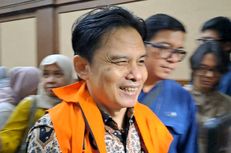
Kupang Regent Becomes a Suspect in Sexual Violence Case, Gerindra Refers to Police
-
News
-
3 minutes ago
This article was translated by AI. Read the original article on Kompas.com. See Original
LAST year, an AI-generated video appeared on my Instagram timeline. The one-minute clip began with a woman staring at the camera and saying, “This is Indonesia without corruption.”
The camera then swept across a classroom of the future. The scene shifted to a modern city, not clogged with traffic but bustling with advanced public transportation.
Next came a high-tech laboratory, barracks where soldiers repaired robots, and finally, farmland managed by farmers with the aid of drones and renewable energy.
Each scene began with the same statement: “This is Indonesia without corruption.”
The comments section was lively. “My heart raced seeing Indonesia without corruption,” wrote one user.
Others suggested that without corruption, Indonesia could become a developed economy like Japan. Everyone knew that the video was merely an AI dream, yet they were still moved.
However, what intrigued me more was what was not shown. There was no parliament or elections. No political parties or heated debates among representatives.
The realm of national life most often associated with corruption was absent from the depiction of a corruption-free Indonesia.
Perhaps it is indeed easier to imagine Indonesia as a technological utopia rather than as a nation with clean politics.
Yet, the absence of politics also reveals how we understand corruption and its “eradication.”
In her classic study on purity and taboo, anthropologist Mary Douglas observed that while shoes themselves are not dirty, placing them on the dining table is considered unclean.
Corruption in the modern sense, defined as the misuse of public office for personal gain, operates under a similar logic.
Particular interests—those of an individual or specific group—are not inherently dirty. They are deemed corrupt when they intrude into improper territories: the public domain, such as office or state budgets.
A father helping his child find a job could be viewed as a good dad. Conversely, a minister appointing his child to a certain position is committing nepotism.
The “essence” of their actions is the same. Both are driven by particular interests. However, in the second case, personal interest overtakes the public role held by a state official.