National Police Postpones Ethics Trial for Inspector General Slamet Uliandi, Suspect in Wiretapping and Treason Case
-
News
-
1 minute ago
This article was translated by AI. Read the original article on Kompas.com. See Original

Sugiono should also be assessed through transparency in wealth reports, tax compliance, and the consistency between income, asset ownership, and sources of wealth.
Thus, wealth scrutiny should not stop at just recording numbers.
More importantly, it should ensure that there are no conflicts of interest, abuse of power, or legally unaccountable wealth.
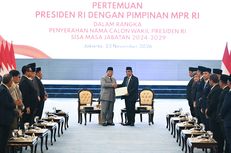
Article 8, paragraph (2) of the 1945 Constitution grants the MPR the authority to elect a vice president if there is a vacancy, from the two candidates proposed by the President, within a maximum period of 60 days.
This provision indicates that the process of filling the vice presidential position is not merely a political process but a constitutional mechanism to ensure the continuity of government.
Therefore, the MPR should not see its task as merely an administrative formality.
The qualifications of candidates must be carefully examined, transparently, and accountably.
Educational documents, health records, legal track records, tax compliance, and wealth reports should be part of a thorough examination.
In this context, Montesquieu's idea of power limitation in *The Spirit of Laws* (1748) remains relevant.
Power must be executed through institutional mechanisms and oversight to prevent it from being centralized in the will of one person.
The MPR indeed selects from the two names proposed by the president.
However, that authority must be exercised with the awareness that what is elected is not the President's personal aide but a state official with constitutional responsibilities.
Ultimately, the comparison between Amran and Sugiono should not lead to judgments about who is closer to the President, who is wealthier, or who is politically stronger.
What must be tested is who is more capable of understanding the constitution, managing the government, maintaining democracy, fostering welfare, and controlling power to stay true to the principles of a state governed by law.
We should not repeat the mistake of electing someone like Gibran as vice president, despite being clearly unqualified in all respects.
Aristotle, in *Politics*, reminds us of the importance of virtuous qualities in leadership. A leader must not only have technical skills but also possess practical wisdom and an orientation towards the common good.
We certainly hope President Prabowo not only gains a loyal vice president but also a statesman who is capable of providing critical consideration, reminding when policies deviate, and standing firm when the constitution faces threats.
For a good vice president is not one who always agrees with the president.
He is someone who dares to speak the truth when policies are right and reminds when policies are wrong.
Indonesia is not seeking the president's personal representative. Indonesia is seeking the Vice President of the Republic of Indonesia. Quo vadis, vice president?