Jimly Proposes MPR Evaluate 60-Day Rule for Vice Presidential Succession: Constitution Should Not Be Rigid
-
News
-
4 minutes ago
This article was translated by AI. Read the original article on Kompas.com. See Original

OBVIOUSLY, there are fundamental questions we must ask in the process of selecting the Vice President of the Republic of Indonesia to fill the vacancy for the 2024–2029 term.
Are we looking for a vice president who has the capacity to lead the nation, or merely someone who has the trust and political loyalty of the president?
This question is particularly relevant after President Prabowo Subianto proposed two names to the People's Consultative Assembly (MPR), namely Andi Amran Sulaiman and Sugiono, to be elected as Vice President to replace Gibran Rakabuming Raka.
Both candidates certainly have their own opportunities, experiences, strengths, and limitations.
Amran is known as an entrepreneur and a technocrat in agriculture, having been entrusted with the position of Minister of Agriculture several times.
Meanwhile, Sugiono has a military background, political experience, a diplomatic role as Minister of Foreign Affairs, and is currently tasked with leading human development and cultural coordination.
However, the position of Vice President is not merely an administrative role. It is a constitutional position that is integral to the highest executive power of the state.
Therefore, the selection should not be based solely on personal closeness, political loyalty, or sectoral success.
Especially considering money politics, as one of the candidates possesses extraordinary wealth.
From the perspective of meritocracy theory, as traced back to Michael Young's thinking in *The Rise of the Meritocracy* (1958), the appointment of an individual to a public office should consider ability, competence, and achievements, rather than solely personal relationships or political patronage.
Meritocracy in filling public posts must be a fundamental principle.
Moreover, the Vice President is not just the President's companion but part of the national leadership that must have the ability to understand issues of governance, constitutionality, politics, economics, international relations, and the dynamics of society.
Max Weber, in his theory of rational-legal bureaucracy, emphasizes the importance of competence, professionalism, and legitimacy based on laws.
Although the Vice President is a political position, the principles of rationality and competence remain relevant as measurements of eligibility because it is possible that they may become President.
Thus, the criteria for judging a vice presidential candidate cannot solely be based on achievements in their previous roles.
The question remains: can that experience be transformed into leadership capabilities and a comprehensive understanding of national issues?
Andi Amran Sulaiman has an advantage in entrepreneurial experience, mastery of the agricultural sector, and governmental experience.
His academic background in agriculture up to a doctoral degree from Hasanuddin University and his experience as Minister of Agriculture from 2014 to 2019 and since 2023 provide significant capital.
He understands food production, agriculture, commodity trade, and the relationship between government policies and economic interests of the public. His experiences in building businesses also reflect managerial capacity and the courage to make decisions.
However, experience managing a company and sectoral ministries does not automatically equate to the ability to perform the functions of the vice president.
Managing the agricultural sector is different from understanding the comprehensive issues of state governance, including inter-agency relations, constitutionalism, foreign policy, defense, and democracy.
In this area, the question of Amran's breadth of national understanding becomes crucial.
Does Amran possess sufficient experience and capacity to perform that function?
However, as is often the case in governance in this country, political power often significantly influences and overrides principles of law, politics, integrity, capacity, and meritocracy.
Sugiono has a different set of experiences.
With an educational background in computer science and business administration, military experience as an officer in the special forces, political activity in the Gerindra Party, and experience as a member of the House of Representatives and Minister of Foreign Affairs, he brings relevant qualifications to the table.
His diplomatic experience enables him to understand international relations, national interests, and geopolitical dynamics.
Political experience also provides him with insights into decision-making processes and the relationships between political forces.
However, what needs to be tested is the depth of that experience in managing government issues comprehensively.
Military experience does not automatically guarantee civil-democratic leadership ability.
Similarly, diplomatic experience does not necessarily demonstrate the capability to manage domestic economic issues, welfare, and governance.
Additionally, Sugiono's political closeness to President Prabowo needs to be assessed proportionally.
Loyalty to the President is not incorrect, but loyalty to the constitution, the state, and the people's interests must take precedence over personal or party loyalty.
Another interesting dimension is the issue of wealth.
Based on the periodic wealth reports for 2025 announced in 2026, Amran’s net worth is recorded at approximately IDR 1.72 trillion, while Sugiono's wealth is around IDR 13.15 billion.
The difference is quite striking. However, substantial wealth does not automatically disqualify someone from being a public official.
Conversely, lesser wealth does not guarantee an individual’s integrity.
From a public ethics theory perspective, wealth should be viewed in relation to transparency, accountability, and potential conflicts of interest.
Amran, with a background as an entrepreneur and public official, should provide sufficient explanations regarding the separation of business interests from governmental authority.
The relationships between business ownership, family, business partners, and public policy must be scrutinized in integrity checks.
Sugiono should also be assessed through transparency in wealth reports, tax compliance, and the consistency between income, asset ownership, and sources of wealth.
Thus, wealth scrutiny should not stop at just recording numbers.
More importantly, it should ensure that there are no conflicts of interest, abuse of power, or legally unaccountable wealth.
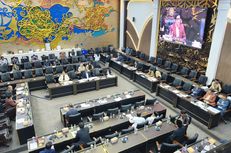
Article 8, paragraph (2) of the 1945 Constitution grants the MPR the authority to elect a vice president if there is a vacancy, from the two candidates proposed by the President, within a maximum period of 60 days.
This provision indicates that the process of filling the vice presidential position is not merely a political process but a constitutional mechanism to ensure the continuity of government.
Therefore, the MPR should not see its task as merely an administrative formality.
The qualifications of candidates must be carefully examined, transparently, and accountably.
Educational documents, health records, legal track records, tax compliance, and wealth reports should be part of a thorough examination.
In this context, Montesquieu's idea of power limitation in *The Spirit of Laws* (1748) remains relevant.
Power must be executed through institutional mechanisms and oversight to prevent it from being centralized in the will of one person.
The MPR indeed selects from the two names proposed by the president.
However, that authority must be exercised with the awareness that what is elected is not the President's personal aide but a state official with constitutional responsibilities.
Ultimately, the comparison between Amran and Sugiono should not lead to judgments about who is closer to the President, who is wealthier, or who is politically stronger.
What must be tested is who is more capable of understanding the constitution, managing the government, maintaining democracy, fostering welfare, and controlling power to stay true to the principles of a state governed by law.
We should not repeat the mistake of electing someone like Gibran as vice president, despite being clearly unqualified in all respects.
Aristotle, in *Politics*, reminds us of the importance of virtuous qualities in leadership. A leader must not only have technical skills but also possess practical wisdom and an orientation towards the common good.
We certainly hope President Prabowo not only gains a loyal vice president but also a statesman who is capable of providing critical consideration, reminding when policies deviate, and standing firm when the constitution faces threats.
For a good vice president is not one who always agrees with the president.
He is someone who dares to speak the truth when policies are right and reminds when policies are wrong.
Indonesia is not seeking the president's personal representative. Indonesia is seeking the Vice President of the Republic of Indonesia. Quo vadis, vice president?