National Police Postpones Ethics Trial for Inspector General Slamet Uliandi, Suspect in Wiretapping and Treason Case
-
News
-
1 minute ago
This article was translated by AI. Read the original article on Kompas.com. See Original

OBVIOUSLY, there are fundamental questions we must ask in the process of selecting the Vice President of the Republic of Indonesia to fill the vacancy for the 2024–2029 term.
Are we looking for a vice president who has the capacity to lead the nation, or merely someone who has the trust and political loyalty of the president?
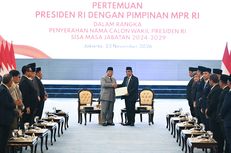
This question is particularly relevant after President Prabowo Subianto proposed two names to the People's Consultative Assembly (MPR), namely Andi Amran Sulaiman and Sugiono, to be elected as Vice President to replace Gibran Rakabuming Raka.
Both candidates certainly have their own opportunities, experiences, strengths, and limitations.
Amran is known as an entrepreneur and a technocrat in agriculture, having been entrusted with the position of Minister of Agriculture several times.
Meanwhile, Sugiono has a military background, political experience, a diplomatic role as Minister of Foreign Affairs, and is currently tasked with leading human development and cultural coordination.
However, the position of Vice President is not merely an administrative role. It is a constitutional position that is integral to the highest executive power of the state.
Therefore, the selection should not be based solely on personal closeness, political loyalty, or sectoral success.
Especially considering money politics, as one of the candidates possesses extraordinary wealth.
From the perspective of meritocracy theory, as traced back to Michael Young's thinking in *The Rise of the Meritocracy* (1958), the appointment of an individual to a public office should consider ability, competence, and achievements, rather than solely personal relationships or political patronage.
Meritocracy in filling public posts must be a fundamental principle.
Moreover, the Vice President is not just the President's companion but part of the national leadership that must have the ability to understand issues of governance, constitutionality, politics, economics, international relations, and the dynamics of society.
Max Weber, in his theory of rational-legal bureaucracy, emphasizes the importance of competence, professionalism, and legitimacy based on laws.
Although the Vice President is a political position, the principles of rationality and competence remain relevant as measurements of eligibility because it is possible that they may become President.
Thus, the criteria for judging a vice presidential candidate cannot solely be based on achievements in their previous roles.
The question remains: can that experience be transformed into leadership capabilities and a comprehensive understanding of national issues?
Andi Amran Sulaiman has an advantage in entrepreneurial experience, mastery of the agricultural sector, and governmental experience.
His academic background in agriculture up to a doctoral degree from Hasanuddin University and his experience as Minister of Agriculture from 2014 to 2019 and since 2023 provide significant capital.
He understands food production, agriculture, commodity trade, and the relationship between government policies and economic interests of the public. His experiences in building businesses also reflect managerial capacity and the courage to make decisions.
However, experience managing a company and sectoral ministries does not automatically equate to the ability to perform the functions of the vice president.