

The MK Claims that the Discussion of the Police Law in the DPR Does Not Comply with the Stages of Law Formation
-
News
-
12 minutes ago
This article was translated by AI. Read the original article on Kompas.com. See Original
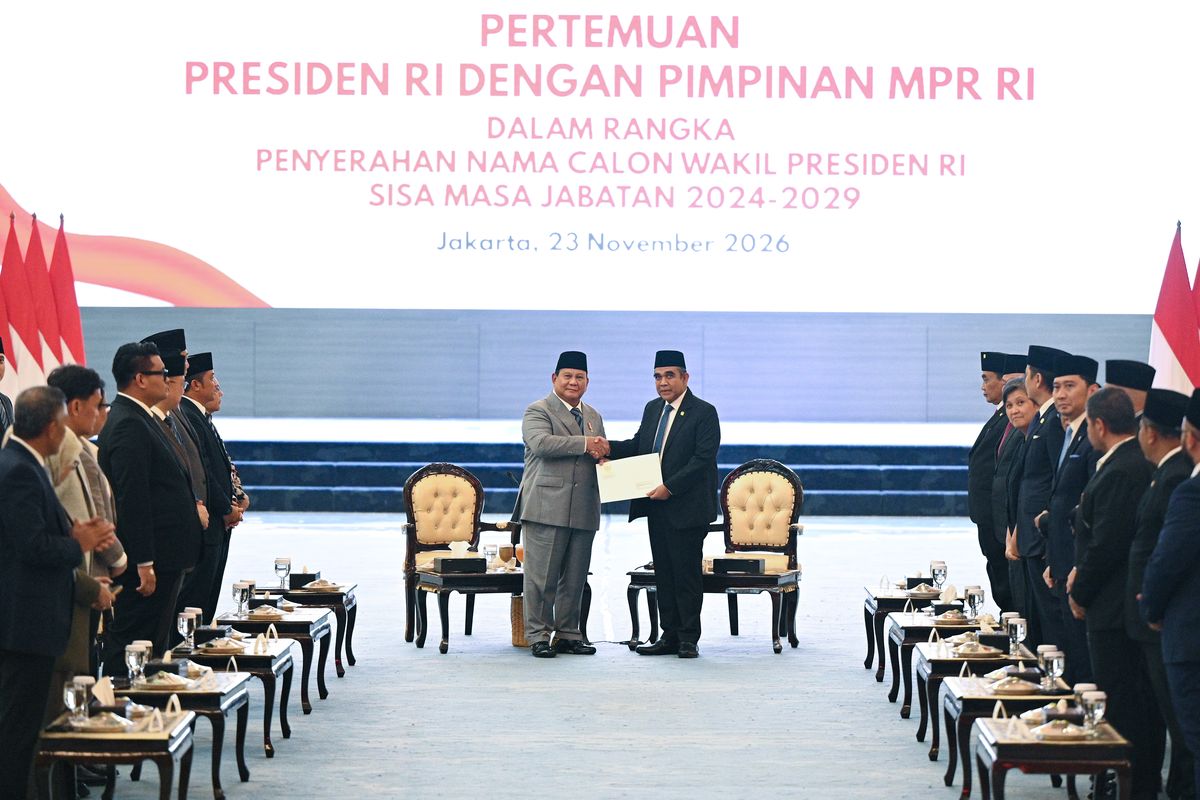
THE PEOPLE elect the president and vice president as a package. However, when the vice presidency becomes vacant during a government term, the public is no longer called to the polls. The replacement is chosen by the People's Consultative Assembly (MPR).
This is one of the unique aspects of the Indonesian constitution. The position, originally obtained through direct election, can be filled through a decision by a representative body. No elections, no campaigns, and no ballots for the public to cast.
This scenario has now become a political reality after Gibran Rakabuming Raka left his post as Vice President.
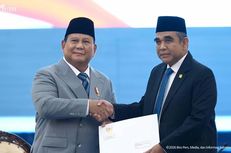
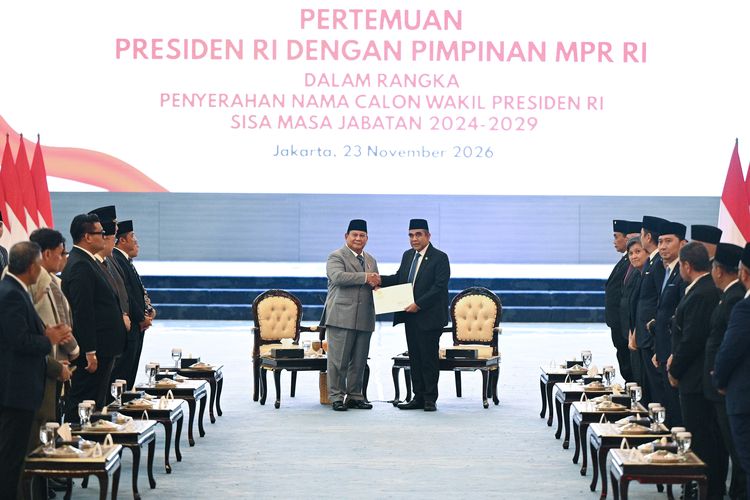
President Prabowo Subianto, on November 23, 2026, proposed two names to the MPR: Andi Amran Sulaiman and Sugiono. The MPR is scheduled to select a replacement on December 11, 2026.
This situation raises fundamental questions. Does a vice president not elected directly by the people have the same democratic legitimacy? To what extent can the president determine the candidates?
And does the MPR genuinely choose, or merely endorse the president's political will?
The answer cannot be found purely in party support calculations. We must return to the constitution, where power obtains its foundation and limits.
Article 6A, paragraph (1) of the 1945 Constitution asserts that the President and Vice President are elected directly by the people as a pair. This provision marks a significant achievement of constitutional reform.
The public no longer entrusts the presidential election to the MPR as was the case prior to the amendment of the 1945 Constitution.
However, the constitution does not assume that governance will always proceed without interruption. Vacancies can occur for various reasons. The state requires a replacement mechanism to ensure governmental continuity.
Article 8, paragraph (2) of the 1945 Constitution provides the answer. If a vice presidency becomes vacant, the MPR must hold a session within a maximum of sixty days to elect a vice president from two candidates proposed by the president.
These two provisions do not conflict. Article 6A regulates the formation of government through elections, while Article 8, paragraph (2) governs filling a vacancy in special circumstances.
Thus, the selection of a vice president by the MPR is not a deviation from the constitution. In fact, it is the constitution that mandates it.
The issue arises when procedural legality is deemed to have resolved all democratic questions. However, something legally valid must also be accountable in terms of the exercise of power.
A vice president elected by the MPR does not hold a constitutionally lower position than one resulting from an election. Both hold the same office with the same powers and responsibilities.
The difference lies in the method of obtaining the position. This distinction requires a political accountability that cannot be ignored.
In a presidential election, the public votes for a pair, not two separate officials. That choice embodies hopes regarding leadership, the continuity of governance, and the direction of state policy.
Therefore, the termination of a vice presidency is not a mere administrative event. There is an electoral mandate component of the pair that changes before the term ends.
Nonetheless, such changes do not automatically end the president's mandate. The 1945 Constitution distinguishes the mechanisms for termination and replacement of each position.
The president continues to exercise governmental authority, while the vice presidency vacancy is resolved through constitutional mechanisms.
This is where it is essential to distinguish between direct electoral legitimacy and constitutional legitimacy through representative bodies.
The replacement vice president indeed does not receive direct votes from the people. However, they are elected by the MPR, whose members come from the House of Representatives (DPR) and the Regional Representative Council (DPD), two bodies founded on democratic representation.
This representation relationship provides a basis for indirect legitimacy, even though it does not equate to the mandate obtained by the president and vice president pair in an election.
Hanna Fenichel Pitkin in The Concept of Representation (1967) reminds us that representation does not end with someone's formal position as a representative. Representation also involves actions that consider the interests of the represented parties.
This thinking is relevant for understanding the responsibilities of the MPR. Its members cannot rely solely on the fact that they once obtained a mandate through elections.
They must demonstrate that the decision to select a vice president considers public interests.