

The MK Claims that the Discussion of the Police Law in the DPR Does Not Comply with the Stages of Law Formation
-
News
-
2 minutes ago
This article was translated by AI. Read the original article on Kompas.com. See Original
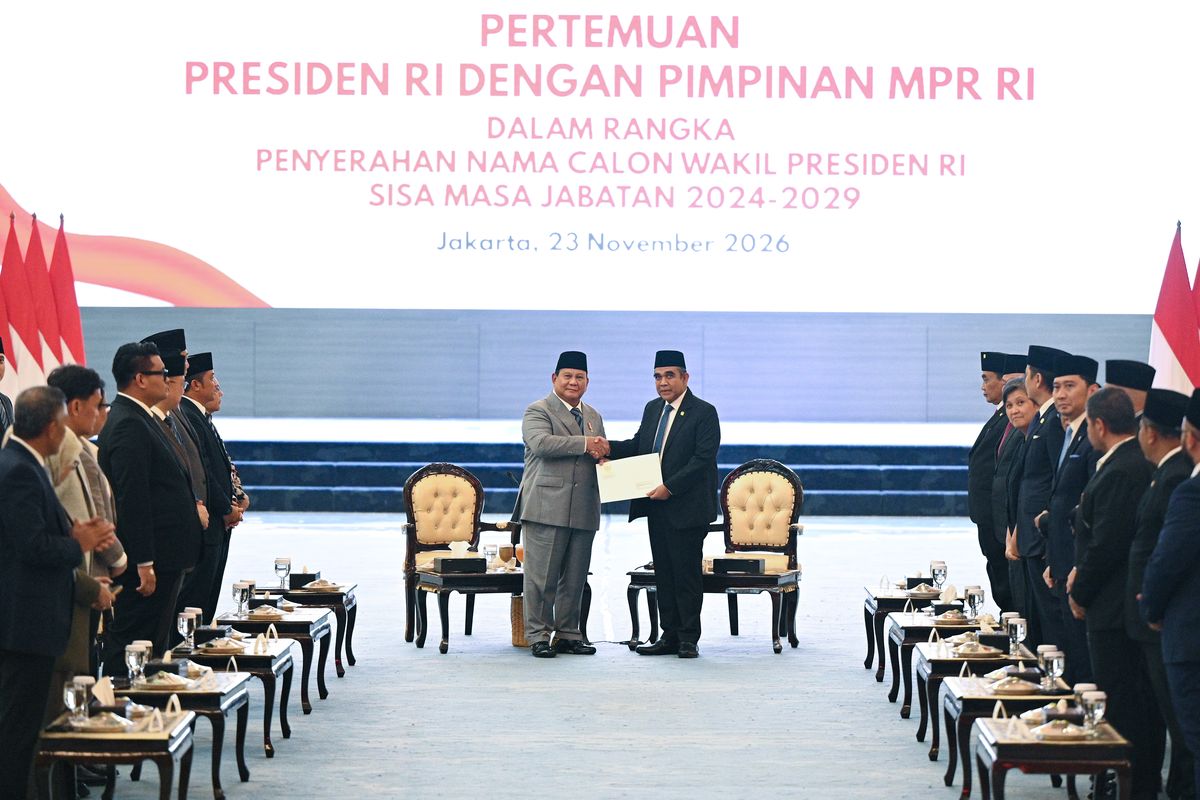
Although the public is not present directly in the MPR vote, their physical absence does not mean their interests can be set aside.
Representative democracy loses meaning when the people's mandate is only remembered during elections, then forgotten when power is being distributed.
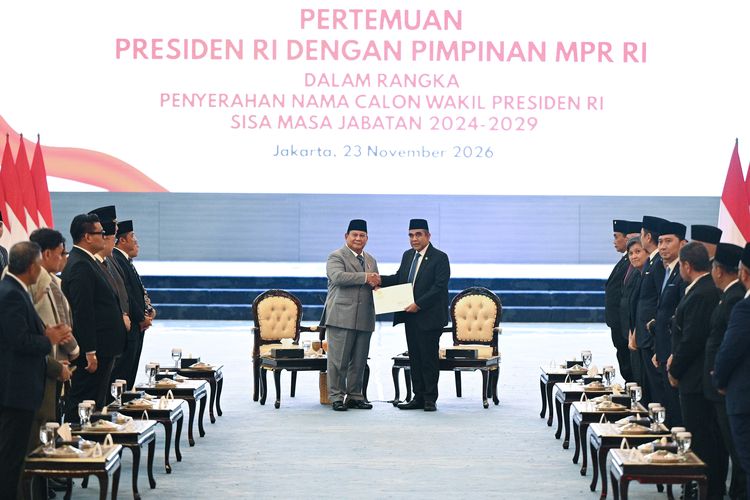
Article 8, paragraph (2) grants the president the authority to propose two vice presidential candidates. The formulation is clear: the president proposes, the MPR chooses.
This division of powers is not coincidental. The president needs a vice president who can collaborate in governance.
Thus, the constitution provides room for the president to determine two individuals deemed capable of accompanying him.
However, the vice president is not merely the president's personal assistant. They are a state official who derives their position directly from the constitution.
Article 4, paragraph (2) of the 1945 Constitution states that the president is assisted by one vice president. Meanwhile, Article 8, paragraph (1) positions the vice president as the replacement for the president in case of death, resignation, dismissal, or inability to perform duties during their term.
The implications are not trivial. The person selected as vice president must be considered not only based on their ability to work with the president but also on their readiness to assume the presidency if constitutional circumstances necessitate it.
Political loyalty may become a consideration in governance relationships. However, such loyalty cannot replace integrity, fulfillment of legal requirements, and state responsibility.
The president indeed has political freedom to propose candidates. However, that freedom is not without limits.
The constitution does not recognize the vice presidency as a reward for political allies or compensation for someone's contributions in the power struggle.
The two names proposed must meet legal requirements. The president's choices should also be justifiable to the public based on governmental needs and national interests.
Constitutional authority does not always require the president to explain every political consideration. However, transparency regarding the reasons for the proposal will strengthen trust in the replacement process.
After the amendment of the 1945 Constitution, the MPR is no longer the highest state institution. The sovereignty of the people is exercised according to the Constitution, not centralized in one institution.
However, this change in position does not eliminate the MPR's authority to elect a vice president in the event of a vacancy. In fact, it is in such situations that the quality of the MPR's institution is tested.
The constitution uses the word choose, not merely approve. This distinction is important because choosing implies a process of determining between two proposed alternatives.
The president cannot unilaterally appoint a replacement vice president. Conversely, the MPR also does not have the authority to nominate a third person outside the two names proposed by the president through the mechanism of Article 8, paragraph (2).
Both are bound by the division of powers determined by the constitution.
In political practice, it is certainly possible for inter-faction agreements to occur before the session is held. Such agreements do not inherently contradict the law.
However, political agreements should not dilute the meaning of the selection, negate the examination of qualifications, or disregard decision-making procedures.
If the entire process merely becomes a formality to announce a predetermined decision, the MPR's authority risks losing its democratic substance.
Another important point to remember is the composition of the MPR. This body consists of members from the DPR and DPD. Both bring different dimensions of representation.
The DPR reflects political representation, while the DPD carries the dimension of regional representation.
Therefore, the selection of a vice president should not be viewed merely as a political party affair. Regional interests and national needs must also find a place in the considerations.
The dignity of the MPR does not lie in its ability to complete the election as quickly as possible, but rather in its seriousness in exercising authority in accordance with the constitution.
Orderly sessions do not necessarily reflect a substantive process. In contrast, openly expressed differences of opinion should not be seen as disruptions to political stability.