

The MK Claims that the Discussion of the Police Law in the DPR Does Not Comply with the Stages of Law Formation
-
News
-
2 minutes ago
This article was translated by AI. Read the original article on Kompas.com. See Original
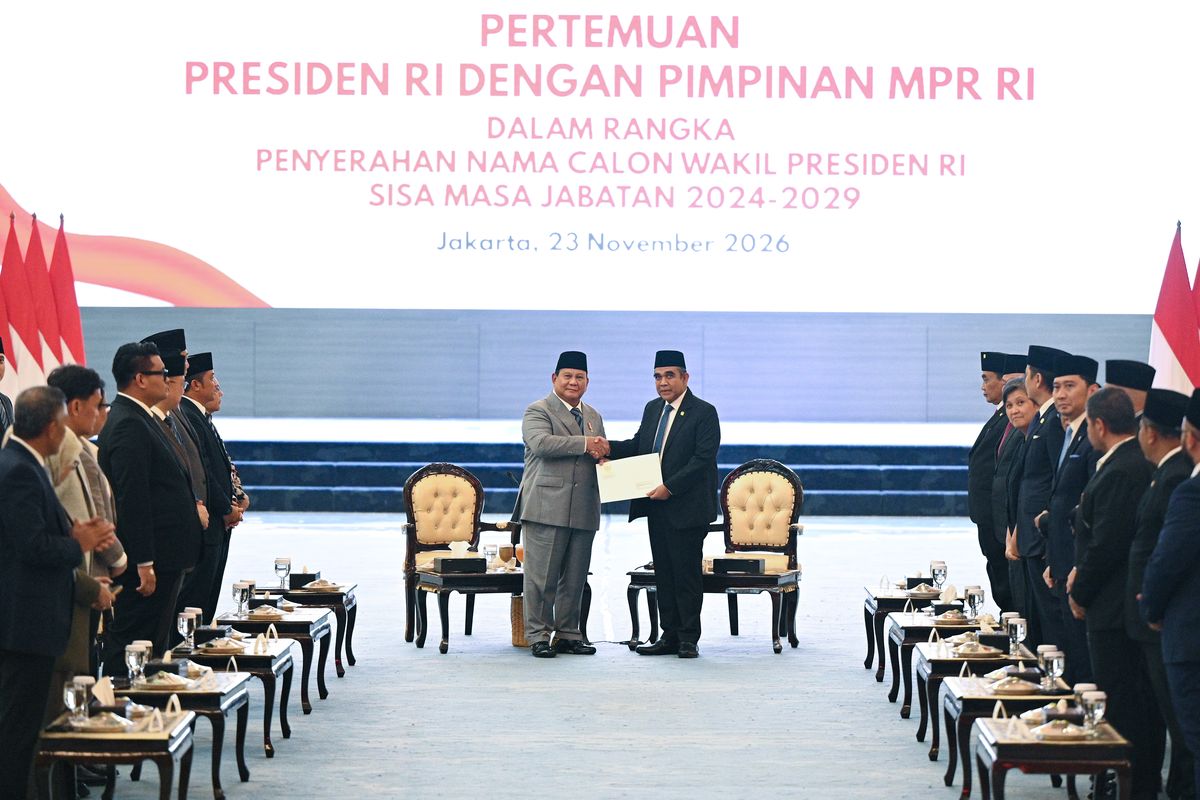
Democracy requires decisions. However, good decisions require a accountable process.
One important issue in filling the vice president position is the examination of the candidates' qualifications.
Statecraft experience shows that issues surrounding candidacy documents can develop into legal disputes and prolonged political debates.
Hence, the candidate examination must not only ensure that all documents have been submitted. There is a fundamental difference between document completeness, formal validity, and material truth.
Complete documents do not necessarily prove that all qualifications have been met. Conversely, certain administrative deficiencies do not always mean someone substantively fails to meet the qualifications.
The examination must be conducted based on legal provisions, valid evidence, and fair procedures.
In administrative law, there is a principle of accuracy. Officials or bodies making decisions must base their actions on sufficient facts and information.
This principle teaches essential lessons for the exercise of public authority, including when the MPR examines vice presidential candidates' qualifications.
Of course, the MPR's decision in exercising its constitutional authority cannot simply be equated with administrative decisions that are typically subjects of disputes in administrative courts.
The character of its authority is different. So too are the mechanisms of accountability and the possibility of legal scrutiny.
However, the specificity of the MPR's authority is not a reason to neglect thoroughness. Qualification examinations should be conducted before the election, not raised as issues post-inauguration.
The same applies to deadlines. Article 8, paragraph (2) sets a maximum of sixty days to hold a selection session from the occurrence of a vacancy.
This constitutional provision must be distinguished from technical regulations regarding candidate nominations and stages of the session in legislation.
Implementation rules must not alter or override the limits set by the 1945 Constitution.
In a rule of law, procedural accuracy is not a trivial matter. Procedures are one way to prevent power from being exercised according to momentary whims.
The election of the Vice President outside of elections ultimately serves as a test of Indonesian democracy's maturity.
The constitution has provided a solution to ensure that vacancies do not disrupt governmental continuity. However, the availability of the mechanism does not automatically guarantee the quality of its implementation.
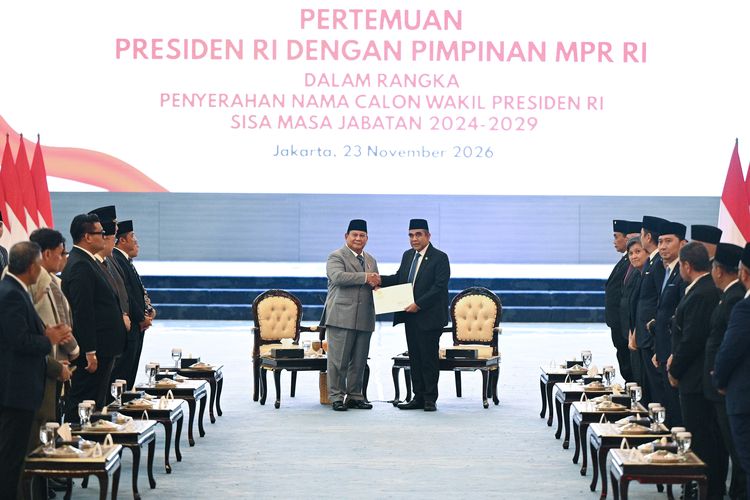
The president has the authority to propose. The MPR has the authority to choose. Both perform distinct functions that complement and simultaneously limit each other.
Neither of them should consider their authority as solely belonging to them or their political group.
The most crucial issue is not merely whether Amran Sulaiman or Sugiono is ultimately selected. Both must be evaluated according to the same legal requirements and constitutional responsibilities.
More fundamentally, the question is whether the selection process can demonstrate that power is still exercised based on rules, not merely as a result of political negotiations.
The constitution does not always require the public to return to the polls every time a vacancy occurs. However, the constitution has never given reasons for state organizers to forget their source of power.
The election of a vice president by the MPR is legitimate as it is mandated by the 1945 Constitution. Its democratic legitimacy will be stronger if the process is open, qualifications are examined carefully, and decisions can be justified to the public.
Ultimately, the vice president's seat is not a political gift, nor is it the property of the president or the supporting party. It is a constitutional mandate that must be executed for the state's interests.
The people may not be present at the polls when the replacement vice president is chosen. However, their sovereignty must not be absent from the MPR chamber.