
Hajj Quota Trial: Gus Alex Acknowledges No Reprimands on DPR Money Requests
-
News
-
3 minutes ago
This article was translated by AI. Read the original article on Kompas.com. See Original
THERE IS something odd about how we penalize unconstitutional laws.
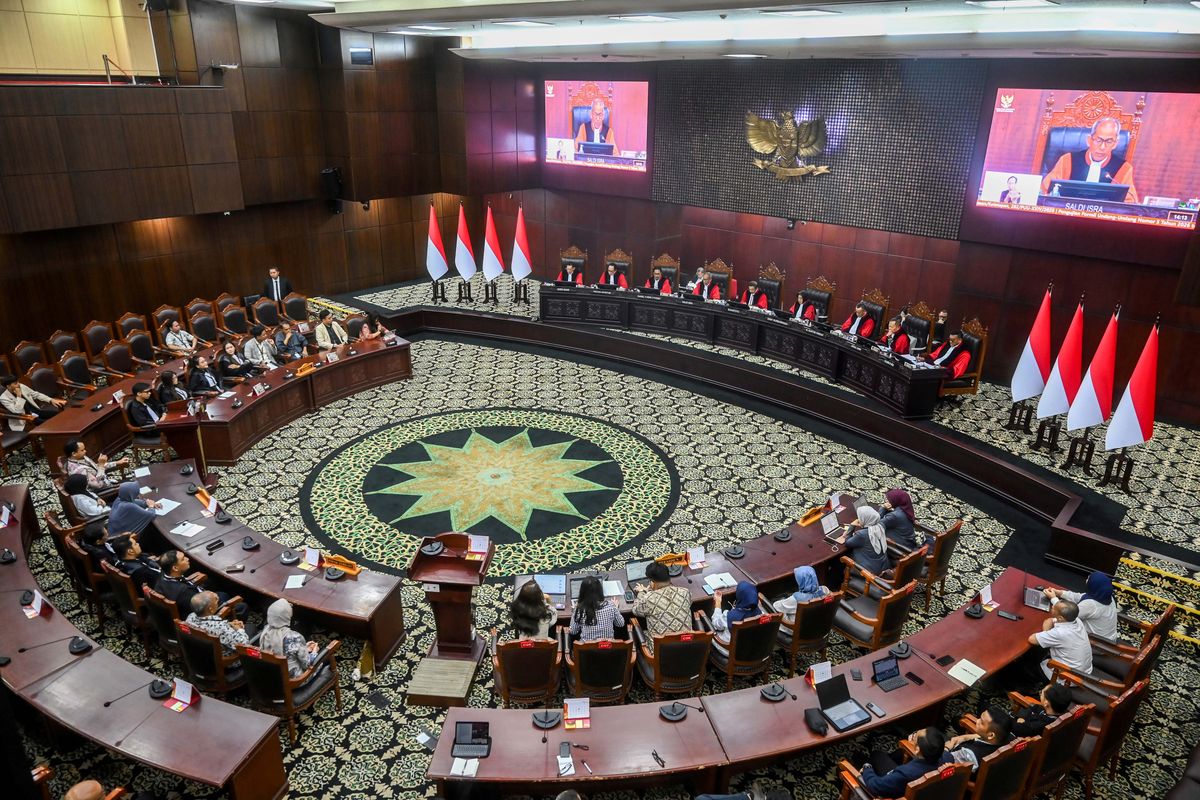
When the Constitutional Court (MK) declares a law in violation of the Constitution, we focus on punishing the product by annulment, rendering it without binding legal power, or requiring revisions.
But what about the entities that politically pushed for the law's enactment?
This question becomes important when we examine data from the MK.
The MK's official website records 2,689 registered law testing applications, with 400 of them granted.
This means there are hundreds of legislations ultimately deemed constitutionally problematic.
However, after a law is declared unconstitutional, our accountability appears to stop at the product.
We rarely, if ever, ask who should be held responsible for the political decisions that birthed that product?
After all, laws do not simply come into existence on their own; they arise from political decisions.
In the Indonesian political system, decisions in the DPR do not solely reflect the aggregation of individual DPR members' wills.
Political parties, factions, organizational policies, and political decisions guide how a DPR member behaves when a bill is decided.
Therefore, if a political party officially instructs its members to support a specific law, and that law is later declared unconstitutional, the question that should arise is not just whether the law is unconstitutional, but also whether the politically organized party that pushed for its formation can be held legally accountable.
Unfortunately, we cannot find a single article in relevant legislation that explicitly punishes parties urging DPR members to agree to unconstitutional laws.
Nonetheless, one article that could at least implicitly be used to punish such parties pertains to the dissolution of political parties.
Article 24C paragraph (1) of the 1945 Constitution of the Republic of Indonesia grants the MK the authority to decide on the dissolution of political parties.
The reasons for dissolution are outlined in Article 2 of MK Regulation No. 12 of 2008.
One reason includes the activities of the political party being contrary to the Constitution, or the consequences thereof being unconstitutional.
When a party officially instructs all its members to support a specific law, this activity does not conflict with the Constitution.
In fact, giving such instructions is constitutional. However, do not forget that the consequences arising from this instruction, which can be deemed as party activity, can also serve as grounds for disbanding the party.
In this context, the consequence is the passage of a legal product in the form of a law that is in contradiction with the Constitution.
For this reason, I believe that the elements described in Article 2 of the MK Regulation may be satisfied, holding the party supporting unconstitutional legislative products accountable through dissolution, although several matters still need to be proven.
For instance, we still need to prove whether there was an official party decision? Was the formulation of this law part of the party's agenda?
Was the action taken as part of organizational policy?
Is the unconstitutional aspect related to the process of its formation or its substance?
And other questions to connect the unconstitutional legislative product with the party's policy to endorse it.
Such proof is essential because I believe that the dissolution of a political party should not be understood as an automatic consequence of any law annulled by the MK.
We must distinguish between flaws in legislative products and flaws in political organizational actions.
Because a law can be declared unconstitutional based on procedural formation issues, not just the substance of its norms.
Therefore, there must be a clear relationship between the actions of the party organization and the consequences that arise.
It must be proven that the actions were indeed organizational policies or decisions, not just individual DPR member opinions.
It must also be proven that the result of these organizational actions indeed contradicts the Constitution.
Without such proof, the dissolution of political parties risks becoming an instrument to penalize political divergences.
The issue is, even if the dissolution of a political party can be an instrument to demand accountability for organizational activities leading to unconstitutional consequences, not every party has the opportunity to file such a request.
Article 3 paragraph (1) of PMK No. 12/2008 only grants the status of applicant in party dissolution cases to the Government.
This means that citizens like us cannot file for the dissolution of a political party.
The government's position as the sole applicant has even been repeatedly emphasized by the MK in several of its decisions.
In Decision No. 53/PUU-IX/2011, for example, the MK stated that granting exclusive rights to the Government as an applicant is a legal policy set by the lawmakers.
This exclusivity was affirmed again in Decisions No. 16/PUU-XXII/2024 and No. 17/PUU-XXII/2024.
These three decisions demonstrate that lawmakers have the discretion to determine who is qualified to be an applicant in political party dissolution cases.
This is because the 1945 Constitution does not explicitly regulate who has standing as an applicant.
Thus, determining who has the right to file for the dissolution of a political party is part of the lawmakers’ authority.
However, this discretion should be used to broaden the scope of valid applicants.
This is because limiting applicants solely to the Government places the enforcement of the constitutionality of political parties entirely in the Government’s hands.
As a consequence, when the Government lacks the will, there is no mechanism for ordinary citizens to penalize political parties engaged in unconstitutional activities or for the consequences of their activities.