

Tax, Rank, and Meritocracy Exam
-
News
-
16 minutes ago
This article was translated by AI. Read the original article on Kompas.com. See Original
JAKARTA, KOMPAS.com - The survival of the Javan rhino (Rhinoceros sondaicus) still faces fundamental issues. The wild population of this rare species is confined to a single area, namely Ujung Kulon National Park (TNUK) in Banten.
This condition puts the future of the Javan rhino at risk, depending solely on one area to protect the entire population from various threats.
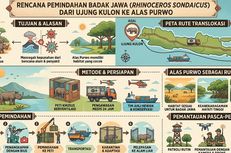
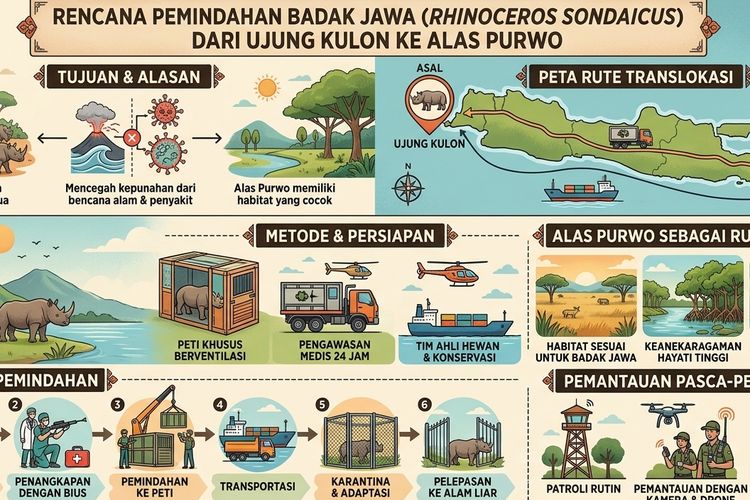
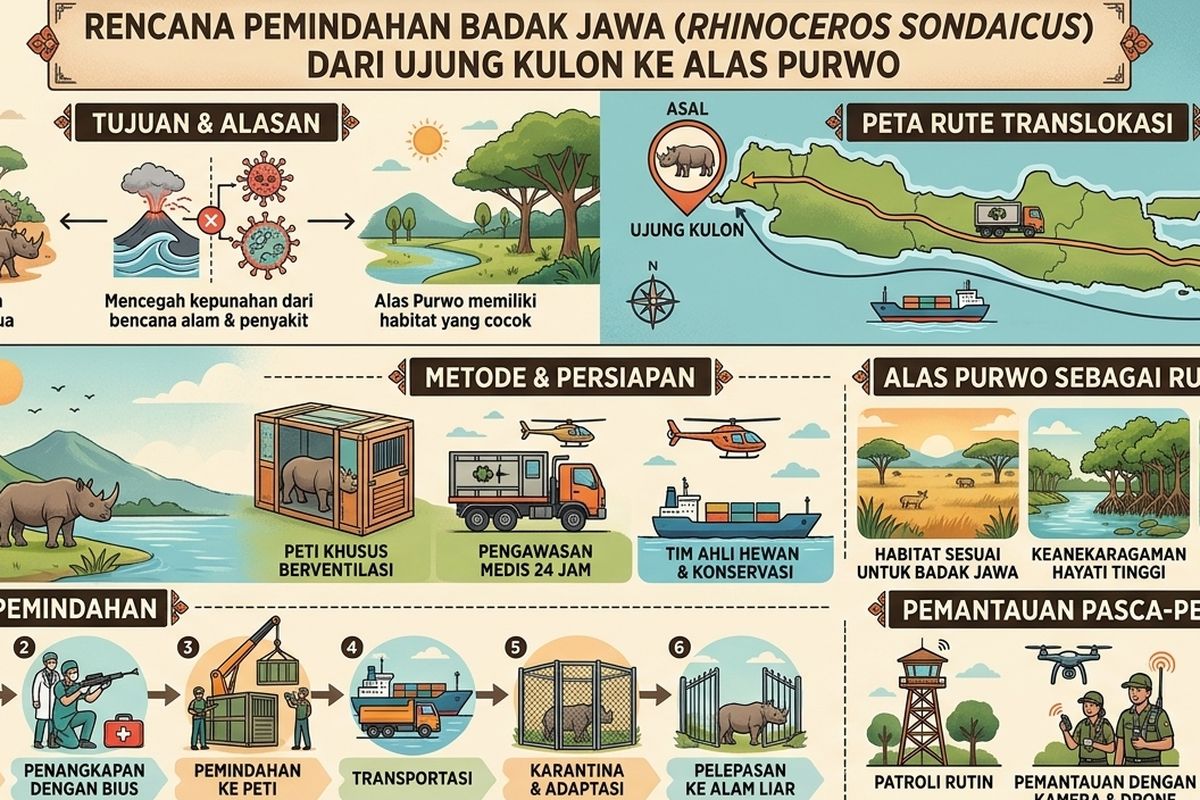
In this context, the government is considering establishing a second habitat for the Javan rhino. One area that has been mentioned as a potential option is Alas Purwo National Park in Banyuwangi, East Java.
The government is concerned that the Javan rhino population, limited to Ujung Kulon, could go extinct if various threats materialize, including the threat of an eruption from Mount Anak Krakatau in the Sunda Strait.
"If there's a tsunami due to an earthquake or volcanic eruption, we could face a tsunami. If that happens, our Javan rhinos could become extinct. Therefore, there's an idea to relocate some Javan rhinos to Alas Purwo," said Hashim Djojohadikusumo at the UN Climate Change Conference (COP31) in Antalya, Turkey, on Thursday (12/11/2026).
Director of Forests and Wildlife at the World Wildlife Fund (WWF) Indonesia, M. Ali Imron, stated that the option to establish a second wild population could indeed be considered.
Ali explained that this proposal is not new. The idea of creating an additional population — not a complete relocation — has existed since the 1980s. However, even after 40 years, this option has never been implemented.
Creating a second wild population would involve methods such as translocation, aimed at forming a new population to mitigate the risk of extinction. He mentioned that this approach is a long-term conservation strategy.
"This needs to be viewed as a long-term conservation strategy that runs parallel to strengthening the protection of the first population. We emphasize that this effort should not replace conservation efforts in the original area," Ali Imron told Kompas.com on Tuesday (17/11/2026).
Ali explained that a second wild population is necessary because potential threats do not only arise from natural disasters — which have shown that animals can survive such challenges.
There are other threats, such as declining numbers due to poaching and land conversion that fail to meet the minimum viable population.
He revealed that the Javan rhino population in that area has struggled to move beyond approximately 100 individuals.
"We know about the minimum viable population. This is the issue. When the population is too small, there's a possibility of inbreeding, which leads to inbreeding depression. Eventually, this could result in deformities and other issues," Ali explained during a Kompas.com News Room discussion.
Thus, providing a second population becomes one of the options available.
Moreover, Indonesia still faces a situation where the rhino habitat is invaded by invasive species. This makes it difficult for rhinos to find food, leading to their habitats becoming increasingly limited.
"This inevitably reduces the capacity of the National Park," he added.
However, he warned that the formation of this population should not be misconstrued as a wholesale relocation of Javan rhinos from Ujung Kulon.
"We shouldn’t interpret this need as a mass relocation. The scientific requirement is that there should be at least two populations that must be preserved. If one is forced to disappear, there's still another. This illustrates the caution necessary in this situation," Ali explained.
Ali also emphasized that the relocation of this highly protected animal must be based on thorough and comprehensive studies.
The study, he said, should assess the needs of the rhinos at the chosen location and the availability of habitat on Java.
The assessment process involves two main steps.