
Tax, Rank, and Meritocracy Exam
-
News
-
6 minutes ago
This article was translated by AI. Read the original article on Kompas.com. See Original
JAKARTA, KOMPAS.com - The survival of the Javan rhino (Rhinoceros sondaicus) still faces fundamental issues. The wild population of this rare species is confined to a single area, namely Ujung Kulon National Park (TNUK) in Banten.
This condition puts the future of the Javan rhino at risk, depending solely on one area to protect the entire population from various threats.
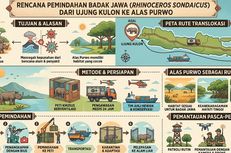
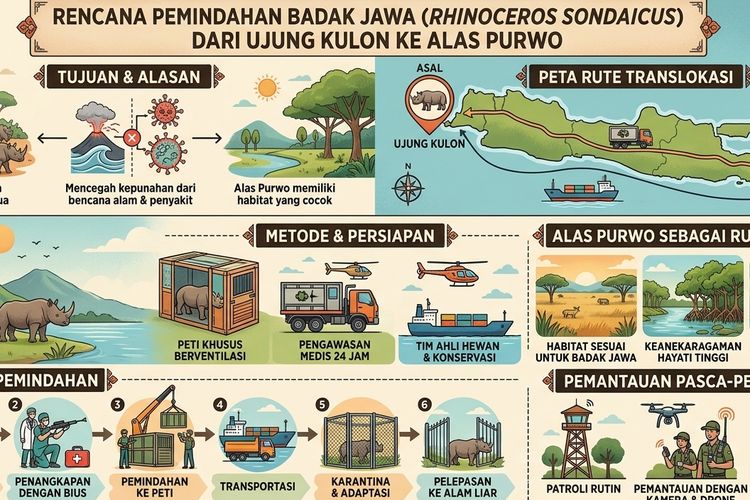
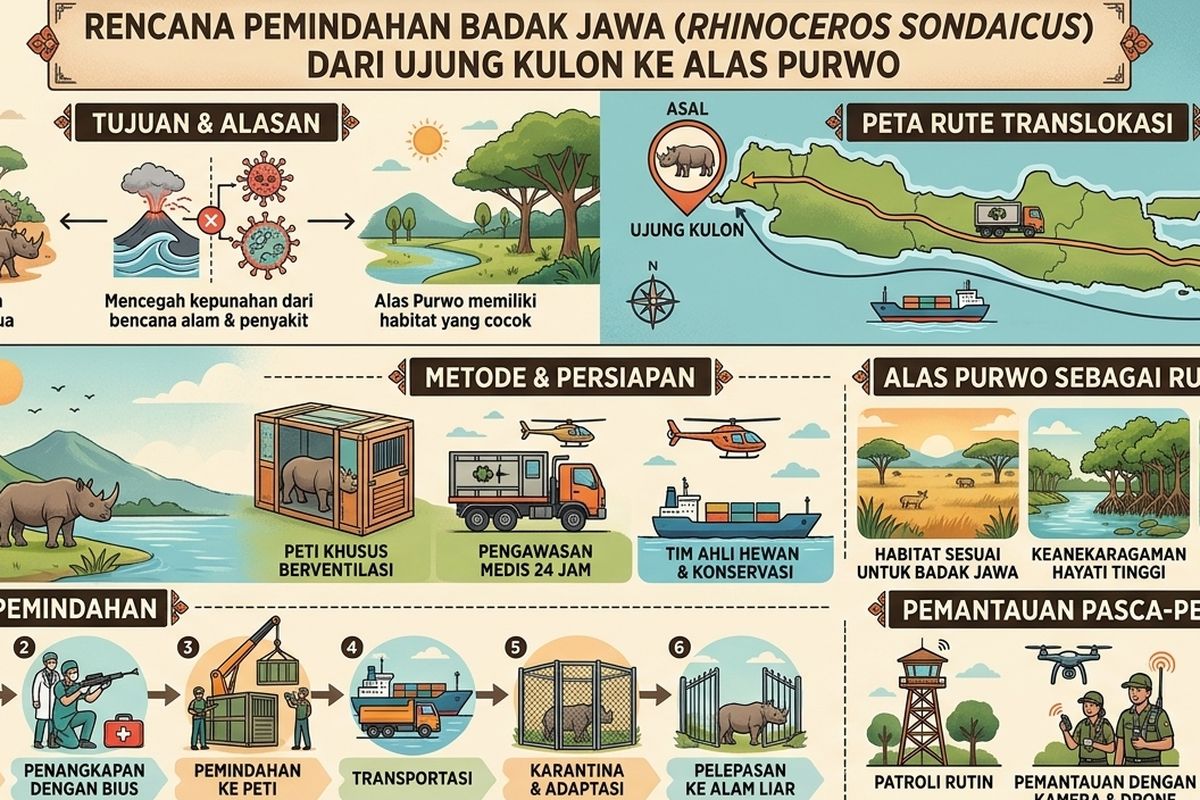
In this context, the government is considering establishing a second habitat for the Javan rhino. One area that has been mentioned as a potential option is Alas Purwo National Park in Banyuwangi, East Java.
The government is concerned that the Javan rhino population, limited to Ujung Kulon, could go extinct if various threats materialize, including the threat of an eruption from Mount Anak Krakatau in the Sunda Strait.
"If there's a tsunami due to an earthquake or volcanic eruption, we could face a tsunami. If that happens, our Javan rhinos could become extinct. Therefore, there's an idea to relocate some Javan rhinos to Alas Purwo," said Hashim Djojohadikusumo at the UN Climate Change Conference (COP31) in Antalya, Turkey, on Thursday (12/11/2026).
Director of Forests and Wildlife at the World Wildlife Fund (WWF) Indonesia, M. Ali Imron, stated that the option to establish a second wild population could indeed be considered.
Ali explained that this proposal is not new. The idea of creating an additional population — not a complete relocation — has existed since the 1980s. However, even after 40 years, this option has never been implemented.
Creating a second wild population would involve methods such as translocation, aimed at forming a new population to mitigate the risk of extinction. He mentioned that this approach is a long-term conservation strategy.
"This needs to be viewed as a long-term conservation strategy that runs parallel to strengthening the protection of the first population. We emphasize that this effort should not replace conservation efforts in the original area," Ali Imron told Kompas.com on Tuesday (17/11/2026).
Ali explained that a second wild population is necessary because potential threats do not only arise from natural disasters — which have shown that animals can survive such challenges.
There are other threats, such as declining numbers due to poaching and land conversion that fail to meet the minimum viable population.
He revealed that the Javan rhino population in that area has struggled to move beyond approximately 100 individuals.
"We know about the minimum viable population. This is the issue. When the population is too small, there's a possibility of inbreeding, which leads to inbreeding depression. Eventually, this could result in deformities and other issues," Ali explained during a Kompas.com News Room discussion.
Thus, providing a second population becomes one of the options available.
Moreover, Indonesia still faces a situation where the rhino habitat is invaded by invasive species. This makes it difficult for rhinos to find food, leading to their habitats becoming increasingly limited.
"This inevitably reduces the capacity of the National Park," he added.
However, he warned that the formation of this population should not be misconstrued as a wholesale relocation of Javan rhinos from Ujung Kulon.
"We shouldn’t interpret this need as a mass relocation. The scientific requirement is that there should be at least two populations that must be preserved. If one is forced to disappear, there's still another. This illustrates the caution necessary in this situation," Ali explained.
Ali also emphasized that the relocation of this highly protected animal must be based on thorough and comprehensive studies.
The study, he said, should assess the needs of the rhinos at the chosen location and the availability of habitat on Java.
The assessment process involves two main steps.
The first step is to create a habitat distribution model to identify potential areas where rhinos once existed.
"Previously, there have been studies in several regions of West Java and Banten, where several options existed but were never executed. I believe the approach will be similar, using modeling first. The entire region of Java will be analyzed via a computer desk study to find the most promising areas," Ali explained.
The second step involves validating the areas that have been mapped.
Through validation, the government, academics, and stakeholders will assess whether the selected land is truly suitable for Javan rhinos, or not.
"We need to consider whether the food is adequate, whether there is enough water, whether it is safe, and whether there are any diseases present. These are the factors to determine suitability," Ali clarified.
Similarly, Umi Marufah, a campaigner for the National Environmental Agency (WALHI), emphasized that comprehensive scientific studies and risk analyses must ensure that the targeted habitat possesses suitable ecological characteristics.
Furthermore, the availability of sufficient food and living space, as well as consideration of the animals’ health, behavior, and adaptation capabilities, are crucial.
"Additionally, long-term monitoring post-relocation is essential to ensure the animals can survive and reproduce," Umi elaborated.
Ali elaborated that establishing a second population should be regarded as a long-term strategy, considering that the conservation process takes many years.
This strategy should be outlined in a conservation action plan, which contains a list of action needs along with their priorities.
"Don’t expect this to be completed in a year or two. It's a much longer process; I estimate that if this is to be carried out, it will undoubtedly take about 15 years, and not in a short timeframe," Ali revealed.
In line with this, the government must enhance its scientific knowledge to avoid missteps. This knowledge encompasses understanding reproduction, disease threats, the most suitable food, and ideal habitat.
Additionally, the characteristics of the local community must be understood. Without community acceptance, these conservation efforts could spark controversy.
"The acceptance of the area also needs to be assessed before taking action. It must fit into the action plan documentation, ensuring that the needs of various parties are met, not just one party, but multiple stakeholders, collaboratively determining, 'This will be our priority moving forward,'" he stated.
Meanwhile, Umi views relocating part of the population as a last resort, under specific conditions.
She believes that moving animals should only be considered when their safety and survival are seriously threatened, such as when their habitat is severely damaged.
This includes instances of disasters rendering the habitat uninhabitable or facing serious threats that cannot be mitigated through protective measures in the original habitat.
Relocation should not be justified without genuinely pressing conditions.
"Relocation must be the last option, not the first solution. Therefore, strengthening habitat protection, monitoring systems, and disaster mitigation should take precedence over simply moving the animals," said Umi.
Similarly, Ali emphasized that the initial population living in the natural habitat should be prioritized for improvement before considering relocation.
Improving this population should be accompanied by habitat restoration and protection.
"This doesn’t mean we take them away to expand their number. No. The first population must be grown until their numbers are sufficient," Ali clarified.
Only then should a metapopulation be formed, which is a collection of two or more populations of the same species living in different habitats.
"Why? Because we cannot rely on a single population for survival. There’s a risk of disease, for example, a disease that spreads rapidly and only affects rhinos can't be maintained in one place. If their habitats are far apart, it's less likely to spread," Ali stressed.
Establishing a second population has the potential to fail if lessons are not learned from the experiences of other countries and from domestic experiences. Ali noted that there are several successful experiences abroad that could serve as examples.
One such example is conservation in India through the Indian Rhino Vision 2020 program.
This program aims to increase the population and expand the range of the Indian rhino (Rhinoceros unicornis) to reduce the risk of extinction caused by population concentration in only a few areas.
Through this program, 22 individual rhinos were gradually relocated from Kaziranga National Park and Pobitora Wildlife Sanctuary to Manas National Park from 2008 to 2021, where they had previously experienced local extinction due to poaching.
These relocations were preceded by habitat preparation, strengthening of area security, and followed by intensive monitoring post-release.
"This program successfully reestablished the rhino population in Manas, which reached 49 individuals by 2021," Ali stated.
In addition to India, the government could also learn from Africa, which has more extensive experiences.
"Both Africa and Asia, like Nepal, have substantial experience. We can learn from them to adopt similar approaches. Of course, there will be many adjustments to make, but the concept is applicable, and later we will make the necessary adjustments," said Ali.
To date, the government is still studying the plan.
The Ministry of Forestry (Kemenhut) stated that this proposal requires further exploration and has yet to be detailed in a technical relocation plan, which includes determining the locations, number of individuals, methods, and implementation timeline.
All subsequent steps will be based on the outcomes of scientific research, expert recommendations, and readiness for area management.
The Head of Public Relations and International Cooperation Bureau of the Ministry of Forestry, Ristianto Pribadi, explained that
On the other hand, the development of a second habitat for the Javan rhino has been a conservation concern for several decades. Various alternative locations have been considered as part of efforts to bolster the survival of this species.
Developing a second habitat requires an assessment of ecosystem suitability, area carrying capacity, food and water availability and continuity, disease risks, disaster threats, area safety, and long-term management readiness.
If the assessment supports the development of a second habitat, the selection of individuals will consider health status, age, gender, genetic diversity, and reproductive potential.
The Ministry of Forestry also reaffirms that Ujung Kulon National Park remains the main habitat for the Javan rhino and a government priority for protection.
Protecting Ujung Kulon and exploring a second habitat are two complementary conservation efforts. Ujung Kulon must remain safeguarded as the primary habitat for the Javan rhino, while every opportunity to develop an additional population must be prepared carefully and responsibly," emphasized Ristianto Pribadi, Head of Public Relations and International Cooperation Bureau of the Ministry of Forestry.