

Tax, Rank, and Meritocracy Exam
-
News
-
6 minutes ago
This article was translated by AI. Read the original article on Kompas.com. See Original
"This doesn’t mean we take them away to expand their number. No. The first population must be grown until their numbers are sufficient," Ali clarified.
Only then should a metapopulation be formed, which is a collection of two or more populations of the same species living in different habitats.
"Why? Because we cannot rely on a single population for survival. There’s a risk of disease, for example, a disease that spreads rapidly and only affects rhinos can't be maintained in one place. If their habitats are far apart, it's less likely to spread," Ali stressed.
Establishing a second population has the potential to fail if lessons are not learned from the experiences of other countries and from domestic experiences. Ali noted that there are several successful experiences abroad that could serve as examples.
One such example is conservation in India through the Indian Rhino Vision 2020 program.
This program aims to increase the population and expand the range of the Indian rhino (Rhinoceros unicornis) to reduce the risk of extinction caused by population concentration in only a few areas.
Through this program, 22 individual rhinos were gradually relocated from Kaziranga National Park and Pobitora Wildlife Sanctuary to Manas National Park from 2008 to 2021, where they had previously experienced local extinction due to poaching.
These relocations were preceded by habitat preparation, strengthening of area security, and followed by intensive monitoring post-release.
"This program successfully reestablished the rhino population in Manas, which reached 49 individuals by 2021," Ali stated.
In addition to India, the government could also learn from Africa, which has more extensive experiences.
"Both Africa and Asia, like Nepal, have substantial experience. We can learn from them to adopt similar approaches. Of course, there will be many adjustments to make, but the concept is applicable, and later we will make the necessary adjustments," said Ali.
To date, the government is still studying the plan.
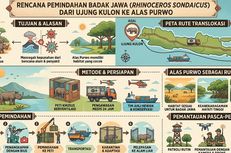
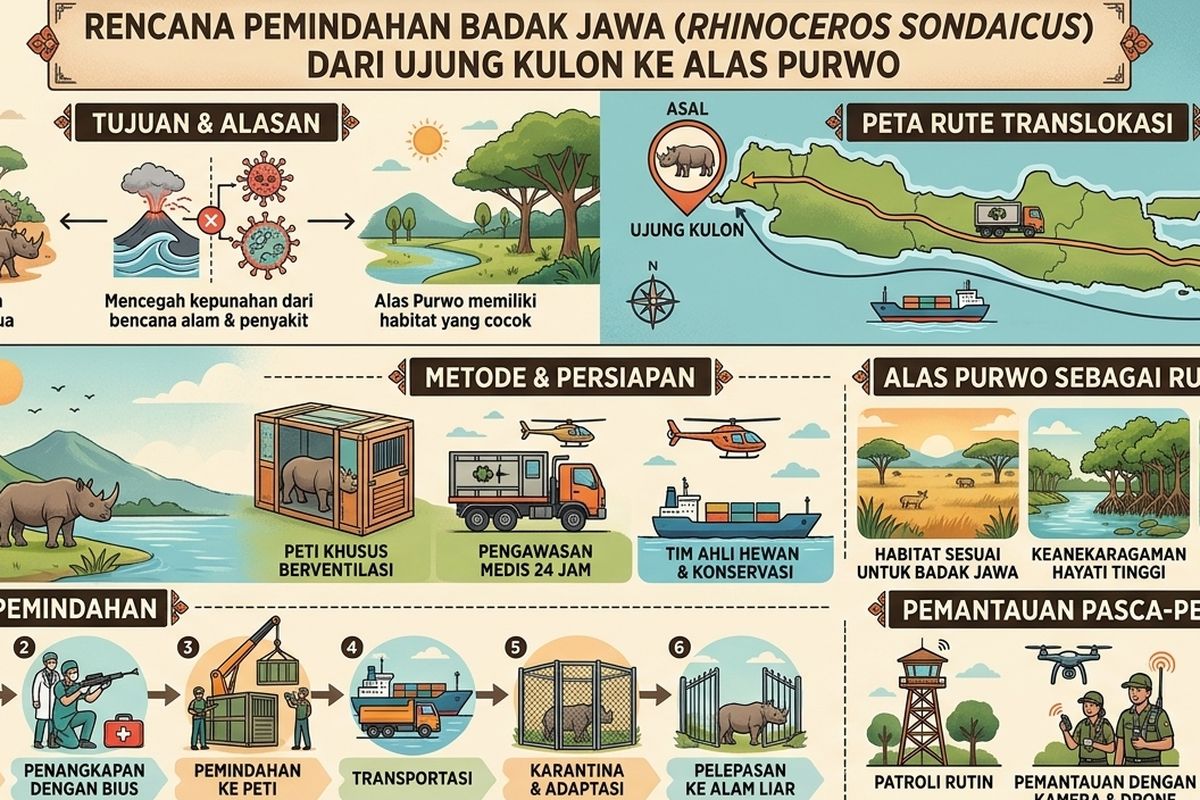
The Ministry of Forestry (Kemenhut) stated that this proposal requires further exploration and has yet to be detailed in a technical relocation plan, which includes determining the locations, number of individuals, methods, and implementation timeline.
All subsequent steps will be based on the outcomes of scientific research, expert recommendations, and readiness for area management.
The Head of Public Relations and International Cooperation Bureau of the Ministry of Forestry, Ristianto Pribadi, explained that
On the other hand, the development of a second habitat for the Javan rhino has been a conservation concern for several decades. Various alternative locations have been considered as part of efforts to bolster the survival of this species.
Developing a second habitat requires an assessment of ecosystem suitability, area carrying capacity, food and water availability and continuity, disease risks, disaster threats, area safety, and long-term management readiness.
If the assessment supports the development of a second habitat, the selection of individuals will consider health status, age, gender, genetic diversity, and reproductive potential.
The Ministry of Forestry also reaffirms that Ujung Kulon National Park remains the main habitat for the Javan rhino and a government priority for protection.
Protecting Ujung Kulon and exploring a second habitat are two complementary conservation efforts. Ujung Kulon must remain safeguarded as the primary habitat for the Javan rhino, while every opportunity to develop an additional population must be prepared carefully and responsibly," emphasized Ristianto Pribadi, Head of Public Relations and International Cooperation Bureau of the Ministry of Forestry.