
Sugiono Ensures State Will Secure Future for Families of Fallen Karhutla Volunteers
-
News
-
56 minutes ago
This article was translated by AI. Read the original article on Kompas.com. See Original

Both receive mandates from the same electoral process, although their positions and constitutional powers differ.
When the vice president replaces the President, power continuity flows through an official who also has received a direct mandate from the people.
The situation differs when presidential duties are carried out by a triumvirate.
The three ministers have not been elected by the people as President or Vice President.
They gain their positions through presidential appointment.
However, this does not imply that the triumvirate's authority is invalid or lacks legitimacy.
Indeed, the 1945 Constitution itself provides the basis for that authority.
The difference lies in the source of the mandate and the nature of power execution.
The vice president possesses an electoral mandate as part of an elected pair.
The triumvirate receives a temporary constitutional authority to maintain the government's operation.
Therefore, the performance of presidential duties by three ministers cannot be treated as a definitive form of leadership.
Article 8, paragraph (3) then returns the election to the MPR through two pairs of candidates proposed by political parties or coalitions based on the previous election results.
This mechanism maintains the relationship between power continuity and democratic mandates.
Thus, the constitution not only seeks to prevent government vacancy but also aims to avert emergencies as a pathway for extending unchecked power.
In a democratic state, certainty about who is ruling must always go hand in hand with certainty regarding the foundation and limits of their authority.
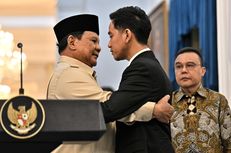
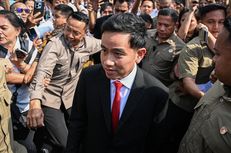
Gibran's resignation should not be viewed as a direct threat to Prabowo’s government.
The President still possesses constitutional authority. The cabinet continues to function. Government decisions do not lose legitimacy simply because the vice president's position is vacant.
However, this calm should not foster the assumption that the vice presidential position is unnecessary.
The 1945 Constitution has established a complementary security arrangement. Article 4 places governmental power in the hands of the President.
Article 8, paragraph (1) regulates the replacement of the President by the Vice President. Paragraph (2) provides a mechanism for filling the vice presidential vacancy.
Meanwhile, paragraph (3) governs the execution of presidential duties in extraordinary circumstances.
All these provisions serve one great purpose: the state must endure even as those in power change.
Thus, filling the vice presidential position is not merely a matter of seeking a new companion for the President.
It is part of the responsibility to maintain the state's continuity.
The President does not lose his authority when the vice president resigns.
However, that intact authority does not exempt the responsibility of executing constitutional mechanisms to fill the vacancy.
In a rule of law, the ability to maintain governance should not be used as a reason to disregard rules regarding power transitions.
Indeed, this is where the maturity of a system is tested.
A strong government can make decisions in normal conditions. A robust constitutional system can ensure that decisions remain possible even when power holders change.
Both are equally necessary.
Thus, "No Wapres, No Problem" should not be interpreted as a statement that the vice president is unimportant.
This phrase is only accurate as long as it is understood that the government does not cease operations when that position is vacant.
Beyond that, there are still questions that must be answered: how to ensure that the state maintains legitimate leadership when circumstances change suddenly?
Indonesia will not lose its government simply due to an empty vice presidential seat.
But that situation serves as a reminder that a President's strength does not always correlate with constitutional resilience.
A mature state not only knows who holds power today but has also ensured who legitimately leads when unforeseen circumstances arise.