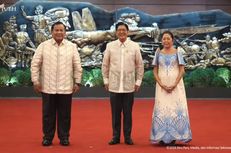

Prabowo Says "Kamsahamnida" While Concluding Speech at the 27th ASEAN-South Korea Summit
-
News
-
17 minutes ago
This article was translated by AI. Read the original article on Kompas.com. See Original

Complex policy work that improves public services, manages budgets, and enforces regulations often loses its appeal compared to touching aid videos.
Here, Jean Baudrillard's ideas of simulacra and hyperreality are relevant. Images no longer merely represent reality but can replace reality in public perception.
Politicians appear to always be present, caring, and working because the cameras are always there. However, videos are not policy audits, view counts are not measures of equity, and positive comments are not democratic mandates.
Even social media gimmicks can create hyperreality when visual allure shifts the substance of politics.
Is this detrimental to the political leadership cadre in Indonesia today? Not necessarily.
Social media opens doors for leaders who were previously hindered by campaign costs, access to mainstream media, or closed political party structures. It can expand participation and connect citizens’ grievances with officials.
However, if political parties only recruit politicians and cadre based on the number of followers, rather than their track record, integrity, policy formulation skills, and courage to make tough decisions, then cadre formation merely becomes an audition for popularity.
If this continues, the result will not be seasoned political leaders, but candidates skilled in managing perceptions.
Laws and governance need to help maintain balance. Freedom of expression must be protected, as reflected in Article 28 of the 1945 Constitution, but the use of public resources for partisan imagery, non-transparent political advertising, information manipulation, and misuse of citizen data must be monitored.
The Information Commission and Broadcasting Commission need to create monitoring agendas to empower the public and encourage critical engagement.
Politicians currently serving as governors, regents, and mayors must clarify policies through measurable standards that can be publicly audited.
Similarly, funding sources used to create social media content should be traced back to regional budgets (APBD) or personal funds.
An audit by the Supreme Audit Agency (BPK) may be necessary to ensure accountability. Otherwise, it will produce a new model of corruption in the digital age.
Transparency on platform content recommendations and political ads must be encouraged. Oversight of the funds used to create this political content should also ensure whether these are executed by regional civil service staff or exclusively by private teams hired using politicians' personal funds.
If civil service resources are used, it could constitute a legal violation by the regional government. Meanwhile, if funded by the national budget (APBN), it would undermine accountability.