

JK Believes National Progress Does Not Depend on Natural Resource Wealth
-
News
-
6 hours ago
This article was translated by AI. Read the original article on Kompas.com. See Original
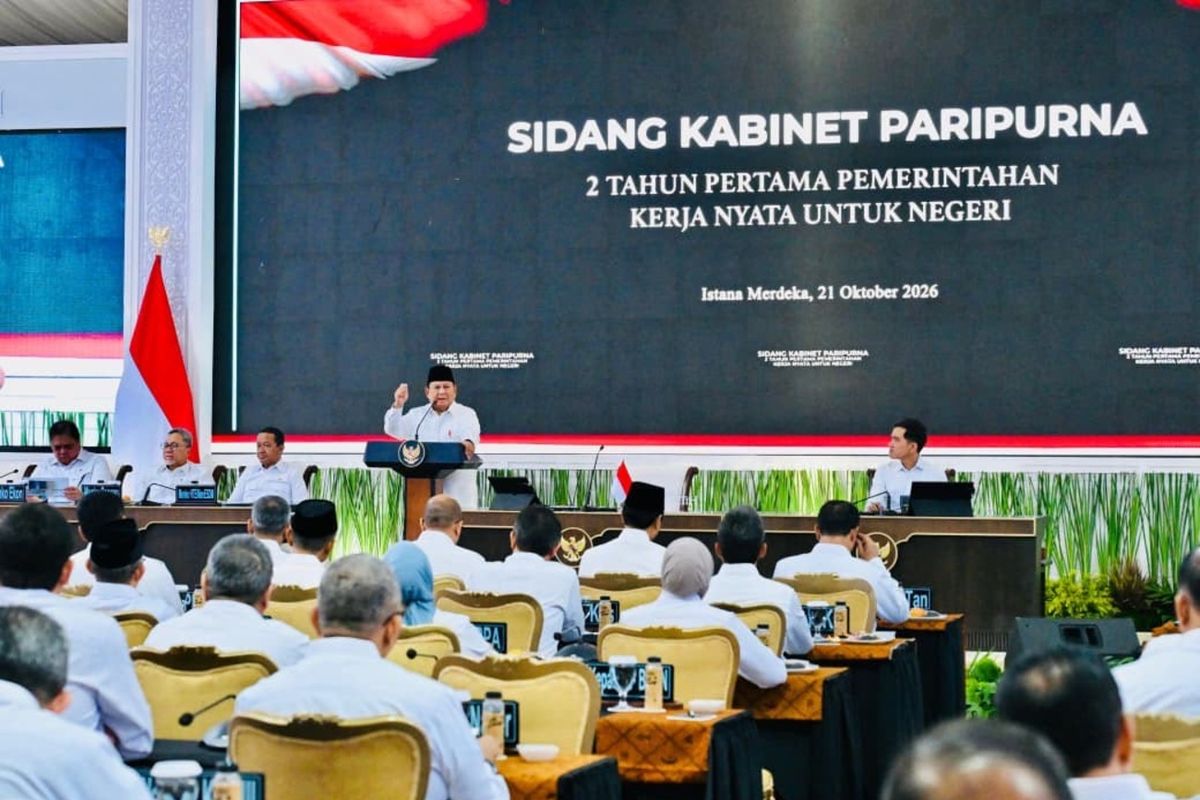
The position of Minister of Finance has changed three times, and the last replacement was communicated to the minister only via telephone.
Each time a reshuffle occurs, the public is only given a list of names, not an explanation of which indicators were failed and by whom.
This void is then filled by other parties.
A survey by the Center of Economic and Law Studies (Celios), released on October 11, 2026, placed Bahlil, Minister of Human Rights Natalius Pigai, and Raja Juli as the three ministers with the lowest performance scores.
Bahlil's score was recorded at minus 159 and Raja Juli at minus 103, while Nusron also made it into the top ten of the same list.
This survey does have limitations as experts were recruited through a chain and public respondents were sourced through social media ads, making the Gerindra Party consider it not objective.
However, these objections highlight a more fundamental issue. When the government does not release its official report, external evaluations become the only public reference.
To understand the meaning behind repeated reshuffles, at least two lenses can be applied.
The first lens comes from Keith Dowding and Patrick Dumont in The Selection of Ministers in Europe (2009).
They interpret the relationship between a president or prime minister and their ministers as a principal-agent relationship.
A reshuffle serves as a means for the principal to correct two mistakes: choosing the wrong individuals from the outset and agents who deviate from directives.
From this perspective, frequent reshuffles can be seen as a sign of decisiveness. However, it can also implicitly acknowledge that initial recruitment was more determined by political compromise than competence.
The second lens comes from Paul Chaisty, Nic Cheeseman, and Timothy Power in Coalitional Presidentialism in Comparative Perspective (2018).
In a multi-party presidential system, cabinet positions are critical tools in what they term the presidential toolbox for managing coalitions.
Reshuffles are not always about performance. They can also serve as a way to reward, impose sanctions, and rebalance party dynamics.