
JK Believes National Progress Does Not Depend on Natural Resource Wealth
-
News
-
6 hours ago
This article was translated by AI. Read the original article on Kompas.com. See Original
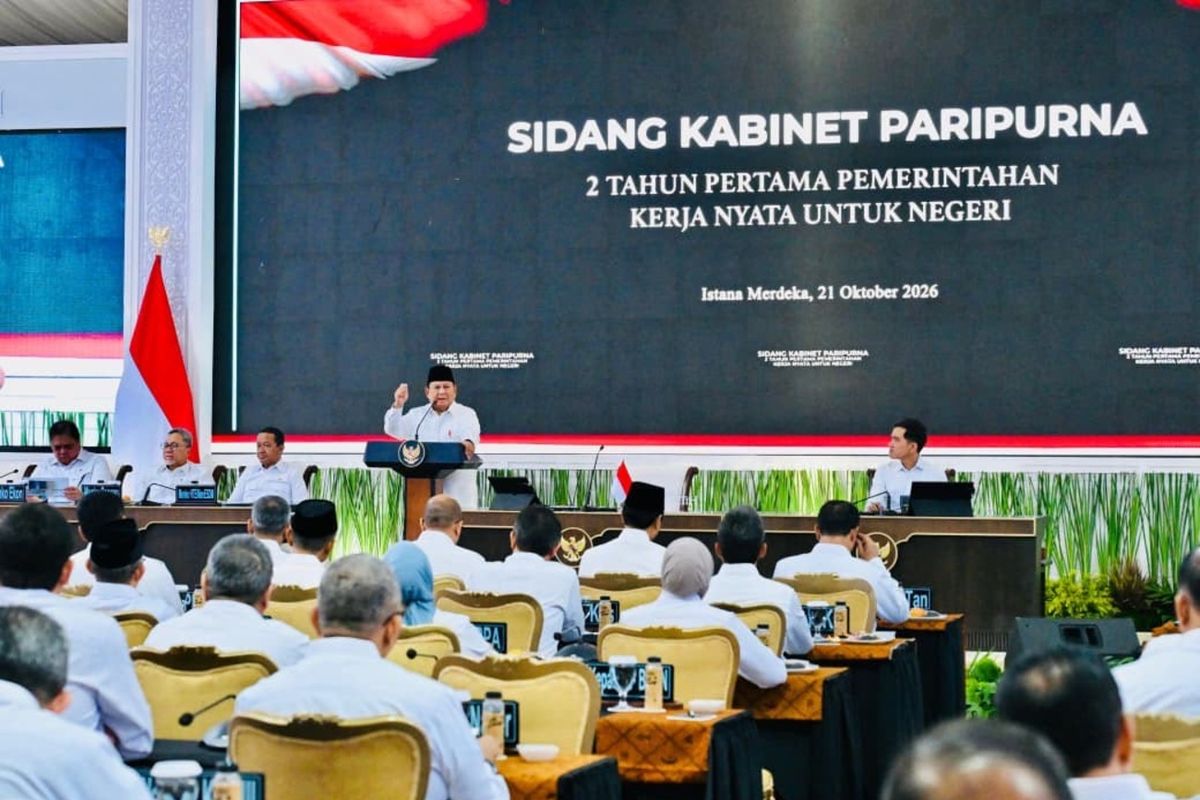
IT HAS NOT even been a month since President Prabowo Subianto appointed officials during the 7th reshuffle on October 1, 2026, and rumors of an 8th reshuffle are already circulating in public.
Three names are reportedly on the brink: Minister of Energy and Mineral Resources Bahlil Lahadalia, Minister of Agrarian Affairs and Spatial Planning / Head of BPN Nusron Wahid, and Minister of Forestry Raja Juli Antoni.
This issue has been voiced by analyst Said Didu (Warta Ekonomi, 21/10/2026), followed by pressure from the Indonesian Consumer Foundation and civil society groups.
So far, the palace has not confirmed anything.
However, this issue arises just as the Prabowo-Gibran administration marks its second anniversary, while the public awaits answers to a simple question: how exactly is the performance of presidential assistants evaluated?
If the rumors are true, the reasons for public frustration with the three individuals are not hard to decipher. In the energy sector, issues like fuel shortages, scarcity of three-kilogram LPG canisters, and rolling blackouts in various regions are directly felt by the people.
Ironically, Bahlil was recently promoted to Coordinating Minister for Downstream Industries without relinquishing his position as Minister of Energy and Mineral Resources.
In the forestry sector, forest and land fires have persisted for months, with smoke spreading across multiple regions.
Nusron's name is linked to allegations of corruption within his ministry that is currently being handled by the KPK.
All three directly impact fundamental needs of the citizens: energy, clean air, and security over land.
The President has established clear benchmarks. When presenting the macroeconomic framework to the DPR in May 2026, he stated that ministers who fail within two years will be replaced.
On another occasion, he referred to reshuffles as a logical step after two years, with the principle of the right man in the right place.
His priorities are also clear, namely food self-sufficiency, energy security, preservation of state wealth, hunger alleviation, and the elimination of extreme poverty.
The issue is that these benchmarks have never been translated into a report that can be read by the public.
In two years, the cabinet has undergone seven reshuffles, averaging once every three to four months.
The position of Minister of Finance has changed three times, and the last replacement was communicated to the minister only via telephone.
Each time a reshuffle occurs, the public is only given a list of names, not an explanation of which indicators were failed and by whom.
This void is then filled by other parties.
A survey by the Center of Economic and Law Studies (Celios), released on October 11, 2026, placed Bahlil, Minister of Human Rights Natalius Pigai, and Raja Juli as the three ministers with the lowest performance scores.
Bahlil's score was recorded at minus 159 and Raja Juli at minus 103, while Nusron also made it into the top ten of the same list.
This survey does have limitations as experts were recruited through a chain and public respondents were sourced through social media ads, making the Gerindra Party consider it not objective.
However, these objections highlight a more fundamental issue. When the government does not release its official report, external evaluations become the only public reference.
To understand the meaning behind repeated reshuffles, at least two lenses can be applied.
The first lens comes from Keith Dowding and Patrick Dumont in The Selection of Ministers in Europe (2009).
They interpret the relationship between a president or prime minister and their ministers as a principal-agent relationship.
A reshuffle serves as a means for the principal to correct two mistakes: choosing the wrong individuals from the outset and agents who deviate from directives.
From this perspective, frequent reshuffles can be seen as a sign of decisiveness. However, it can also implicitly acknowledge that initial recruitment was more determined by political compromise than competence.
The second lens comes from Paul Chaisty, Nic Cheeseman, and Timothy Power in Coalitional Presidentialism in Comparative Perspective (2018).
In a multi-party presidential system, cabinet positions are critical tools in what they term the presidential toolbox for managing coalitions.
Reshuffles are not always about performance. They can also serve as a way to reward, impose sanctions, and rebalance party dynamics.
Bahlil is the chairman of the Golkar Party, and Raja Juli is a key cadre of the Indonesian Solidarity Party, two parties that have been close to the circles of 7th President Joko Widodo.
Previously, Pratikno, one of Jokowi's trusted aides, was also shifted from the Coordinating Minister position to the Presidential Advisory Council, a prestigious role far from budgetary control.
If both are replaced, the public rightly interprets this move not just as a performance evaluation but also as a reconfiguration of the power map leading into the third year.
These two lenses are not mutually exclusive. A reshuffle can be driven by both performance and political calculations.
What distinguishes corrections from mere power rotations is the transparency of the measures.
Without clear indicators, the public will never know whether a minister was replaced for failing to fulfill their duties or for political reasons.
Frequent reshuffles also come at a significant cost.
Policies lose continuity, the bureaucracy tends to wait for new directions, and new ministers require time to understand the terrain.
The market reacts as well. The Composite Stock Price Index fell to around 6,000 after the reshuffle on October 1.
Certainty is an often-overlooked asset for governance, and unexplained reshuffles erode that.
Therefore, several steps should be considered by the President to restore public trust.
First, regularly publish performance reports of ministries, at least for indicators concerning national priorities like energy availability, handling of forest and land fires, and food program achievements.
Second, openly explain the reasons for each ministerial change, so that reshuffles are understood as policy corrections rather than political puzzles.
Third, end dual positions that burden one individual with excessive responsibilities, as also reminded by the Gerindra Party spokesperson.
Fourth, maintain the integrity of the cabinet by ensuring that each minister cooperates with legal processes.
Fifth, establish meritocracy as the basis for recruitment, so that reshuffles no longer signify initial selection errors.
These steps align with the President's own claims that evaluations are conducted objectively and continuously.
Objectivity that cannot be scrutinized by the public remains merely a claim.
In contrast, opening the reports will enhance the President's authority, as every decision would have a justifiable basis.
Two years is enough time to assess, and an opportune time for improvements.
The people do not demand a perfect cabinet. They simply want to know why the power goes out, why the smoke lingers, and why their land remains uncertified.
If the reports of ministers continue to be kept in the palace drawer, how can the public trust that each reshuffle is genuinely made for them?