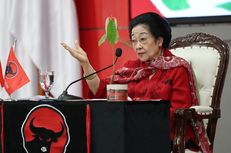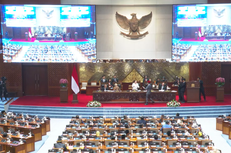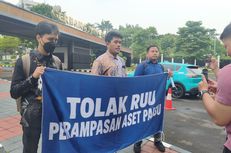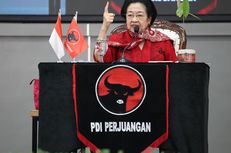

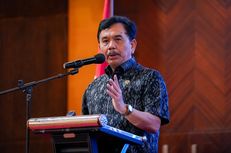
Head of Bakom Did Not See PSI at Prabowo's Meeting with Party Leaders at Bogor Palace
-
News
-
9 minutes ago
This article was translated by AI. Read the original article on Kompas.com. See Original

As quoted from Kompas.id, the government is currently saddled with debt obligations with a tight schedule for repayment over the past two years.
This condition drains funds that should ideally be allocated for developmental innovations to cover principal payments and interest on debts.
Nearly seventy percent of our national spending is binding, such as salaries, regional transfer funds, and energy subsidies, which are vulnerable to fluctuations in global oil prices and the exchange rate of the rupiah.
As a result of these pressures, the government is forced to implement extreme efficiency measures to fund new initiatives.
Cutting travel and ceremonial event budgets deserves recognition as a short-term frugality measure.
However, efficiency measures taken without selectivity risk undermining the ministries' capacity to carry out essential public service programs.
Some technical ministries have complained about the lack of operational funds for field supervision.
This is the irony of our bureaucracy today; when top-level ambitions are very high, the bureaucratic machinery at the grassroots level is starved of fuel to keep moving.
As a solution, the government must shift its paradigm from budget cuts to creating sustainable new revenue sources.
Relying on off-budget financing schemes or public-private partnerships is indeed a smart solution, but their implementation is slow.
According to a press release from the Ministry of Investment, foreign direct investment realization has reached trillions of rupiah, but its distribution has yet to be even across labor-intensive sectors.
The government needs to be more aggressive in improving the core tax system to pursue tax dodgers, rather than pressuring the purchasing power of the middle class.
On the international stage, the president's proactive diplomatic style has brought a new dimension to our geopolitics.
Various state visits have yielded numerous large investment agreements and positioned Indonesia as a global power balancer.
Recent reports published by international research institutions note that Indonesia's non-aligned stance successfully attracted foreign investors in the national energy transition sector.