

Prabowo Gathers Gerindra Cadres in Hambalang, Dasco and KDM Attend
-
News
-
43 minutes ago
This article was translated by AI. Read the original article on Kompas.com. See Original
THERE is a quieter tragedy than losing in a courtroom: when a verdict ceases to be read as a legal document and starts to function as a mirror in which each faction sees its own beliefs.
The matter of Gibran Rakabuming Raka's educational qualifications before the Constitutional Court presents this paradox.
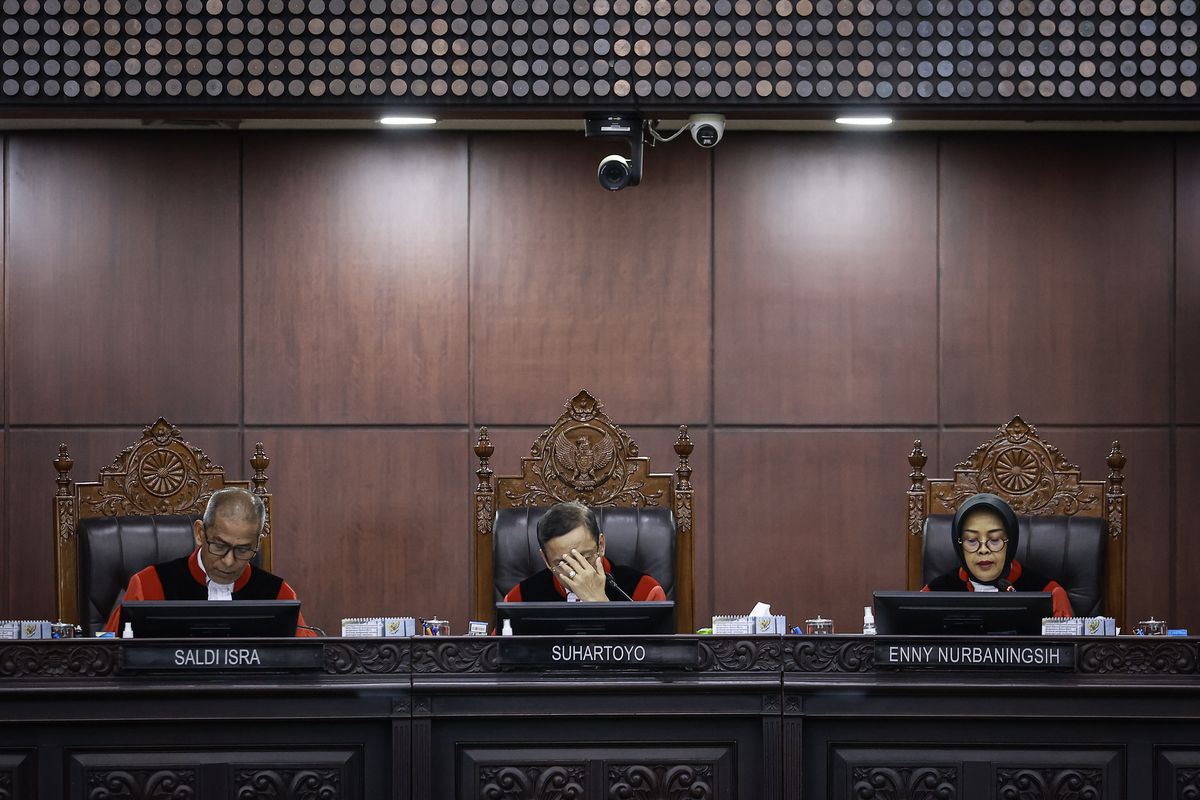
The Court stated that it did not find convincing evidence in the form of diplomas or foreign educational certificates that could serve as the basis for equivalence as required by the Election Law.
However, the petition was declared inadmissible because the petitioners did not have legal standing.
The Court also did not assert that Gibran had falsified his diploma or had never pursued the education he claimed (Kompas.com, 8/10/2026).
The question is not merely who wins and who loses. What is more difficult is this: can we still read the same verdict with the same standard when the names involved are changed?
Legal decisions are not born in a sterile psychological space. Once they leave the courtroom, facts immediately enter the realm of identity.
Gibran's supporters may read the ruling of “inadmissible” as evidence that the matter has been resolved.
His opponents can highlight the phrase “did not obtain convincing evidence” as an unsolved legitimacy issue. Both hold genuine parts of the decision.
The problem arises when favorable segments that align with one's own beliefs are treated as the whole truth.
Political psychology has long recognized this tendency as motivated reasoning. Charles S. Taber and Milton Lodge found that people tend to rate arguments that align with their initial beliefs more highly, actively counter opposing information, and seek evidence that confirms their positions.
Notably, the tendency to polarize is strongest among those with entrenched beliefs and high political sophistication (Taber & Lodge, 2006).
This means that knowledge does not automatically cure bias. In certain circumstances, knowledge may even provide a more sophisticated arsenal of arguments to defend it.
That’s where Gibran's case is compelling as a political laboratory. The public may say, “I believe Gibran” or “I do not believe Gibran.”
Educated individuals possess a much more sophisticated vocabulary: legal standing, legitimacy, constitutionality, legal certainty, substantive justice, or the morality of power.