

Bakom RI Dismisses Ulta Levenia Since November 1, 2026
-
News
-
17 minutes ago
This article was translated by AI. Read the original article on Kompas.com. See Original
THERE is a quieter tragedy than losing in a courtroom: when a verdict ceases to be read as a legal document and starts to function as a mirror in which each faction sees its own beliefs.
The matter of Gibran Rakabuming Raka's educational qualifications before the Constitutional Court presents this paradox.
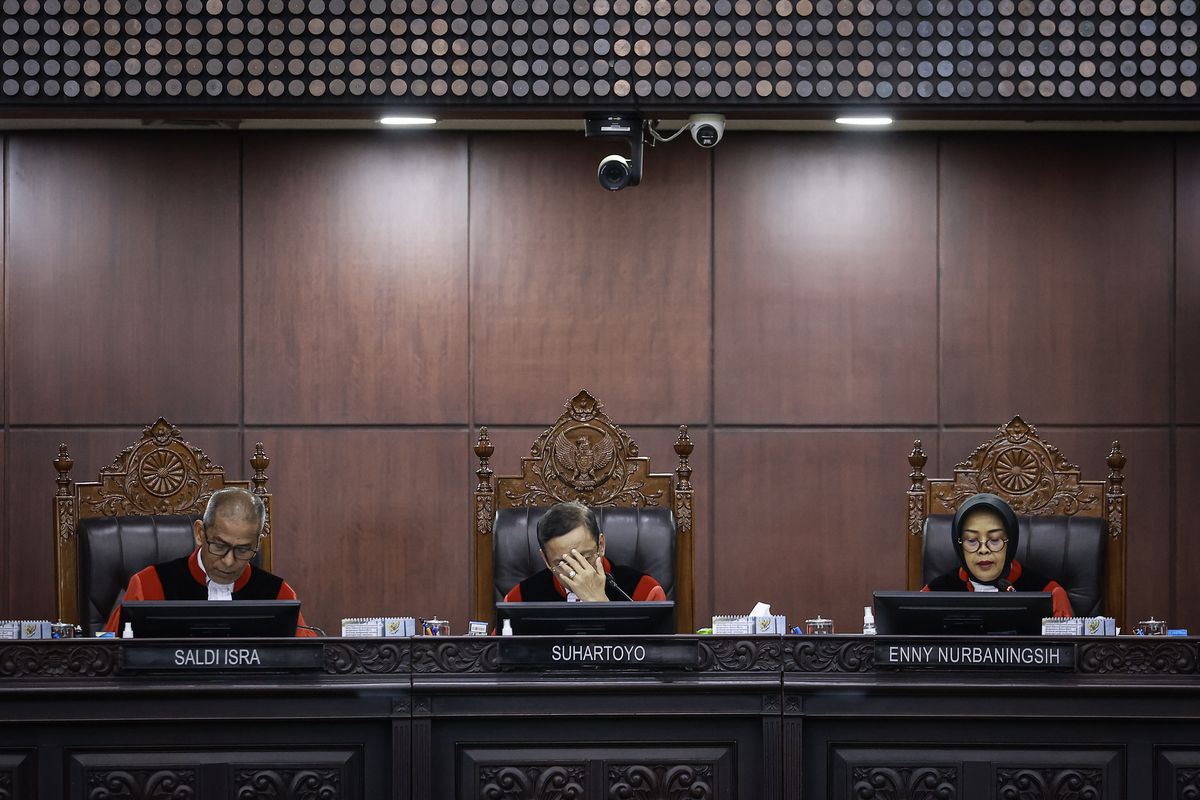
The Court stated that it did not find convincing evidence in the form of diplomas or foreign educational certificates that could serve as the basis for equivalence as required by the Election Law.
However, the petition was declared inadmissible because the petitioners did not have legal standing.
The Court also did not assert that Gibran had falsified his diploma or had never pursued the education he claimed (Kompas.com, 8/10/2026).
The question is not merely who wins and who loses. What is more difficult is this: can we still read the same verdict with the same standard when the names involved are changed?
Legal decisions are not born in a sterile psychological space. Once they leave the courtroom, facts immediately enter the realm of identity.
Gibran's supporters may read the ruling of “inadmissible” as evidence that the matter has been resolved.
His opponents can highlight the phrase “did not obtain convincing evidence” as an unsolved legitimacy issue. Both hold genuine parts of the decision.
The problem arises when favorable segments that align with one's own beliefs are treated as the whole truth.
Political psychology has long recognized this tendency as motivated reasoning. Charles S. Taber and Milton Lodge found that people tend to rate arguments that align with their initial beliefs more highly, actively counter opposing information, and seek evidence that confirms their positions.
Notably, the tendency to polarize is strongest among those with entrenched beliefs and high political sophistication (Taber & Lodge, 2006).
This means that knowledge does not automatically cure bias. In certain circumstances, knowledge may even provide a more sophisticated arsenal of arguments to defend it.
That’s where Gibran's case is compelling as a political laboratory. The public may say, “I believe Gibran” or “I do not believe Gibran.”
Educated individuals possess a much more sophisticated vocabulary: legal standing, legitimacy, constitutionality, legal certainty, substantive justice, or the morality of power.
All these concepts are valid. However, their sophistication does not erase a simple obligation: will we apply the same concepts if the subject of the case is a figure from our favored faction?
That is the true test of impartiality.
We must also be careful to distinguish legality from legitimacy. Electoral success yields electoral mandates; law determines the validity of positions; while legitimacy pertains to social acceptance of authority. The three are related but not identical.
A meta-analysis by Angus Chan, Ben Bradford, and Clifford Stott across 123 studies involving 200,966 participants found a significant relationship between procedural justice, social identity, and legitimacy.
Social identity has even been shown to mediate the relationship between perceptions of procedural justice and legitimacy (Chan, Bradford & Stott, 2023).
This research pertains to police legitimacy, not the Indonesian Constitutional Court. Thus, it is inappropriate to take its conclusions literally.
However, the psychological mechanisms provide a useful warning: perceptions of institutional justice are not solely shaped by outcomes but also by how processes are evaluated across different social groups.
Indonesia's experience indicates that institutional trust does not move in one direction.
LSI surveys noted public trust in the Constitutional Court was about 61 percent in January 2024, increasing to 73 percent in April 2024.
The April survey involved 1,213 respondents with a margin of error of plus or minus 2.9 percent. LSI linked this increase to positive public assessments during the presidential election dispute hearings of 2024 (LSI, 2024; Tempo, 19/4/2024).
This figure is important precisely because it refutes our temptation to create overly simplistic narratives: the legitimacy of the Court can indeed decline, but it can also recover.
Therefore, it is unfair to conclude that the ruling in Gibran's case represents a “moral bankruptcy of the judiciary” simply because the outcome does not resolve the substantive disquiet of some public members.
Yet, equally unfair is using the inadmissible ruling to assert that all substantive questions automatically lose their relevance.
The law has jurisdictional limits. The public has the right to question. The two do not have to invalidate each other.
Here, the matter becomes larger than just a Vice President’s diploma. The threat to common sense arises not just when procedures defeat substance.
A closer threat emerges when we only champion substance when it benefits our faction, and suddenly embrace procedures when they favor someone we support.
Gibran's defenders, therefore, deserve the uncomfortable question: if the Court’s ruling regarding another candidate from the opposing side was the same, would they still urge the public to move on?
Critics must confront the same tough question: if the subject of the case was a figure they supported, would the phrase “did not obtain convincing evidence” still lead them to a similar moral conclusion?
These questions do not intend to equate the parties involved. Impartiality is not fifty-fifty journalism, nor is it merely a habit of taking a safe position in the middle.
Intellectual neutrality means maintaining the same standard of proof when the subject's identity is exchanged.
That’s why I am more concerned about something not even mentioned in the ruling: this nation's ability to correct its own conclusions.
Today, Gibran is at the center of attention. Tomorrow, it may be a figure we admire. The day after, perhaps someone we disdain.
If the standard of truth changes every time a name changes, what is damaged is not just the legitimacy of one institution or one official. What is damaged is our own epistemic tools of democracy.
Thus, I find myself questioning the very title of this piece. Is a gravestone of common sense truly being erected at the altar of the Court? Perhaps not yet.
The gravestone will only be firmly in place when Gibran’s supporters accept the ruling but ignore the reasoning; when his opponents quote the reasoning but disregard the ruling; when experts choose concepts that favor their predispositions; and when we all claim our own biases as common sense.
At that moment, the Court will not need to bury anything. It is we who quietly bury the last judge within ourselves.



















