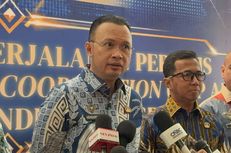
Prabowo Gathers Gerindra Cadres in Hambalang, Dasco and KDM Attend
-
News
-
1 hour ago
This article was translated by AI. Read the original article on Kompas.com. See Original

The Indra Kenz case is seen as an opportunity to evaluate the overall management of inmate rights.
Suparji stated that this issue should be viewed in the context of correctional governance, not merely as an individual case.
"In my opinion, this issue must be seen as a matter of correctional governance, not just a personal case," he said.
He argued that there should be a clear distinction between the parties proposing and those verifying.
Additionally, documents serving as the basis for remittances must be audited, and the entire decision-making process should have a digital trail.
With such a system, each stage can be traced, from who inputs the data, verifies, to who gives the approval.
"There must be a clear separation between the proposing and verifying parties, an audit of all foundational documents, cross-checking of prison term calculations, and a digital trail showing who has input, examined, approved, and set each remittance," Suparji asserted.
This bolstering becomes increasingly important, especially when remittances are related to particular circumstances of the inmate.
Suparji cited long-term illness remittances, emphasizing that verification should not stop at merely examining one doctor's letter.
Diagnosis, treatment history, the competence of the physician providing the information, and the patient’s condition's compliance with criteria set forth in regulations need to be thoroughly examined.
"There must be a thorough check of the diagnosis, treatment history, the competence of the reporting doctor, and the patient's condition against the established criteria," he stated.
To prevent similar errors, Suparji proposed a layered verification system in the remittance process.
The first stage is administrative verification, which includes examining court verdicts, detention periods, rehabilitation registers, disciplinary violations, and all remittances received by the inmate previously.
The next stage is substantive verification.
For remittances granted due to health conditions, for instance, independent medical second opinions should be sought, especially if the remittance directly impacts the qualification for conditional release.
"In my view, layered verification is necessary," Suparji stated.
Moreover, calculations of prison terms need to be integrated into a digital system.
This system would allow for automatic recalculation of sentence periods when a remittance is canceled or under review.
Conditional releases should not be issued before resolving these issues.
"All calculations of prison terms must be digitally integrated so that when a remittance is canceled or under examination, the system automatically recalculates the two-thirds duration of the prison sentence and does not issue the conditional release until the matter is settled," he asserted.
Suparji also encourages the establishment of an audit trail and random audits by the Inspectorate.
This mechanism allows for thorough tracking of every remittance decision: who proposed it, who verified it, what documents were used, and who provided final approval.
"There must be an available audit trail and random audit mechanisms by the Inspectorate," stated Suparji.