
Toward a New Vice President: Prabowo Gathers Proposals, MPR Prepares for Election
-
News
-
22 minutes ago
This article was translated by AI. Read the original article on Kompas.com. See Original
Sadly, in this epistemological spectrum, we must grapple with procedural questions; is it appropriate to submit this matter to the Constitutional Court? Especially given that so much time has passed.
Like it or not, in legal science, procedures— the twin of formalism—are required not to complicate or, worse, extinguish justice, but rather as a means to enliven justice.
In its symbolic nature, procedure is necessary to promote not harmony, but justice.
If Gibran's diploma is equivalent to high school, which was deemed complete and valid at the time of registration, but is actually nonexistent, and any corrections framed within electoral law are not accepted because the presidential election has long passed, then the issue is the same; is it logical to penalize procedure as an obstruction or as a source of injustice?
In this context of epistemology and legal science, reason assigns equal value to both; substantialism and formalism. Hence this is the case.
The absence or emptiness of law, within the epistemological spectrum, appears to justify the existence of law. Once law exists, it loses relevance for further needs.
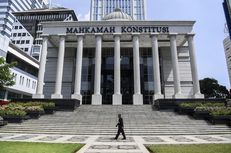
Has there been a legal emptiness in this case, necessitating the Court to create new regulations merely to allow Gibran's diploma to be scrutinized as a presidential election dispute? This is intriguing.
Interestingly, Gibran stands alone in this storm of justice. He, for some reason, allows the Court to proceed without him.
If his solitude in this catastrophic storm is guided by his natural instinct that what he is accused of has never concerned President Prabowo on a personal level, then that's commendable.
However, if his solitude in this storm reflects his legal awareness that he is part of President Prabowo within the electoral law framework, then Gibran is one hundred percent mistaken.
The unity of presidential and vice-presidential candidates in electoral law objectively ends as soon as the presidential election dispute is determined by the Court. Practically since the Court resolves the presidential election dispute, both the President and the Vice President become autonomous legal subjects, distinct from one another.
Legally, both the President and Vice President are autonomously responsible, separated from each other for their personal actions.
Logically, President Prabowo cannot be included alongside Gibran, the Vice President, to bear responsibility for Gibran's personal actions.
In legal terms, the personal actions of both are attached to their respective personas.
Their personas delineate responsibility. Persona serves as the dividing line or breaking point of the dual responsibility.
Separating the responsibility between the President and the Vice President for their personal actions reflects a demand of reason.
This reason is subjective, the basis of persona emergence. Justice inherently aligns with reason, so one cannot be made responsible for another's actions.
The Court, staffed by esteemed judges, knows that Gibran is an independent persona, just like President Prabowo.
The Court understands that, epistemologically, each persona bears responsibility for their own actions.
The Court knows better than anyone that no existing law in the repository of knowledge allows it to construct reasoning that would enable President Prabowo to be included in the issue of Gibran's diploma.
No legal science, even legal philosophy, provides any premise, let alone for the entirety, even small elements, to justify shared responsibility without being derived from persona.
The universal premise of legal science is clear; the capacity for thought and personal actions is the basis for the burden of responsibility. Nothing outside of that, regardless of any forced rationale.
Responsibility, in legal science, is a basic consequence. Legal science necessitates, even posits the mental capacity— the awareness of the persona to map out the consequences of their actions.
A madman, in legal science, is not conceived as a persona, for he lacks the mental capacity to evaluate the morality of his actions.
This is the fundamental premise behind the legal reasoning that a madman is not burdened with responsibility. Plato, in his best-selling book Republic, asserts, "a madman cannot be a friend of God."
The perspectives provided by legal science regarding responsibility are as intriguing as Gibran allowing this storm to swirl without his presence in the Court.