Prabowo Gathers Gerindra Cadres in Hambalang, Dasco and KDM Attend
-
News
-
2 hours ago
This article was translated by AI. Read the original article on Kompas.com. See Original

The government's view is that the phrase "taking into account" in Article 21 of the IKN Law already includes an obligation to identify, consider, and factor in the interests, rights, and potential impacts on communities.
"Meanwhile, the phrase 'providing protection' mandates measures to prevent, minimize, and address detrimental impacts in accordance with legal provisions," Kurniawan said.
Previously, the Balik Sepaku Indigenous Community and the Indigenous Peoples Alliance of the Archipelago (AMAN) challenged Article 21 of Law Number 21 of 2023, concerning Amendments to Law Number 3 of 2022 on the Capital City (IKN Law).
Both parties contest the phrase "taking into account" in Article 21 of the IKN Law, which reads, "Spatial planning, land affairs and land rights transfer, environmental management, disaster mitigation, as well as defense and security as referred to in Articles 15 to 20 shall be carried out by taking into account and providing protection for the individual rights or communal rights of indigenous peoples and cultural values that reflect local wisdom."
The legal representative for the Balik Sepaku Indigenous Community and AMAN, Yance Arizona, explained that the petitioners have suffered constitutional losses due to the implementation of spatial planning and land rights transfer in the IKN.
"The constitutional loss suffered by petitioners as a unity of indigenous law community is specific and actual due to the implementation of the five sectors regulated in Articles 15 to 20 of the IKN Law, namely spatial planning, land affairs, land rights transfer, environment, disaster mitigation, as well as defense and security," Yance said during the hearing of Case Number 299/PUU-XXIV/2026 on Tuesday (18/8/2026).
He explained that the Balik Sepaku indigenous community holds legal standing based on the enactment of East Kalimantan Provincial Regulation Number 1 of 2015 concerning Guidelines for the Recognition and Protection of Indigenous Law Communities, as well as Provincial Regulation Number 2 of 2017 on the Preservation and Protection of Paser Customs.
However, in the spatial planning of the Nusantara Capital City (IKN), the Balik Sepaku indigenous community was not involved by the IKN Authority.
A similar situation occurred in land affairs and land rights transfers, where the Balik Sepaku indigenous community was completely excluded and received no fair compensation.
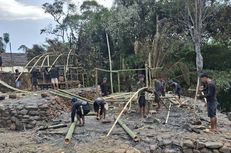
The petitioners also highlighted the construction of several IKN infrastructures that caused the Balik Sepaku indigenous community to lose access to natural water sources and experience a decline in water quality.
"The construction of the Sepaku river intake and the Sepaku Semoi Dam for IKN purposes has resulted in reduced community access to natural water sources, deterioration of river water quality, drying up of fish ponds and residents' wells, as well as disruption to the ecological functions of the area which have long supported community livelihoods," Yance stated.
In their petition, the Balik Sepaku Indigenous Community and AMAN requested that the MK declare Article 21 of the IKN Law contrary to the 1945 Constitution of the Republic of Indonesia and conditionally unconstitutional insofar as it is not interpreted to mean:
Spatial planning, land affairs and land rights transfer, environmental management, disaster mitigation, as well as defense and security as referred to in Articles 15 to 20 shall be carried out only after obtaining the collective approval from indigenous peoples freely and without coercion based on true, complete, and understandable information, and providing protection for the individual rights or communal rights of indigenous peoples and cultural values that reflect local wisdom.
They also asked the MK to order the Head of the IKN Authority to monitor and review the IKN Authority Head Regulations related to spatial planning, land affairs and transfer of land rights, environmental management, disaster mitigation, as well as defense and security, and to make amendments ensuring the implementation of a mechanism for obtaining collective approval from indigenous peoples freely and without coercion based on accurate, complete, and understandable information, while providing protection for individual and communal indigenous rights and cultural values that reflect local wisdom.